Fertiliser prices and fertiliser availability have been among the main talking points for farmers this year.
The impact of the war in Ukraine has been felt in every farmyard in the country as the cost of urea hit north of €1,000/t for the very first time. But is Teagasc’s research farm at Solohead in Tipperary scouting a path for farmers to reduce their dependence on nitrogen?
James Humphreys certainly thinks so. And the figures from Solohead’s trials with clover support this contention.
The 56ha farm, which is leased from Tipperary Co-op and Tipperary Racecourse, carries dairy herds managed under three different systems:
A control herd which is run conventionally. A herd that grazes swards which are high in clover but receive restricted nitrogen.A herd that grazes high-clover swards that receive no nitrogen. Net margin
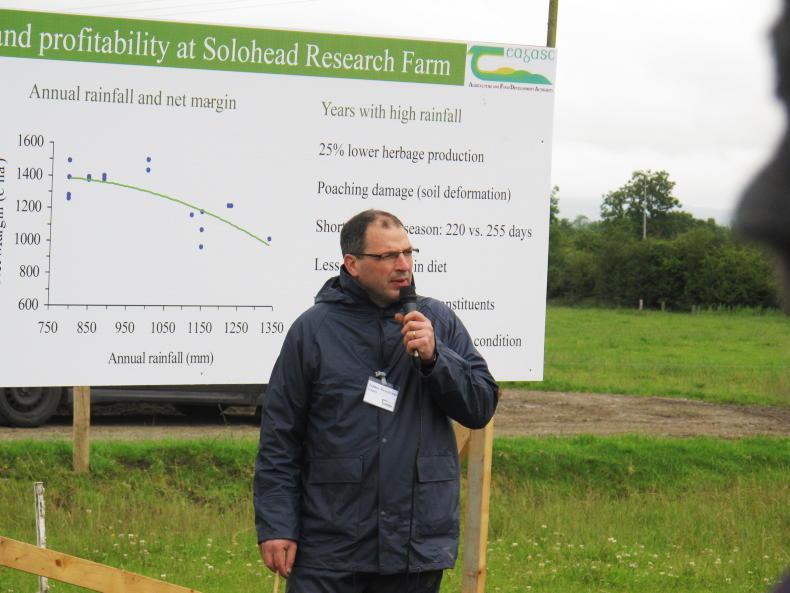
Last year, the zero-nitrogen herd gave a net margin (including labour) of €1,719/ha. This was €236/ha better than the control herd, and this difference is likely to grow this year given the hike in fertiliser prices.
In fact, Humphreys points out that the zero-nitrogen herd was 2c/l better than the control herd in terms of net margin. This converts to a potential saving of over €10,000 for the average dairy herd.
Crucially, the zero-nitrogen option also delivered a 20% reduction in greenhouse gas emissions – mainly nitrous oxide, as well as some methane and CO2 – compared to the control herd, and a 35% cut in ammonia emissions.
“At 9.5t/ha emissions are still high at Solohead, but this is an intensive system in terms of stocking rate,” Humphreys explains.
'Backward step'
He contends that the Solohead trials are demonstrating how increased clover usage can cut fertiliser usage, cut emissions and cut costs.
“I think the talk around cutting cow numbers and de-intensifying dairying is a backward step. Solohead is offering a model where you can hold the intensity, while reducing greenhouse gas emissions,” Humphreys argues.
This message is certainly striking a chord with ordinary dairy farmers. Over 200 discussion groups and 2,000 farmers have visited Solohead over the last 15 months.
“It’s fierce important to bring farmers to see what we are doing here. You can talk of this at a meeting but nothing beats actually walking the farm and answering farmers’ questions. You don’t want to sell them a pig in a poke,” he says.
Getting roughage into the diet is the key
“We are showing farmers here that you can keep clover in swards for more than four or five years, if you keep the potassium levels right, keep nitrogen usage to a minimum, graze the swards tight during the last rotation, and extend the rotation in the autumn,” Humphreys explains.
A tie-up with 17 commercial dairy farmers across Tipperary and Cork has helped move the clover research from the trial stage to real-farm situations.
Greater focus
The feedback has been very positive, and this validation has given the research at Solohead a greater focus.
Looking to the future, Humphreys aims to optimise the management of both red and white clover at higher stocking rates – moving from 2.6LU/ha to 3.3LU/ha.
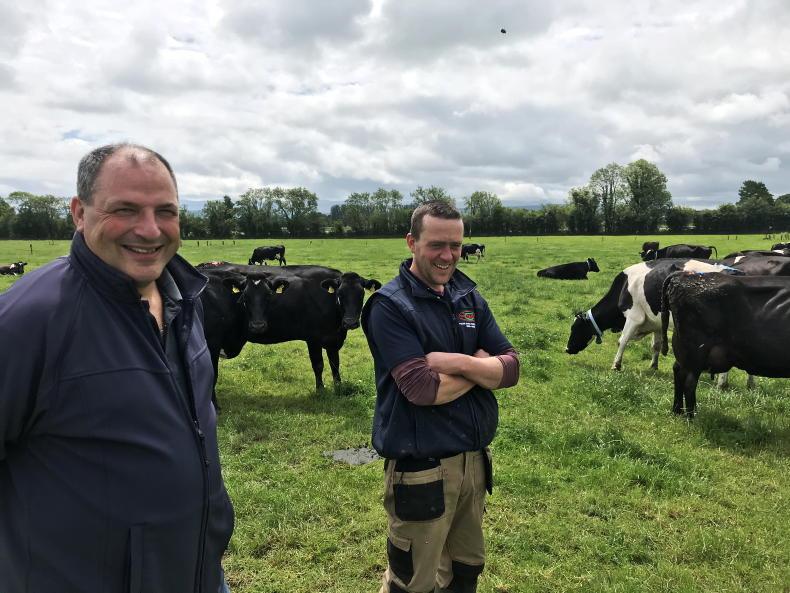
James Humphreys and Daniel Barrett at Solohead.
Ultimately, he hopes the work at Solohead will help to demonstrate that there is an alternative to culling cows.
“Cutting cow numbers is not in the national interest and not in farmers’ interests,” he insists.
Treating farmers’ nitrogen addiction
Getting farmers to trust in the nitrogen-fixing potential of clover is one of the main challenges for James Humphreys and his team.
“The biggest problem is getting farmers over their nitrogen addiction; most dairy farmers have to be weaned off of it,” Humphreys maintains.
Pointing to a graph which shows clover dry-matter yields falling from 4.5t/ha per year to 0.5t/ha as nitrogen usage increases from 25kg/ha to 350kg/ha, Humphreys explains that nitrogen always favours grass.
“Farmers sometimes say that they spread fertiliser on blocks that have been reseeded in order to give the clover a boost,” he says.
“But they don’t realise that nitrogen favours the grass over clover. The grass then forces the clover out,” he adds.
Growth rates
“For me the only way to get into clover is to go to zero nitrogen, or at least to stop spreading fertiliser when you’re hitting growth rates of 45kg [of grass per hectare per day] in March or April,” Humphreys says.
The Teagasc researcher accepts that cutting out nitrogen completely, or even significantly reducing usage, is a “very hard message to sell”.
“The first thing you have to do is build farmers’ confidence,” Humphreys insists.
He says farmers who are converting to greater clover usage should do so by gradually reseeding blocks of their holdings.
“Farmers should continue to spread the same tonnage of fertiliser on the farm as a whole at the start.
“Apply a limited amount of fertiliser on the lands reseeded with clover, but spread extra across the remainder of the farm,” the Teagasc scientist explains.
Once the farmers realise that the clover is actually fixing sufficient nitrogen on the reseeded blocks, then they can start to cut back on their overall fertiliser usage, Humphreys maintains.
He says that some of the 17 commercial farms that are following the Solohead model have already moved to a zero-nitrogen approach on ground which has been reseeded with clover, while others are restricting spreading to the early spring.
Getting fibre into the diet is the key to tackling difficulties with bloat, according to Humphreys.
Incidents of bloat are also more likely during conversion when you have herds moving from non-clover to high-clover swards
While the Solohead farm has lost just three cows with bloat over the last 23 years, Humphreys admits that fears around bloat are a “real negative” for farmers who are considering introducing more clover into swards.
Incidents of bloat are also more likely during conversion when you have herds moving from non-clover to high-clover swards.
However, Solohead farm manager Dan Barrett says adding silage into the diet, particularly in the back-end of the year, helps to prevent bloat.
“Getting roughage into the diet is the key,” Barrett says. “And not having cows going into clover swards when they are hungry.”
Solohead also uses bloat oil in the water troughs.
Clover will not sort nitrates issues
Increased clover usage in swards will not address issues around nitrates leakage from intensive dairy farms. “You might get a 5% to 10% reduction in nitrate leaching but the reduction will be small,” Humphreys says.
“This is still a high nitrogen system,” he explains.
While the clover delivers the nitrogen in a more “just-in-time manner”, Humphreys points out that there is still nitrogen leaching associated primarily with the high stocking rates and the excretion of nitrates from the cows.
However, he points out that studies to-date have shown very little leaching of nitrates at Solohead.
Humphreys believes this is associated with the sub-strata of marl in the local soils.
Fertiliser prices and fertiliser availability have been among the main talking points for farmers this year.
The impact of the war in Ukraine has been felt in every farmyard in the country as the cost of urea hit north of €1,000/t for the very first time. But is Teagasc’s research farm at Solohead in Tipperary scouting a path for farmers to reduce their dependence on nitrogen?
James Humphreys certainly thinks so. And the figures from Solohead’s trials with clover support this contention.
The 56ha farm, which is leased from Tipperary Co-op and Tipperary Racecourse, carries dairy herds managed under three different systems:
A control herd which is run conventionally. A herd that grazes swards which are high in clover but receive restricted nitrogen.A herd that grazes high-clover swards that receive no nitrogen. Net margin
Last year, the zero-nitrogen herd gave a net margin (including labour) of €1,719/ha. This was €236/ha better than the control herd, and this difference is likely to grow this year given the hike in fertiliser prices.
In fact, Humphreys points out that the zero-nitrogen herd was 2c/l better than the control herd in terms of net margin. This converts to a potential saving of over €10,000 for the average dairy herd.
Crucially, the zero-nitrogen option also delivered a 20% reduction in greenhouse gas emissions – mainly nitrous oxide, as well as some methane and CO2 – compared to the control herd, and a 35% cut in ammonia emissions.
“At 9.5t/ha emissions are still high at Solohead, but this is an intensive system in terms of stocking rate,” Humphreys explains.
'Backward step'
He contends that the Solohead trials are demonstrating how increased clover usage can cut fertiliser usage, cut emissions and cut costs.
“I think the talk around cutting cow numbers and de-intensifying dairying is a backward step. Solohead is offering a model where you can hold the intensity, while reducing greenhouse gas emissions,” Humphreys argues.
This message is certainly striking a chord with ordinary dairy farmers. Over 200 discussion groups and 2,000 farmers have visited Solohead over the last 15 months.
“It’s fierce important to bring farmers to see what we are doing here. You can talk of this at a meeting but nothing beats actually walking the farm and answering farmers’ questions. You don’t want to sell them a pig in a poke,” he says.
Getting roughage into the diet is the key
“We are showing farmers here that you can keep clover in swards for more than four or five years, if you keep the potassium levels right, keep nitrogen usage to a minimum, graze the swards tight during the last rotation, and extend the rotation in the autumn,” Humphreys explains.
A tie-up with 17 commercial dairy farmers across Tipperary and Cork has helped move the clover research from the trial stage to real-farm situations.
Greater focus
The feedback has been very positive, and this validation has given the research at Solohead a greater focus.
Looking to the future, Humphreys aims to optimise the management of both red and white clover at higher stocking rates – moving from 2.6LU/ha to 3.3LU/ha.
James Humphreys and Daniel Barrett at Solohead.
Ultimately, he hopes the work at Solohead will help to demonstrate that there is an alternative to culling cows.
“Cutting cow numbers is not in the national interest and not in farmers’ interests,” he insists.
Treating farmers’ nitrogen addiction
Getting farmers to trust in the nitrogen-fixing potential of clover is one of the main challenges for James Humphreys and his team.
“The biggest problem is getting farmers over their nitrogen addiction; most dairy farmers have to be weaned off of it,” Humphreys maintains.
Pointing to a graph which shows clover dry-matter yields falling from 4.5t/ha per year to 0.5t/ha as nitrogen usage increases from 25kg/ha to 350kg/ha, Humphreys explains that nitrogen always favours grass.
“Farmers sometimes say that they spread fertiliser on blocks that have been reseeded in order to give the clover a boost,” he says.
“But they don’t realise that nitrogen favours the grass over clover. The grass then forces the clover out,” he adds.
Growth rates
“For me the only way to get into clover is to go to zero nitrogen, or at least to stop spreading fertiliser when you’re hitting growth rates of 45kg [of grass per hectare per day] in March or April,” Humphreys says.
The Teagasc researcher accepts that cutting out nitrogen completely, or even significantly reducing usage, is a “very hard message to sell”.
“The first thing you have to do is build farmers’ confidence,” Humphreys insists.
He says farmers who are converting to greater clover usage should do so by gradually reseeding blocks of their holdings.
“Farmers should continue to spread the same tonnage of fertiliser on the farm as a whole at the start.
“Apply a limited amount of fertiliser on the lands reseeded with clover, but spread extra across the remainder of the farm,” the Teagasc scientist explains.
Once the farmers realise that the clover is actually fixing sufficient nitrogen on the reseeded blocks, then they can start to cut back on their overall fertiliser usage, Humphreys maintains.
He says that some of the 17 commercial farms that are following the Solohead model have already moved to a zero-nitrogen approach on ground which has been reseeded with clover, while others are restricting spreading to the early spring.
Getting fibre into the diet is the key to tackling difficulties with bloat, according to Humphreys.
Incidents of bloat are also more likely during conversion when you have herds moving from non-clover to high-clover swards
While the Solohead farm has lost just three cows with bloat over the last 23 years, Humphreys admits that fears around bloat are a “real negative” for farmers who are considering introducing more clover into swards.
Incidents of bloat are also more likely during conversion when you have herds moving from non-clover to high-clover swards.
However, Solohead farm manager Dan Barrett says adding silage into the diet, particularly in the back-end of the year, helps to prevent bloat.
“Getting roughage into the diet is the key,” Barrett says. “And not having cows going into clover swards when they are hungry.”
Solohead also uses bloat oil in the water troughs.
Clover will not sort nitrates issues
Increased clover usage in swards will not address issues around nitrates leakage from intensive dairy farms. “You might get a 5% to 10% reduction in nitrate leaching but the reduction will be small,” Humphreys says.
“This is still a high nitrogen system,” he explains.
While the clover delivers the nitrogen in a more “just-in-time manner”, Humphreys points out that there is still nitrogen leaching associated primarily with the high stocking rates and the excretion of nitrates from the cows.
However, he points out that studies to-date have shown very little leaching of nitrates at Solohead.
Humphreys believes this is associated with the sub-strata of marl in the local soils.






SHARING OPTIONS