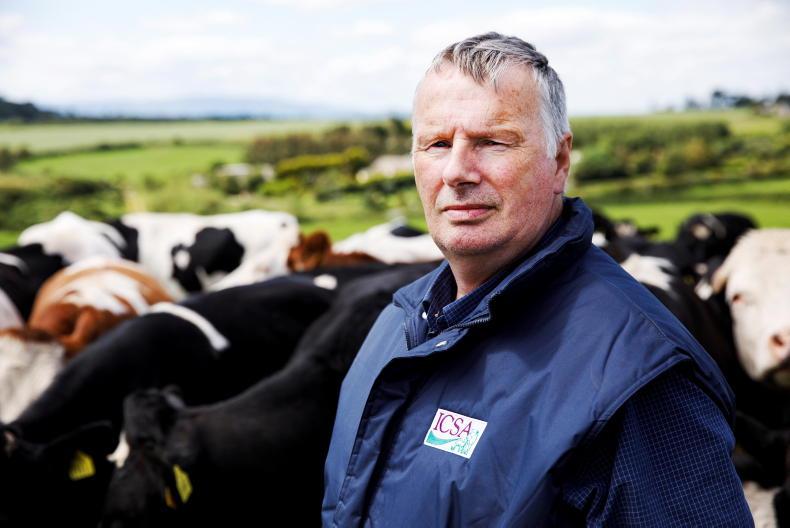
The lack of any increase in the overall allocation of funding to the Department of Agriculture raises serious questions about whether the Government is doing enough to support farm viability.
That's according to the Irish Cattle and Sheep Farmers' Association (ICSA) rural development chair, Edmund Phelan.
He was commenting in reaction to Budget 2027. With farmers currently struggling with “extremely high costs”, he said it is difficult to see how the Government can deliver the level of support farmers need without an increase in the overall allocation to the Department.
Not far enough
Phelan said the extension of the fuel support scheme provides some short-term relief but does not go far enough to tackle rising fuel costs.
“Fuel costs have become one of the biggest pressures facing farmers and we need to see a proper response to the cost of agricultural fuel.”
He also highlighted that additional funding has been allocated to the fuel scheme even though a large portion of the original funding remains unspent: “We have to question why €31.2 million has been allocated for the further five-month period when around €58 million of the original allocation remained unspent.”
Phelan said that farmers need more than temporary relief as fuel has gone from being a manageable cost in running a farm to a major and increasingly damaging cost.
He welcomed the reduced excise rates, which will now remain in place until the end of February, and the suspension of further carbon-tax increases.
“However, the phased restoration of excise from March to June next year means that farmers will continue to face rising fuel costs,” he said. “We need a lasting solution that gives farmers greater certainty over what it will cost to run their farms.”
Sheep Welfare Scheme
He said the €22 million allocation for the National Sheep Welfare Scheme is a concern as this remain unchanged from last year’s funding, when payments were cut because the scheme was oversubscribed.
“That is not good enough for a low-income sector that needs support to remain viable,” he said. “If a scheme is oversubscribed, that should be a signal that more funding is needed.”
He deemed the changes to succession farm partnerships as positive steps, but Phelan highlighted that much more needs to be done to support generational renewal:
“Succession is one of the biggest challenges facing the future of Irish farming. These measures are welcome, but the starting point has to be viable farms. The next generation will not take over farms if there is no sustainable income from farming.”
Fertiliser support
Phelan welcomed the national top-up to the EU fertiliser support scheme, bringing the overall fund to almost €46 million.
“Fertiliser is a fundamental cost for farmers and this support is welcome, but the scheme needs to be rolled out quickly and farmers need clarity on the detail and when payments will be made.”
He also welcomed the extension of accelerated wear-and-tear allowances for farm-safety equipment and the increase in the farmer flat-rate VAT addition.
“There are positive measures in Budget 2027 and we welcome those that will make a practical difference to farmers. But the real test is whether this Budget does enough to reduce the cost of production, strengthen farm incomes, and keep our family farms going,” he said.
“Farmers cannot build a future on temporary relief and underfunded schemes.”