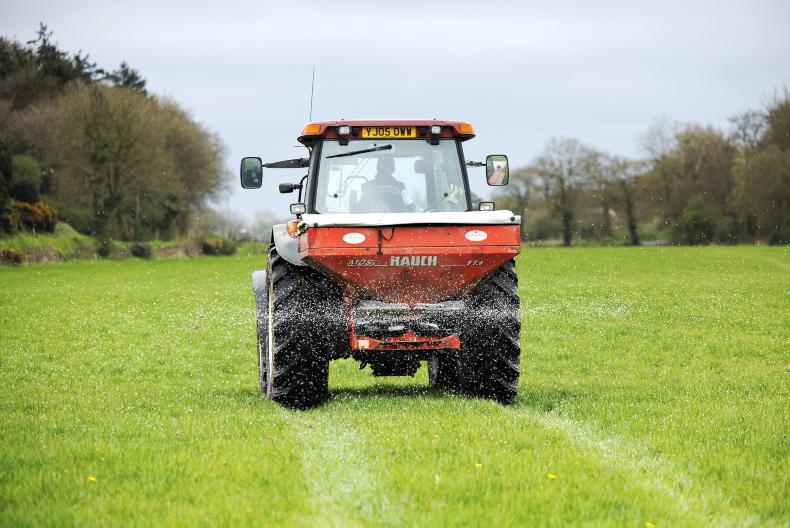
The last five to six weeks have been far from typical spring weather with this week’s rainfall reversing any recent improvement in ground conditions in many areas.
A small percentage of farms have fertiliser applied for first cut silage with a spike in activity likely once conditions allow.
The quality of silage, or hay for that matter, made in the coming months will have a major influence on animal performance.
For example, papers published by Tim Keady, Teagasc, based on 11,500 silage samples analysed in Hillsborough in 2012 showed the mean silage quality recorded at 67.3 DMD.
The minimum quality recorded in that year was 52 DMD, while the maximum quality was 82 DMD. The 67.3 DMD silage is capable of supporting 9.8kg milk yield per day, 0.45kg daily liveweight gain (DLWG) in a bullock and 48g in a finishing lamb.
The minimum quality silage was not capable of supporting any performance while the maximum-quality silage sustained 22.6kg milk yield per day, 1.1kg DLWG in a bullock and 173g in a lamb.
Benefit
The benefit of ensiling high-quality silage gains even more credence in the current era of high concentrate prices.
The Teagasc paper showed a five DMD reduction in digestibility equates to 2.75kg concentrates per cow required to maintain performance, 1.8kg/day for finishing cattle and 22.6kg over a late pregnancy feeding programme for ewes.
Important factors
There are a number of factors that determine silage digestibility including harvest date, sward type, silage fermentation, level of nitrogen fertiliser applied and the wilting process.
Within these, harvest date is raised as the most important with silage digestibility declining by over three DMD percentage points for each one week delay in harvest date.
This can increase to as high as nine percentage units where crops are lodged and there is an accumulation of dead leaf and stem at the base of the sward.
Therefore, it is vital to attain the best balance between quality and yield.
Many farmers focus heavily on yield with the aim of ensuring that sufficient bulk is available which is understandable. It must also be highlighted, however, that animal intake can also be restricted where high-quality silage is present.
Almost every system also requires a supply of top-quality silage. For example, spring milking herds require at least 20% top-quality silage to feed at the shoulders of the year.
Most suckler systems require high-quality silage for feeding to weanlings while the level of concentrates required to be fed to ewes in late pregnancy can be cut greatly.
Fertiliser application
The timing and level of fertiliser applied will have a direct influence on potential harvest dates.
Reseeded or young perennial ryegrass swards will have a 20% to 25% higher nitrogen requirement than permanent pasture.
Such a crop capable of delivering 5t/ha of dry matter will typically require 125kg N/ha or 100 units / acre.
Grass silage will use about 2.5kg N/ha/day or two units per day.
Teagasc advice cautions that luxury amounts of K may be taken up by grass where more than 90kg/ha K is applied
Therefore, crops which have received 100 units of nitrogen will need to wait at least 50 days in normal grass-growing conditions before all nitrogen is utilised.
Reports indicate that there is a lot of grass available on some farms due to inclement weather preventing turnout and, in this regard, it is especially important to get fertiliser applications correct.
Previous application
It is also important to take account of any nitrogen present from organic or chemical fertiliser applied previously.
Mark Plunkett, Teagasc, advises that for nitrogen applied for early grazing, 25% of this could still be available for the silage crop.
P and K requirements
For permanent grassland or older swards, the recommendation is 70 to 80 units of nitrogen. Applying more nitrogen than is required will have a negative effect on preservation.
It is also important to consider the phosphorus (P) and potassium (K) requirement with these nutrients vital in maximising grass yields. A crop of grass silage will remove in the region of 4kg P and 25kg K per tonne of grass dry matter removed. The most cost-effective source of P and K is recycling organic fertilisers.
Table 1 details the typical N, P and K rates present in cattle and pig slurry. This is a guide and nutrient values can vary greatly depending on the diet fed to animals from which the organic fertiliser derives.
Recommended
Table 2 details recommended rates of N, P and K at the four different soil P and K indexes required for a 5t/ha grass dry matter silage crop (10t fresh grass/acre)and to build/maintain soil P and K status.
Teagasc advice cautions that luxury amounts of K may be taken up by grass where more than 90kg/ha K is applied.
It may also reduce fertiliser K efficiency and interfere with the K:Mg/Na balance. For this reason, it is recommended to apply the remainder required to the silage aftermath or in late autumn.