Sheep farmers on the island of Ireland are facing a relatively new threat with cases of haemonchus contortus rising slowly in recent years.
The worm, which is often known as barber’s pole worm due to its red and white-striped appearance, is a common threat in countries with a hot climate and was believed to be a lower threat in countries like Ireland with cooler climatic conditions.
The regional veterinary laboratories have identified the presence of disease from as far north west as Sligo with the most common prevalence in the east and midlands. The overall risk from the disease remains low in the context of the challenge facing the sheep sector but individual farms can and have been hit hard.
As such, farmers are advised to be mindful of the warning signs of disease and the importance of acting early if any such warning signs emerge. The worm species is one of the most efficient in terms of its reproductive capabilities. The Sustainable Control of Parasites (SCOPS) body explains that a reproductive female can produce 5,000 to 15,000 eggs per day compared to 400 eggs for the teladorsagia roundworm.
Combined with a short life cycle of about 20 days, there can be rapid build-up of parasites on pasture given favourable environmental conditions.
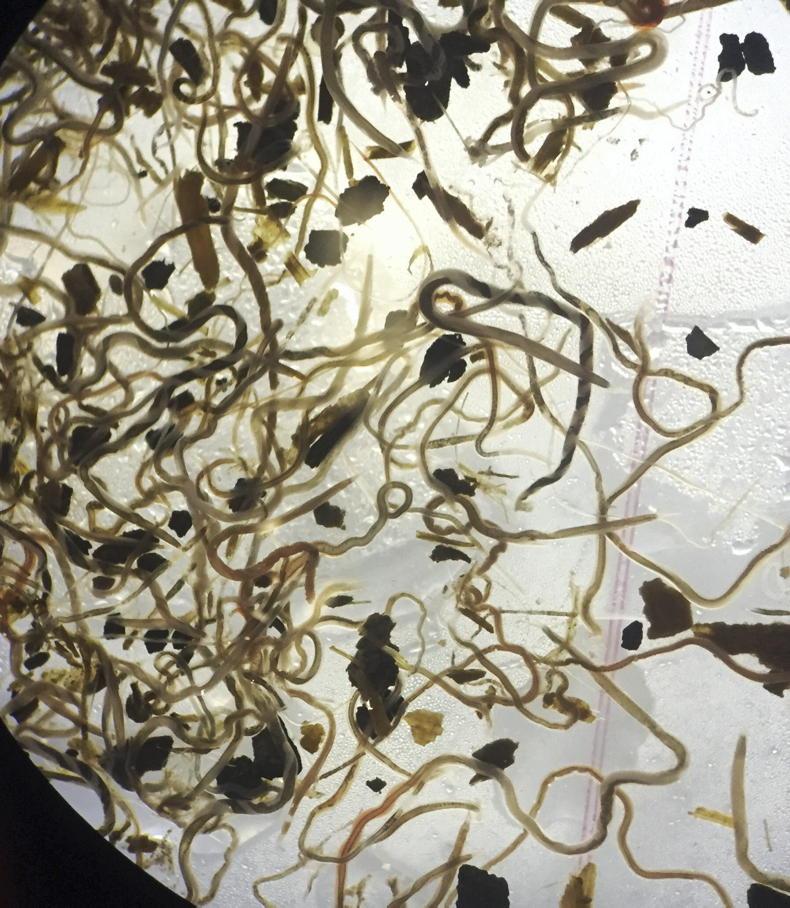
Haemonchus contortus worms recovered from a sheep carcase in Kilkenny Regional Veterinary. Note typical barber's pole appearance of some worms. Photo - Kilkenny RVL.
Adult worms or worms approaching adulthood have the ability to remove 0.05ml of blood from their host. To put the severity of potential disease into perspective, a sheep carrying 5,000 Haemonchus worms can remove 250ml of blood per day. A much lower worm burden is also capable of causing damaging problems.
Clinical signs
Early clinical signs are sheep quickly losing body condition and demonstrating similar classical symptoms to liver fluke. This includes paleness of gums and conjunctivae, the characteristic swelling under the jaw or bottle-jaw appearance and an increased rate and depth of breathing/increased heart rate. Sudden deaths or ill-thrift despite sheep being offered a good plane of condition should be explored. Scouring or diarrhoea is not a classic symptom in the same way that is seen in other parasitic gastroenteritis infections.
Control options
There are no preventative control options. It is thought that liver fluke treatment with products with the active ingredient closantel could be curtailing the development of problems in some areas. Where problems are identified then treatment with a closantel-based product is sufficient to treat the disease.
Farmers are advised to adopt a programme of using faecal egg counts (FECs) to determine the need to treat sheep for worms. This practice will identify any rapid spikes in faecal egg counts and while standard FECs will not distinguish to the presence of Haemonchus a rapid increase in egg counts will highlight the possibility that the disease is present. Monitoring performance and assessing any sheep where performance dips or submitting any cases of mortality for post-mortem will also help.
Experience of the disease on individual farms in Ireland has shown that a significant number of sheep in a flock can quickly die from the infection and as such it is important to continually investigate any sudden dips in performance and to consult your vet quickly.
Sheep farmers on the island of Ireland are facing a relatively new threat with cases of haemonchus contortus rising slowly in recent years.
The worm, which is often known as barber’s pole worm due to its red and white-striped appearance, is a common threat in countries with a hot climate and was believed to be a lower threat in countries like Ireland with cooler climatic conditions.
The regional veterinary laboratories have identified the presence of disease from as far north west as Sligo with the most common prevalence in the east and midlands. The overall risk from the disease remains low in the context of the challenge facing the sheep sector but individual farms can and have been hit hard.
As such, farmers are advised to be mindful of the warning signs of disease and the importance of acting early if any such warning signs emerge. The worm species is one of the most efficient in terms of its reproductive capabilities. The Sustainable Control of Parasites (SCOPS) body explains that a reproductive female can produce 5,000 to 15,000 eggs per day compared to 400 eggs for the teladorsagia roundworm.
Combined with a short life cycle of about 20 days, there can be rapid build-up of parasites on pasture given favourable environmental conditions.

Haemonchus contortus worms recovered from a sheep carcase in Kilkenny Regional Veterinary. Note typical barber's pole appearance of some worms. Photo - Kilkenny RVL.
Adult worms or worms approaching adulthood have the ability to remove 0.05ml of blood from their host. To put the severity of potential disease into perspective, a sheep carrying 5,000 Haemonchus worms can remove 250ml of blood per day. A much lower worm burden is also capable of causing damaging problems.
Clinical signs
Early clinical signs are sheep quickly losing body condition and demonstrating similar classical symptoms to liver fluke. This includes paleness of gums and conjunctivae, the characteristic swelling under the jaw or bottle-jaw appearance and an increased rate and depth of breathing/increased heart rate. Sudden deaths or ill-thrift despite sheep being offered a good plane of condition should be explored. Scouring or diarrhoea is not a classic symptom in the same way that is seen in other parasitic gastroenteritis infections.
Control options
There are no preventative control options. It is thought that liver fluke treatment with products with the active ingredient closantel could be curtailing the development of problems in some areas. Where problems are identified then treatment with a closantel-based product is sufficient to treat the disease.
Farmers are advised to adopt a programme of using faecal egg counts (FECs) to determine the need to treat sheep for worms. This practice will identify any rapid spikes in faecal egg counts and while standard FECs will not distinguish to the presence of Haemonchus a rapid increase in egg counts will highlight the possibility that the disease is present. Monitoring performance and assessing any sheep where performance dips or submitting any cases of mortality for post-mortem will also help.
Experience of the disease on individual farms in Ireland has shown that a significant number of sheep in a flock can quickly die from the infection and as such it is important to continually investigate any sudden dips in performance and to consult your vet quickly.
SHARING OPTIONS