The recent adverse weather is forcing some farmers to rethink their spring fertiliser plans. It is important to note that circumstances on sheep farms vary greatly, with a marked difference between land type, stocking rate and lambing date. This means best practice also varies greatly. There will also be sharp differences in grass supplies, influenced by autumn closing dates.
The farmers facing the most impending issues are those who have lambed and are moving through grass reserves much quicker than planned, with a high percentage of flocks lambing or starting to lamb in the coming weeks.
Grazing targets
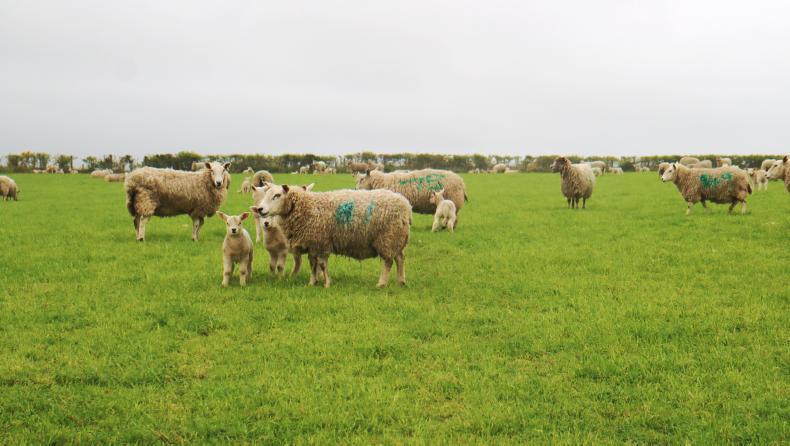
One of the first things to do is see how the farm is currently faring. Grass growth rates were pretty good in January, but have dipped as a result of waterlogged soils. Teagasc advice, based on research from Mellows Campus, Athenry, suggests that for an early/mid-March lambing flock, the aim should be to have an average opening farm grass cover of 600kg to 700kg grass DM/ha for flocks stocked about 10 ewes/ha and 750kg to 800kg DM/ha for flocks stocked at 12 ewes/ha.
A mid-season flock in normal circumstances should target 20 to 25 days grazing ahead of the start of lambing
In normal weather conditions, every centimetre in grass height will generally translate to between 250kg and 300kg grass DM/ha. Grass is calculated from a residual height of 3cm to 3.5cm early in the year and 4cm as the year progresses. Multiplying the grass height by the area will give an estimate of the total herbage available in a particular paddock.
A ewe requires 2.4kg to 2.5kg DM intake daily over the first four weeks of lactation (this rises to 3.2kg DM from week five to eight). Using this information will allow you to calculate the number of days of grazing available. A mid-season flock in normal circumstances should target 20 to 25 days grazing ahead of the start of lambing.
Stretching supplies
If conditions do not improve significantly over the coming week to 10 days, then it is likely that some flocks could be facing a grass shortage, stemming from insufficient supplies or swards being too wet to graze and utilisation taking a hammering.
This is a situation that the research demonstration flocks in Teagasc Athenry faced in recent years. One of the most challenging cases was during a prolonged period of adverse weather in 2013.
Researcher Philip Creighton explained that 40% to 50% of the ewe’s daily intake was made up from 1.5kg grass dry matter, with the shortfall made up by supplementing ewes with close to 1kg concentrates. When grass supplies were at their lowest, ewes were also offered good-quality silage.
Where grass supplies are sufficient, but dry matter is low, then there is an advantage in offering supplementation to increase the overall dry matter of the diet.
The level of supplementation will also be influenced by ewe body condition score (BCS). Ewes in BCS 2.75 to 3+ are capable of mobilising body reserves to underpin energy intake.
If conditions do not improve significantly over the coming week to 10 days, then it is likely that some flocks could be facing a grass shortage
Teagasc’s advice for twin-suckling ewes in such condition achieving an intake of 1kg grass dry matter is supplementation with 1kg of a 20% crude protein concentrate, rising to 1.4kg where ewes are in poor body condition of BCS 2.25 to 2.5.
Where ewes are receiving a higher allocation of concentrates, the crude protein content can be reduced, as the overall protein intake will be sufficient. The advice for single-suckling ewes is 0.5kg of a 20% concentrate for ewes in good body condition, rising to 0.75kg of a 15% concentrate for ewes in poor body condition.
Quick recovery
All farmers can do is bide their time and be in a position to act quickly once an opportunity presents itself. The following tips will help get your farm back on track when weather improves.
Quick action: Fertiliser should be ordered and available in the yard when weather finally does improve, as there may be heightened demand and a delay in accessing supplies. Adequate application: Philip advised that once weather picks up and fertiliser can be applied, in the region of 23 to 25 units of nitrogen should be applied on whatever ground is trafficable. He says that compound fertilisers may play a role on low-index soils, but in general, it is best to apply these during summer and autumn. This is particularly the case with high-fertility soils, as applying compound fertilisers may increase the risk of tetany. Blanket application: Every opportunity should be taken to apply nitrogen on heavy covers. Nitrogen will help to maintain quality while also working away in the background and helping to aid recovery and boost regrowth. Targeted grazing: Grazing principles should be remembered, where possible. Rotational grazing will help manage supplies better and get back on track faster than allowing all areas to be grazed. Avoiding poaching or over-grazing will also deliver benefits.Soil pH: Heavy and persistent rainfall contributes significantly to leaching and lowering the soil pH. Take note of this, as it may be more beneficial to apply lime in place or in combination with an application of fertiliser later in the year.
The recent adverse weather is forcing some farmers to rethink their spring fertiliser plans. It is important to note that circumstances on sheep farms vary greatly, with a marked difference between land type, stocking rate and lambing date. This means best practice also varies greatly. There will also be sharp differences in grass supplies, influenced by autumn closing dates.
The farmers facing the most impending issues are those who have lambed and are moving through grass reserves much quicker than planned, with a high percentage of flocks lambing or starting to lamb in the coming weeks.
Grazing targets
One of the first things to do is see how the farm is currently faring. Grass growth rates were pretty good in January, but have dipped as a result of waterlogged soils. Teagasc advice, based on research from Mellows Campus, Athenry, suggests that for an early/mid-March lambing flock, the aim should be to have an average opening farm grass cover of 600kg to 700kg grass DM/ha for flocks stocked about 10 ewes/ha and 750kg to 800kg DM/ha for flocks stocked at 12 ewes/ha.
A mid-season flock in normal circumstances should target 20 to 25 days grazing ahead of the start of lambing
In normal weather conditions, every centimetre in grass height will generally translate to between 250kg and 300kg grass DM/ha. Grass is calculated from a residual height of 3cm to 3.5cm early in the year and 4cm as the year progresses. Multiplying the grass height by the area will give an estimate of the total herbage available in a particular paddock.
A ewe requires 2.4kg to 2.5kg DM intake daily over the first four weeks of lactation (this rises to 3.2kg DM from week five to eight). Using this information will allow you to calculate the number of days of grazing available. A mid-season flock in normal circumstances should target 20 to 25 days grazing ahead of the start of lambing.
Stretching supplies
If conditions do not improve significantly over the coming week to 10 days, then it is likely that some flocks could be facing a grass shortage, stemming from insufficient supplies or swards being too wet to graze and utilisation taking a hammering.
This is a situation that the research demonstration flocks in Teagasc Athenry faced in recent years. One of the most challenging cases was during a prolonged period of adverse weather in 2013.
Researcher Philip Creighton explained that 40% to 50% of the ewe’s daily intake was made up from 1.5kg grass dry matter, with the shortfall made up by supplementing ewes with close to 1kg concentrates. When grass supplies were at their lowest, ewes were also offered good-quality silage.
Where grass supplies are sufficient, but dry matter is low, then there is an advantage in offering supplementation to increase the overall dry matter of the diet.
The level of supplementation will also be influenced by ewe body condition score (BCS). Ewes in BCS 2.75 to 3+ are capable of mobilising body reserves to underpin energy intake.
If conditions do not improve significantly over the coming week to 10 days, then it is likely that some flocks could be facing a grass shortage
Teagasc’s advice for twin-suckling ewes in such condition achieving an intake of 1kg grass dry matter is supplementation with 1kg of a 20% crude protein concentrate, rising to 1.4kg where ewes are in poor body condition of BCS 2.25 to 2.5.
Where ewes are receiving a higher allocation of concentrates, the crude protein content can be reduced, as the overall protein intake will be sufficient. The advice for single-suckling ewes is 0.5kg of a 20% concentrate for ewes in good body condition, rising to 0.75kg of a 15% concentrate for ewes in poor body condition.
Quick recovery
All farmers can do is bide their time and be in a position to act quickly once an opportunity presents itself. The following tips will help get your farm back on track when weather improves.
Quick action: Fertiliser should be ordered and available in the yard when weather finally does improve, as there may be heightened demand and a delay in accessing supplies. Adequate application: Philip advised that once weather picks up and fertiliser can be applied, in the region of 23 to 25 units of nitrogen should be applied on whatever ground is trafficable. He says that compound fertilisers may play a role on low-index soils, but in general, it is best to apply these during summer and autumn. This is particularly the case with high-fertility soils, as applying compound fertilisers may increase the risk of tetany. Blanket application: Every opportunity should be taken to apply nitrogen on heavy covers. Nitrogen will help to maintain quality while also working away in the background and helping to aid recovery and boost regrowth. Targeted grazing: Grazing principles should be remembered, where possible. Rotational grazing will help manage supplies better and get back on track faster than allowing all areas to be grazed. Avoiding poaching or over-grazing will also deliver benefits.Soil pH: Heavy and persistent rainfall contributes significantly to leaching and lowering the soil pH. Take note of this, as it may be more beneficial to apply lime in place or in combination with an application of fertiliser later in the year. 





SHARING OPTIONS