


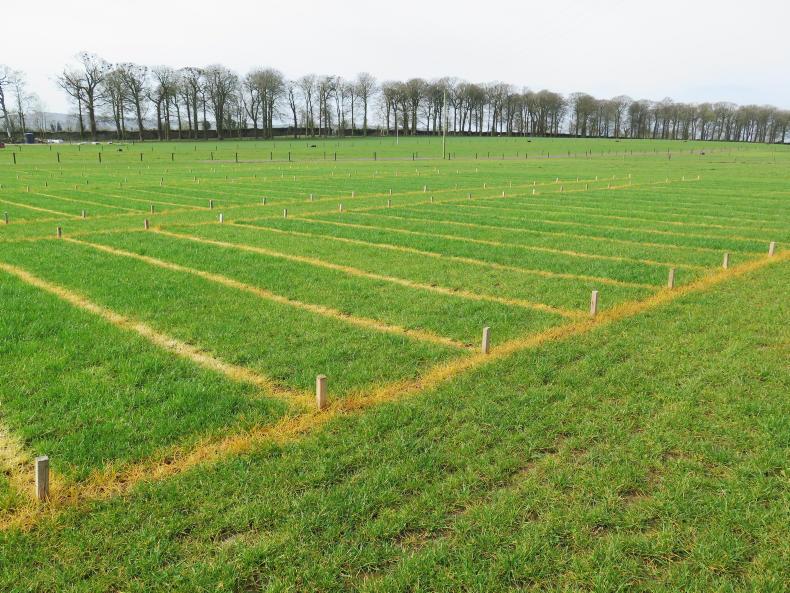
The diploid grass variety AberGreen is performing very well in the Teagasc on-farm grass variety evaluation study. The study involves sowing monocultures of grass varieties on commercial dairy farms. There are 89 farms on the study comparing 18 varieties and the study has been going since 2013.
Varieties are evaluated for total grass yield, spring, summer and autumn growth, quality, post grazing sward height and the number of grazings and silage cuts.
Total growth for AberGreen is 15.7t/ha. The next best variety is Abergain at 14.8t/ha followed by Drumbo and Astonenergy at 14.5t/ha. AberGreen had the highest spring growth at 1.4t/ha, 0.2t/ha higher than Abergain which is 0.2t/ha higher than Glenveagh, the variety with the lowest spring growth.
Farmers should be picking varieties that grow well and are easily managed
AberGreen also has the highest mid-season growth at 9t/ha. Mid-season is classified as being from mid-April to mid-August.
AberGain is runner-up in this category also at 8.5t/ha which is 1t/ha higher than Majestic which has the lowest summer growth at 7.5t/ha. Astonenergy and Drumbo perform best in the autumn, at 5.13t/ha between mid-August and the end of November. AberChoice grows the least in the autumn at 4.7t/ha.
Quality
While total growth is important, quality is important also. The researchers are looking at this in a number of ways. Samples are taken from pre-grazing yields and they are analysed for dry matter digestibility (DMD%). Results from 2014 to 2016 show that AberChoice scores the highest at 85.5% DMD, while Glenveagh performs the worst at 81.1% DMD. AberGreen results are in the lowest quartile at 81.3% DMD.
However, looking at just 2017 DMD data, Astonenergy performs the best at 84.3% followed by AberGain and Twymax at 83.5% with AberGreen at 83.3% DMD. Majestic and Glenveagh have the lowest DMD at 80.6% and 81.3% respectively. The other way of looking at quality is to look at what happens on the farm. This is the advantage of putting varieties on farms. The number of grazings and the post grazing height are good indicators of how well the cows like the variety. If the grass is tasty the post grazing height will be low and the regrowth will be high quality.
On the other hand, if the grass isn’t tasty, the post grazing height will be higher and there will be more stem and rejected grass in the next grazing. Correcting this will involve cutting that grass for silage.
AberGreen had the highest number of grazing at eight per year, followed by Kintyre and Abergain at 7.5 grazings per year. Dunluce and Glenveagh are grazed least often at 6.36 and 6.59 times per year respectively.
These varieties were cut for silage more often than any other varieties. When it comes to post grazing sward height, Astonenergy is grazed the lowest at 4.07cm. Clanrye is the highest post grazing height at 5.2cm. AberGreen has the second highest post grazing sward height at 4.8cm.
Farmers should be picking varieties that grow well and are easily managed. New varieties like AberGreen are promising in this regard and are a good complement to well proven varieties like Abergain, Astonenergy, Aberchoice and Drumbo. New varieties tested in 2017 include Aberclyde (17.5t/ha), Aberplentiful (16.7t/ha) and Aspect (15.5t/ha). All of these varieties are higher yielding than the top performing existing varieties. This is good to see as it shows there is progress being made in the breeding programme.


SHARING OPTIONS