



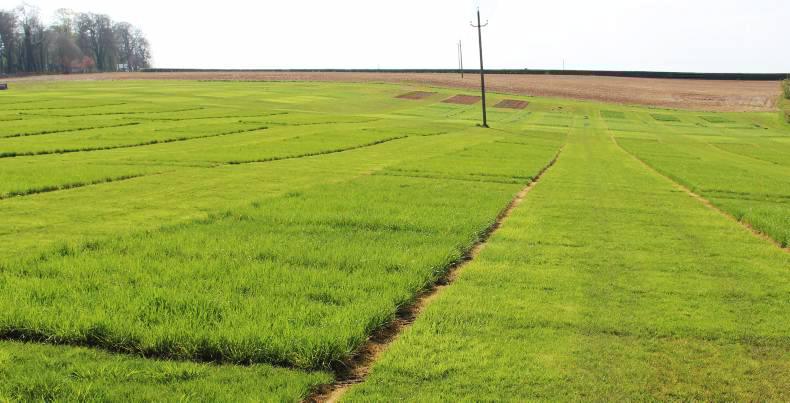
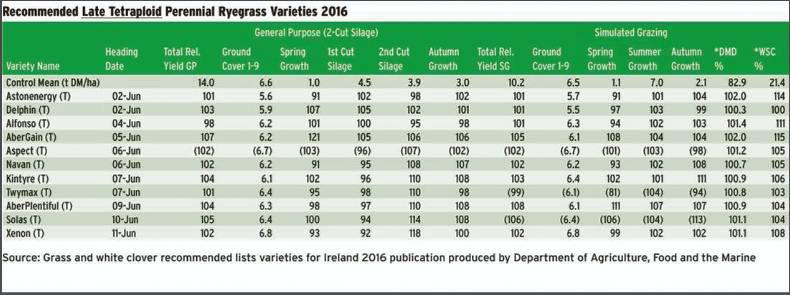
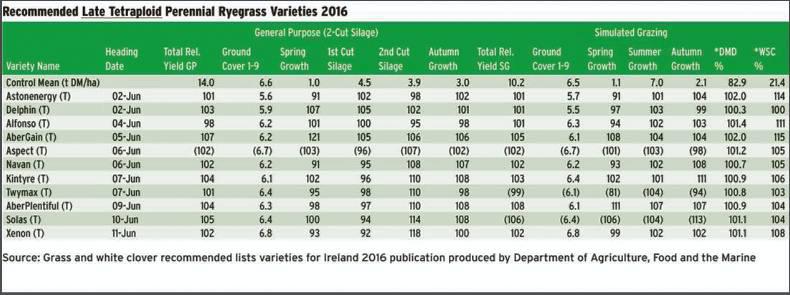
Four new varieties have been added to the Department of Agriculture recommended grass lists and the Teagasc Pasture Profit Index (PPI) for 2016. The new varieties are the intermediate diploid Nifty, the late diploid Kerry and the late tetraploids Alfonso and Xenon.
In total, there are 30 varieties on the recommended list and the PPI between intermediate and late diploids and tetraploids. AberMagic tops the PPI for 2016, jumping €26 from its 2015 value to €210 and overtaking AberGain in the top spot, which has dropped €9 to second place with a PPI of €199.
AberMagic is an intermediate diploid, with a heading date of the 31 May and scored highly in spring, summer and autumn growth while also scoring highly in grass quality. Abermagic’s jump in PPI can largely be attributed to a rise in its value for quality and persistency, jumping €28 from last year in persistency alone.
In third place on the PPI is the new diploid variety Nifty, which scores very highly on spring, summer and autumn growth, but which has a negative (€-6) value for quality. Widely used varieties, Astonenergy, Dunluce, Kintyre and Tyrella remain largely unchanged, with relatively small changes in their PPI value, although Tyrella continues to fall in value at €63, down from €71 last year and remains second lowest on the PPI.
The PPI places an economic value on a grass variety’s traits in €/ha relative to a control variety. The PPI is generated by Teagasc in Moorepark, based on the simulated grazing data generated by the Department of Agriculture in the grass variety evaluation trials used for formulating the recommended lists. This is the second year in which the recommended lists and the PPI are published together.
Ploidy
Ploidy refers to whether a variety is diploid or tetraploid. The difference between the two refers to the way they were bred, with diploid varieties having two chromosomes per cell, while tetraploids have four. Physically, diploids tend to be shorter growing and denser, with higher ground cover than tetraploids. However, tetraploids tend to have higher growth and quality characteristics.
Heading date
This refers to the average date in which the variety goes to seed. Quality deteriorates after a plant heads, so later heading varieties are preferable to early heading varieties. Earlier-heading varieties are more likely to head out at multiple times during the year also, making it harder to maintain quality.
DM production
Dry matter production in the recommended lists is given as a figure relative to a control, with the control being 100, so every variety is ranked based on the control figure. In the PPI, dry matter production in spring, summer and autumn is given as an economic figure in €/ha, based on the value of grass growth at that time of year.
To read the full Reseeding Focus Supplement click here.




SHARING OPTIONS