



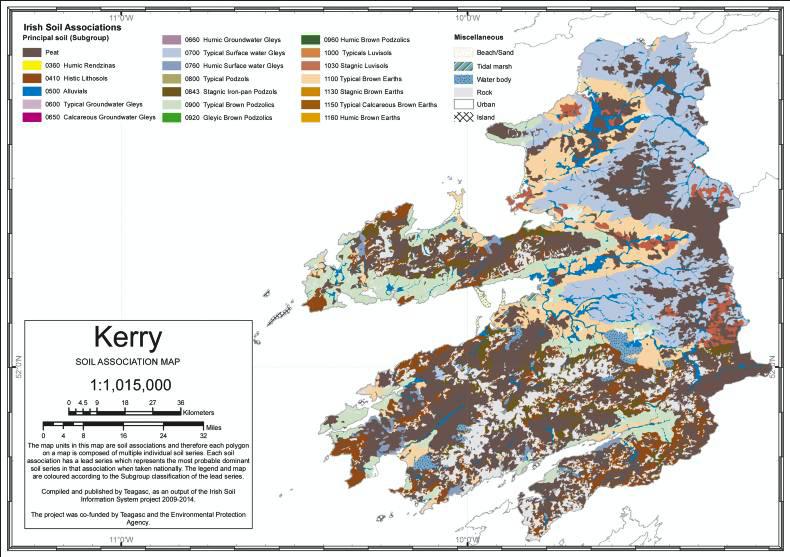
Co Kerry is known as the Kingdom and few would argue that its landscape is not deserving of such a title. Loosely, it can be divided into two main geographical regions, north and south.
For the most part, the northern portion of the county, from Tralee towards Lixnaw and Listowel, comprises lowlands with gentle hills. This area is characterised by undulating shale, with shale glacial drift, and the soils found here include surface-water gleys (slowly permeable subsurface layer) and brown earths (free-draining). The presence of blanket bog can be found on the hilly areas, especially along the Limerick-Cork border.
In contrast, the landscape in south Kerry has rugged hills and mountains and is home to Carrantuohill on the Iveragh Peninsula, which is the highest mountain in Ireland. Overall, this part of the county can be described as mountainous with peat, interrupted with areas of exposed sandstone or shale bedrock.
Blanket peat is frequently found in these upland areas. Histic lithosols, which are shallow peat soils less than 40cm deep, are noticeable, along with podzols, which are nutrient-poor acidic soils generally associated with mountainous locations. Humic brown earths are also found on the moderate slopes. These are free-draining soils, with a high accumulation of organic matter.
The most commonly found soil types in Kerry are surface-water gleys, which make up almost one-third of all soils. Typically, these are found stretching north from Killarney to Listowel. Surface-water gleys are found on heavy glacial till, which gives rise to heavy textured sub-soils and as a result are poorly drained, making them difficult to work with. Here, the majority are the Kilrush series (found in association 0700b led by subgroup 0700).
The slower permeability of these soils, coupled with their higher clay content means that these are heavy soils from a farming perspective and have limited use-range. Typically, grass production is the optimum agricultural use for these soils. For grazing, good management is essential to reduce the risk of poaching.
The second most commonly found soils are brown earths. These are good agricultural soils as they are free-draining, with reasonably good nutrient retention. These soils form a zig-zag pattern, stretching from Killarney to Ballybunion, loosely following the coastline. They do not stretch down the peninsulas, but can be found in pockets in areas such as Waterville in the Iveragh Peninsula and to the northeast of Dingle in the northern peninsula.
Brown podzolics are another commonly found soil type in Kerry. These are mostly on the peninsulas, fringing the Dingle Mountains and the MacGillacuddy’s Reeks.
Brown podzolic soils have lost much of their nutrients (in particular iron and aluminium) as a result of acidic conditions and high rainfall over time. Thus, these soils can be considered as nutrient-poor and may benefit from liming periodically. They are naturally free-draining, so they should not require any additional drainage.



SHARING OPTIONS