Seven years ago this column opened with a rumination about how sporting events can often be boiled down to useful shorthand and how ‘Chicago’ would forever serve as an important aide-mémoire in the Irish rugby lexicon.
The reason for that, two years on from the historic first win over New Zealand, was that Ireland were back in the Windy City, but to face Italy – as impressive as the subsequent 54-7 win was, no commemorative DVDs exist for that one.
Now, a return to Soldier Field awaits for another tilt against the All Blacks and it’s worth reflecting on how similar or different the landscape is compared with seven years ago.
That facile Italy victory was followed by another triumph against New Zealand, the first home win – and, as far as RTÉ seemed to be concerned, the first ever, as they didn’t broadcast the 2016 one – and Ireland’s trajectory continued upwards, securing top spot in the world rankings for the first time.
There was another home win over the All Blacks in 2021, and a historic pair of triumphs in the summer tour of New Zealand of 2022. However, in between Chicago 2016 and Chicago 2025, there were two other clashes on neutral soil – Tokyo in 2019 and Paris in 2023, World Cup quarter-finals both – where the men in black effected an all-too-similar denouement for Ireland.
Promising picture
Still, overall the picture remains promising, though it’s worth noting that the maiden column also referenced the fact that the IRFU had just launched a strategic plan for the five years to follow. It included targets of two Six Nations titles in the period to 2023 – Ireland won that year’s and again in 2024 – as well as semi-final appearances or better at the next two World Cups (say no more).
On the women’s rugby front, objectives included a Six Nations title but England have established a grip on that, winning the last seven titles in a row; a top-six finish at the 2021 World Cup was hoped for but Ireland didn’t even qualify for the finals – thankfully, the quarter-final appearance this year did represent progress, even if it was outside the five-year period the plan dealt with.
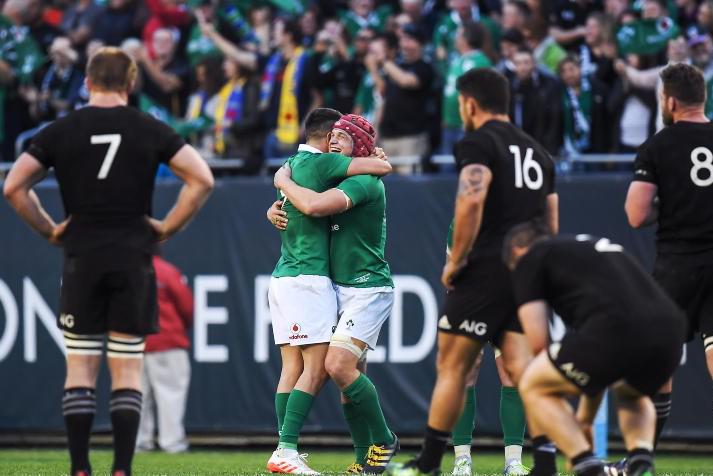
Josh van der Flier, right, and Conor Murray of Ireland celebrate victory over New Zealand back in 2016 at Soldier Field in Chicago. \ by Brendan Moran/Sportsfile
Irish teams did live up the union’s hopes for what was then the Pro14, now the United Rugby Championship, with Leinster and Munster both lifting the trophy. However, we are still waiting for Leinster’s 2018 Champions Cup win to be added to – the strategic plan expressed the view that two wins in the five-year spell was a viable aim.
Of course, as Mike Tyson once said, everybody has a plan until they get punched in the face and success for the provinces or the national team is never going to be easily achieved. And, if the stated aims in the plan had not been lofty, then the IRFU would have been accused of lacking ambition.
It may not grab headlines, but things are in a fairly good state overall – they could of course be better but they could certainly be worse, as anybody who lived through the 1990s would agree.
While the IRFU may not have reached the targets of the previous plan – and it’s notable the current one, encompassing 2024-28, stops short of expressing such clear targets, instead focusing on strong inputs which will generate positive results – they deserve credit for their head-coach appointments.
When Joe Schmidt’s era ended, it was not at all inevitable that the high standards he imposed would be maintained but Andy Farrell has built on the foundations and overseen the loss of key leading players without a notable drop-off in performance.
The Wigan native’s new book, The Only Way I Know, is a must-read and will be covered here soon when we look at the best offerings of the year in sports literature. It illustrates how he has progressed to such a level while retaining his down-to-earth approach and it is something that is certainly working for Ireland.
Farrell would probably prefer a situation where the squad named for the November internationals didn’t have 13 Leinster forwards out of a total of 19, but an equitable dispersal of talent among the four provinces is no easy balancing act.
Ireland are slight underdogs for Chicago, but one side-effect of managing to get the monkey off the back with regard to beating New Zealand is that the games lose a small bit of their lustre as big events.
Rather than a tilt at glory, such fixtures are now battles between fairly evenly-matched sides – and, ultimately, the current situation is a more preferable one.
With world champions South Africa and a resurgent Australia coming to Dublin in November too – normally, a European team would only face two of the southern hemisphere ‘big three’ – we should get a good idea of Ireland’s current standing.
Certainly, they are games to approach with expectation of competing rather than the generations-old fear of losing.
Seven years ago this column opened with a rumination about how sporting events can often be boiled down to useful shorthand and how ‘Chicago’ would forever serve as an important aide-mémoire in the Irish rugby lexicon.
The reason for that, two years on from the historic first win over New Zealand, was that Ireland were back in the Windy City, but to face Italy – as impressive as the subsequent 54-7 win was, no commemorative DVDs exist for that one.
Now, a return to Soldier Field awaits for another tilt against the All Blacks and it’s worth reflecting on how similar or different the landscape is compared with seven years ago.
That facile Italy victory was followed by another triumph against New Zealand, the first home win – and, as far as RTÉ seemed to be concerned, the first ever, as they didn’t broadcast the 2016 one – and Ireland’s trajectory continued upwards, securing top spot in the world rankings for the first time.
There was another home win over the All Blacks in 2021, and a historic pair of triumphs in the summer tour of New Zealand of 2022. However, in between Chicago 2016 and Chicago 2025, there were two other clashes on neutral soil – Tokyo in 2019 and Paris in 2023, World Cup quarter-finals both – where the men in black effected an all-too-similar denouement for Ireland.
Promising picture
Still, overall the picture remains promising, though it’s worth noting that the maiden column also referenced the fact that the IRFU had just launched a strategic plan for the five years to follow. It included targets of two Six Nations titles in the period to 2023 – Ireland won that year’s and again in 2024 – as well as semi-final appearances or better at the next two World Cups (say no more).
On the women’s rugby front, objectives included a Six Nations title but England have established a grip on that, winning the last seven titles in a row; a top-six finish at the 2021 World Cup was hoped for but Ireland didn’t even qualify for the finals – thankfully, the quarter-final appearance this year did represent progress, even if it was outside the five-year period the plan dealt with.
Josh van der Flier, right, and Conor Murray of Ireland celebrate victory over New Zealand back in 2016 at Soldier Field in Chicago. \ by Brendan Moran/Sportsfile
Irish teams did live up the union’s hopes for what was then the Pro14, now the United Rugby Championship, with Leinster and Munster both lifting the trophy. However, we are still waiting for Leinster’s 2018 Champions Cup win to be added to – the strategic plan expressed the view that two wins in the five-year spell was a viable aim.
Of course, as Mike Tyson once said, everybody has a plan until they get punched in the face and success for the provinces or the national team is never going to be easily achieved. And, if the stated aims in the plan had not been lofty, then the IRFU would have been accused of lacking ambition.
It may not grab headlines, but things are in a fairly good state overall – they could of course be better but they could certainly be worse, as anybody who lived through the 1990s would agree.
While the IRFU may not have reached the targets of the previous plan – and it’s notable the current one, encompassing 2024-28, stops short of expressing such clear targets, instead focusing on strong inputs which will generate positive results – they deserve credit for their head-coach appointments.
When Joe Schmidt’s era ended, it was not at all inevitable that the high standards he imposed would be maintained but Andy Farrell has built on the foundations and overseen the loss of key leading players without a notable drop-off in performance.
The Wigan native’s new book, The Only Way I Know, is a must-read and will be covered here soon when we look at the best offerings of the year in sports literature. It illustrates how he has progressed to such a level while retaining his down-to-earth approach and it is something that is certainly working for Ireland.
Farrell would probably prefer a situation where the squad named for the November internationals didn’t have 13 Leinster forwards out of a total of 19, but an equitable dispersal of talent among the four provinces is no easy balancing act.
Ireland are slight underdogs for Chicago, but one side-effect of managing to get the monkey off the back with regard to beating New Zealand is that the games lose a small bit of their lustre as big events.
Rather than a tilt at glory, such fixtures are now battles between fairly evenly-matched sides – and, ultimately, the current situation is a more preferable one.
With world champions South Africa and a resurgent Australia coming to Dublin in November too – normally, a European team would only face two of the southern hemisphere ‘big three’ – we should get a good idea of Ireland’s current standing.
Certainly, they are games to approach with expectation of competing rather than the generations-old fear of losing.






SHARING OPTIONS