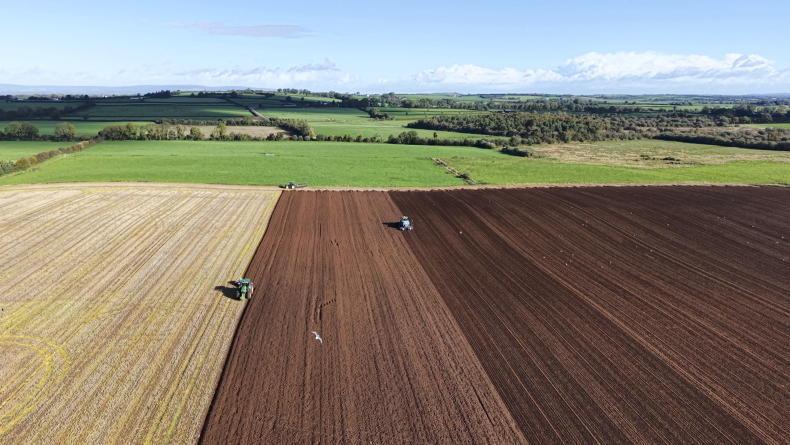
Ploughing progress still remains largely behind on previous years.
ADVERTISEMENT
The late spring has spilled over to another week as Easter Monday brought no letup in the weather.
There were falls of rain and sleet on Monday morning, particularly in the north, followed by scattered heavy showers, especially across Leinster. Unfortunately, much of the rest of the week appears to be no better, with milder and very showery conditions set to hit the whole of the country on Tuesday and Wednesday.
Weeks of mixed weather has delayed essential spring work in the fields, although some progress was made with fertiliser and spraying last week, with limited sowing taking place in a handful of locations.
ADVERTISEMENT
While there has been limited growth in recent weeks, forward crops are heading towards stem extension, which brings nitrogen and growth regulation into focus. Later sown or backward crops are more about catching up with fertiliser and spraying, especially herbicides.
Spraying
Weeds remain the most urgent job but growth regulation may not be far away for forward winter cereals. If you have winter crops that have not yet received herbicide, watch Terrachem's Gary Beirne, Bayer's James Burn and TP Whelehan's Chris Maughan discuss the options still available to you this spring.
Part one
Part one focuses on herbicide options available for grassweed control in winter cereals.
Part two
Part two of the conversation focuses on broadleaved weed control in winter cereals.
More advanced crops are coming close to GS30 and will required a PGR application. An application of CCC 1.5L/ha before GS30 may be beneficial for some of the crops with lower plant counts. This will encourage tiller survival and can give a yield response (0.2t/ha) and also help even up crops.
Fertiliser
All winter crops should have received N, P and K by now. Forward crops will soon be in stem extension and so time for the main N split, but it is best to wait for active growth. Sulphur could go with first or second nitrogen. Active growth minimises the risk of loss, should there be heavy spills of rain post application.
Planting
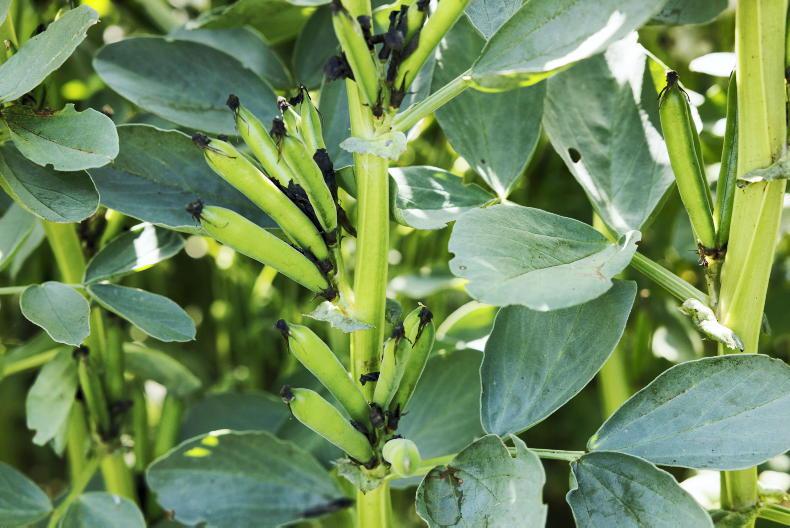
We are coming dangerously close to the end of what’s considered safe to plant spring beans. The later beans are planted, the later they are harvested. Target 35 seeds/m2 - 175-210kg/ha (11-13 st/ac) for 450g to 550g TGW seed. Where possible, get the necessary fertiliser down into the seedbed. It should be as close to pH 7 as possible, so top-dress a granular lime if needed. Seed rate should always take account of seed size and ground conditions.
This content is available to digital subscribers and loyalty code users only. Sign in to your account, use the code or subscribe to get unlimited access.
The reader loyalty code gives you full access to the site from when you enter it until the following Wednesday at 9pm. Find your unique code on the back page of Irish Country Living every week.
CODE ACCEPTED
You have full access to the site until next Wednesday at 9pm.
CODE NOT VALID
Please try again or contact support.
The late spring has spilled over to another week as Easter Monday brought no letup in the weather.
There were falls of rain and sleet on Monday morning, particularly in the north, followed by scattered heavy showers, especially across Leinster. Unfortunately, much of the rest of the week appears to be no better, with milder and very showery conditions set to hit the whole of the country on Tuesday and Wednesday.
Weeks of mixed weather has delayed essential spring work in the fields, although some progress was made with fertiliser and spraying last week, with limited sowing taking place in a handful of locations.
While there has been limited growth in recent weeks, forward crops are heading towards stem extension, which brings nitrogen and growth regulation into focus. Later sown or backward crops are more about catching up with fertiliser and spraying, especially herbicides.
Spraying
Weeds remain the most urgent job but growth regulation may not be far away for forward winter cereals. If you have winter crops that have not yet received herbicide, watch Terrachem's Gary Beirne, Bayer's James Burn and TP Whelehan's Chris Maughan discuss the options still available to you this spring.
Part one
Part one focuses on herbicide options available for grassweed control in winter cereals.
Part two
Part two of the conversation focuses on broadleaved weed control in winter cereals.
More advanced crops are coming close to GS30 and will required a PGR application. An application of CCC 1.5L/ha before GS30 may be beneficial for some of the crops with lower plant counts. This will encourage tiller survival and can give a yield response (0.2t/ha) and also help even up crops.
Fertiliser
All winter crops should have received N, P and K by now. Forward crops will soon be in stem extension and so time for the main N split, but it is best to wait for active growth. Sulphur could go with first or second nitrogen. Active growth minimises the risk of loss, should there be heavy spills of rain post application.
Planting
We are coming dangerously close to the end of what’s considered safe to plant spring beans. The later beans are planted, the later they are harvested. Target 35 seeds/m2 - 175-210kg/ha (11-13 st/ac) for 450g to 550g TGW seed. Where possible, get the necessary fertiliser down into the seedbed. It should be as close to pH 7 as possible, so top-dress a granular lime if needed. Seed rate should always take account of seed size and ground conditions.
If you would like to speak to a member of our team, please call us on 01-4199525.
Link sent to your email address
We have sent an email to your address. Please click on the link in this email to reset your password. If you can't find it in your inbox, please check your spam folder. If you can't find the email, please call us on 01-4199525.
ENTER YOUR LOYALTY CODE:
The reader loyalty code gives you full access to the site from when you enter it until the following Wednesday at 9pm. Find your unique code on the back page of Irish Country Living every week.
SHARING OPTIONS