



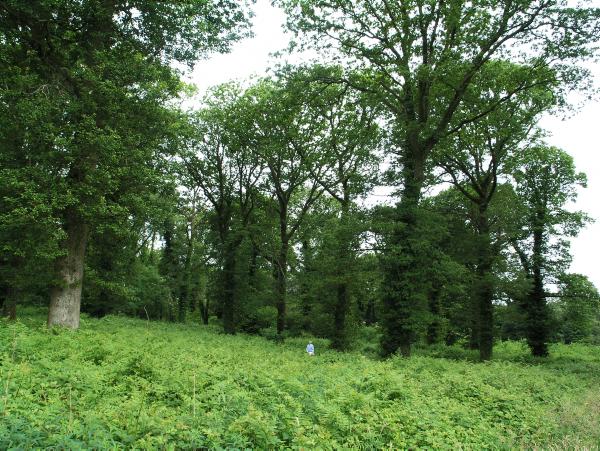
Over the past decade, native broadleaves have accounted for more than one third of afforestation programmes in Ireland, compared with less than 5% for most of the last century. The importance of conserving and planting oak, Ireland’s most important indigenous species, is central to planting and conservation programmes, such as the Native Woodland Scheme.
There is a new urgency in protecting and planting oak since the future of ash has been placed in doubt due to the disease Chalara fraxinea. In addition, the disappearance of elm from our landscape due to Dutch Elm disease has left Ireland with an extremely limited pallet of native species to choose from. Even ‘‘minor’’ natives, such as cherry and alder, are subject to insect and fungal attack.
Today, oak stands alone as Ireland’s most important heritage and commercial indigenous species. Unlike conifers, it demands considerable silvicultural expertise to establish successfully, which is one of the reasons why Irish foresters have traditionally looked to countries such as Germany for advice in managing oak.
Now, a new book – Oak: Fine Timber in 100 Years – provides a challenging approach from a French perspective. This welcome publication is a translation by Bede Howell of Le Chêne Autrement by Jean Lemaire published in 2010.
Lemaire has based his findings on 30 years of research. He argues convincingly that the two species of oak – pedunculate and sessile – native to Ireland and most of Europe, can be grown at shorter rotations than previously thought, provided they are managed properly. This is in marked contrast to German, British and Irish publications. In Ireland, studies such as Growing Broadleaves (Joyce et al, 1998) “estimate economic rotations [of] 130 years for pedunculate oak and 160 for sessile”.
While some textbooks on managing oak tend to combine both species, Lemaire differentiates between the ecological requirements of pedunculate and sessile oak. “They need different silvicultural regimes and should be restocked on sites that suit them,” he maintains.
“The spatial key distribution of these two oak species should follow the trends of soil richness and humidity – moist, rich sites with pedunculate, and dryer poorer ones with sessile,” he writes.
In France, it seems that pedunculate oak is favoured on most sites, much to the dismay of Lemaire. “It is estimated that 80% of pedunculate oaks are on sites which suit them poorly or not at all,” he claims.
Lemaire’s approach to oak establishment is radical and likely to be controversial among foresters in Ireland, Britain and Germany. For two decades until 2010, the Forest Service only grant-aided oak plantations that carried at least 6,600 plants per hectare. Co-authors of Irish publications on broadleaves, such as professors emeriti Dr Padraic Joyce and Dr Jürgen Huss, believe that 6,600 plants per hectare is the minimum required.
Cost-saving
Stocking was reduced to 3,300 plants in 2010, which was a cost-saving exercise due to a decrease in State funding rather than a silviculturally-based decision. This caused some angst at the time among foresters and nursery managers.
Forest Service officials who made the decision can now rest easy as Lemaire recommends an initial stocking rate of “not more than 1,400 plants per hectare” (Table 1).
Irish foresters will regard a 1,400 stocking rate as extremely risky but Lemaire’s thorough approach to site preparation, planting and crop management is convincing, especially his methodology in thinning.
His main objective is to achieve a final crop of between 30 and 50 oaks trees per hectare, so he selects 70 ‘‘winners’’ at first thinning and adopts a ‘‘halo thinning’’ around these. His winners are dominant, good quality trees, which will yield an average volume of 3.2m3 of ‘‘planking volume’’ (veneers, cabinet making, furniture and joinery) yielding €300/m3 at 60cm diameter with €10 added per centimetre increase in diameter. In addition, final crop trees provide second quality sawlog (carcassing, pallets and railway sleepers) and lowest grade material (firewood and pulp).
His book includes five chapters covering the biology and ecology of oak; successful oak regeneration; thinning; and successful timber sales. It is liberally illustrated with tables, figures and photographs to demonstrate Lemaire’s findings. It is first and foremost a technical guide and, at €35, is not cheap, but it is a must for Irish foresters and forest owners who wish to gain a new understanding of oak woodland establishment and management.
The publication was funded by Woodland Heritage in Britain, with support from the Department of Agriculture, Food and the Marine in Ireland, while Future Trees Trust acted as co-ordinator of the project.
Oak: Fine Timber in 100 Years by Jean Lemaire (translated by Bede Howell) from the original Le Chêne Autrement, published by Forêt Privée Française (2010) pp176 A4 format in paperback, €35. Payment by cheque to Orla Cashen, Forest Sector Development, Department of Agriculture, Food and the Marine, Agriculture House, Kildare St, Dublin 2.
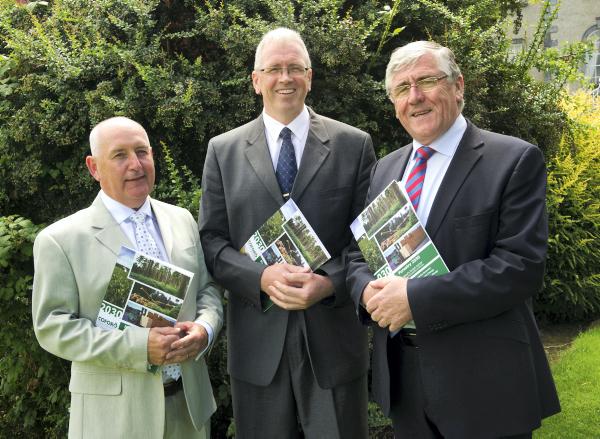
Tom Hayes, Minister of State with responsibility for forestry, launched Forestry 2030 in Dundrum recently. Forestry 2030 comprises five short papers on Irish forestry published by COFORD in the Department of Agriculture, Food and the Marine. They cover forestry and the economy, climate change, renewable energy, biodiversity and recreation.
Compiled by Donal Whelan, with input from stakeholders in the forestry sector, they set out two key challenges to be achieved by 2030:
“There are often general statements made about the importance of the forestry sector to the Irish economy and society but these papers give the facts and the figures to support those statements,” said Minister Hayes.
“That they have been issued by COFORD, a respected and reputable body, enables us to rely on those figures which distil the most recent scientific, technical and economic data on key aspects of the forest sector,” the Minister said.
COFORD chairman Michael Lynn thanked Donal Whelan and council members for their work in compiling the papers.
The forestry and energy section will be one of the major attractions at the Tullamore Show on Sunday 10 August. “This expanding section will showcase all facets of Ireland’s rapidly developing farm forestry and renewable energy sectors,” says Liam Kelly, Teagasc.
“With hi-tech machines, and an array of indoor and outdoor exhibits, the forestry and energy section is not to be missed in Tullamore,” he claims.
This year, the forestry section will be centrally located in the all-weather site with the emphasis on providing information on forestry to enhance family farm income, particularly through new afforestation, forestry thinning and wood energy. Regular demonstrations of modern wood processing technology will take place, such as timber extraction machines, wood chippers and firewood processors.
“The use of wood as a fuel has created opportunities to improve our environment and reduce heating costs,” says Liam Kelly.
“Renewable energy exhibits will showcase a range of engineered technologies in the supply and use of wood fuel and other energy sectors.”




SHARING OPTIONS