


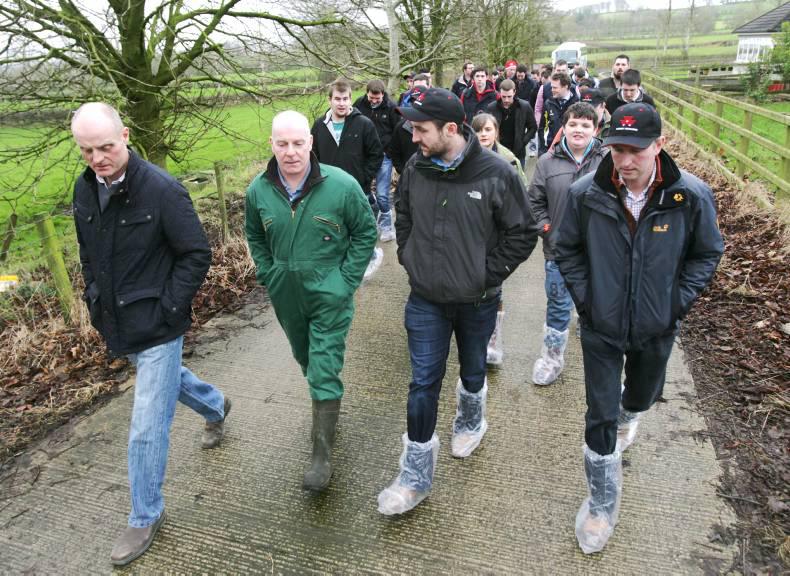
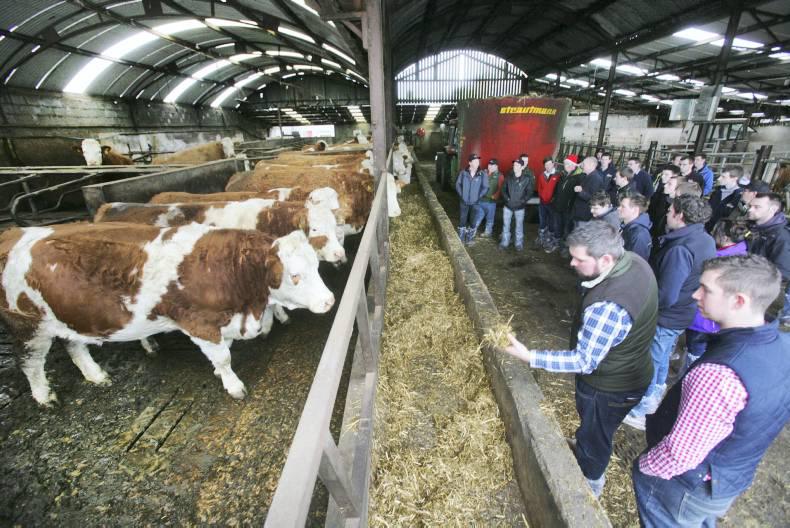
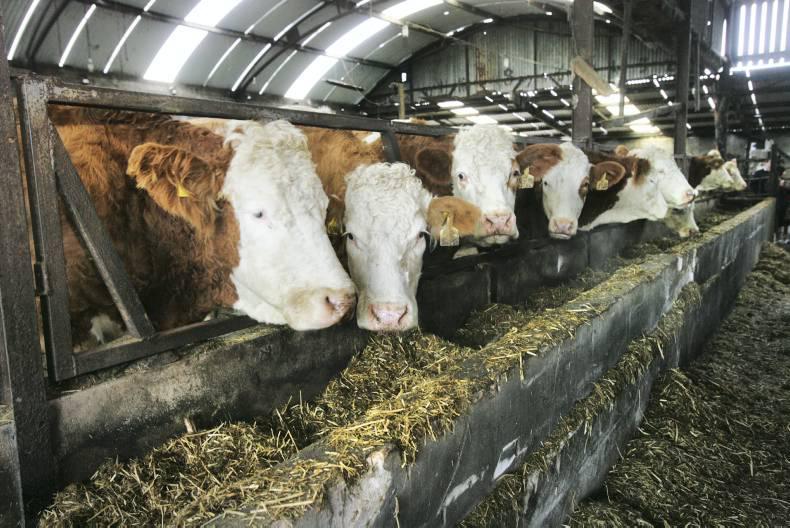
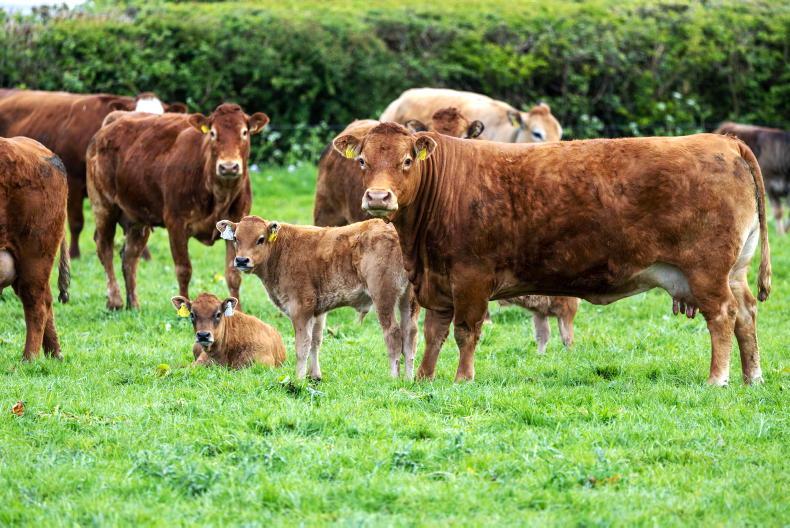
Delegates at the YFCU Optimise agricultural conference on Saturday visited the farm of Michael and Norman Robson near Doagh, Co Antrim, where they run 100 pedigree Simmental cows, as well as 360 sows in a birth-to-bacon system.
The pig unit has not expanded in recent years due to restrictions resulting from Integrated Pollution Prevention and Control (IPPC) laws so, instead, the focus has been on improving the efficiency of the pig enterprise. The principle of increased efficiency in pigs has subsequently been mirrored into the suckler cow herd.
The main breeding focus for the pedigree Simmental herd is to have cattle that are easily fleshed, so that cows have low maintenance requirements and calves can come ready for slaughter at younger ages and at carcase weights within current weight specifications.
Michael maintained that this is possible with the Simmental breed and it was not necessary to opt for traditional breeds to decrease cow size.
Breeding
Other important criteria for the herd include high growth rates, fertility, good feet and legs and temperament. “The only way to improve temperament in a herd is to stop breeding from any animals that are not docile,” Michael said.
He predicts that in the future, polled bulls will become more popular as welfare rules surrounding dehorning and disbudding could become stricter here, and also due to the labour involved in removing horns.
In the Robson herd, most cows are artificially inseminated for the first cycle, with stock bulls used after that. “In the summer, we tend to use less AI as cows are at grass,” Michael said.
Around half of the bulls born on the farm are sold for breeding with the rest finished as bull beef. Heifers are either sold to pedigree or commercial farmers or retained for replacements. No females are bought onto the farm.
A lot of the breeding bulls are sold in Stirling in Scotland, with nine due to be sold there next month. Bulls are also sold locally at sales in Dungannon and Ballymena, as well as privately at home. More recently, Michael has started selling at Carlisle in England to open up a new market outlet for his stock.
Cows calve in two blocks in the spring and autumn. Replacement heifers that are born in one block calve down in the other at two and half years old.
Spring-calving cows do not receive concentrates and are put to grass as early as possible with creep feeders usually going out to calves in July. Autumn-born calves have access to creep pens in houses. Dry cows receive 20kg silage and 3kg straw.
Most of the cows on the farm weigh around 800kg, with the main aim being to wean a 400kg calf. Growth rates of 2kg per day are being achieved by bulls born last spring. Michael said that most bulls kept for beef are ready for slaughter before 14 months.
“Performance-recording is important for us in certain traits such as muscle depth score and gestation length – mainly for traits that can be accurately measured. Measures such as calving ease are not as relevant as a lot of problems with calving come down to management in the dry period,” maintained Michael.
He said that they have never bought a bull based on figures alone as the look of the bull is still important for a pedigree breeder, but added that good estimated breeding values (EBVs) add value to bulls that look correct.
Calving sensors (PharVet Vel’Phone) are used on the farm to monitor cows close to calving. The device measures the cow’s temperature and sends text alerts when a cow is within 48 hours of calving following a constant rise and then drop in temperature. As the cow begins to calve, the monitor passes out with the water bag and automatically sends another text.
“The technology frees up your time well and is very accurate. It also allows dry cows to stay in the cubicles longer as they only have to be moved to straw-bedded calving pens when we know they are close to calving. The control box for the system cost £1,300 and each device costs £100 but they are re-used,” Michael said.
The main theme of the event was “Optimise” with the 90 delegates reminded during workshops and farm visits of the need to analyse and improve all aspects of their businesses.
What also came across during the event was the importance of producing a product to meet customer needs.
Applying this to the red-meat sector, head of agriculture at Dunbia Jonathan Birnie said that the current EUROP grading system gives an indication of meat yield. However, because certain parts of the carcase are worth more than others, the current grading system only partially reflects the actual value of the animal to a meat processor.
“There can be a lot of variation between two apparently identical carcases. The industry will have to address this over the next few years – there are a lot of technologies in development. Breeders who prepare for this now will be hugely advantaged compared with those that ignore this change,” he said.
He maintained that farmers should aim to finish cattle quickly with carcases longer in length and weighing around 330kg to 340kg.
He was not advocating any specific breed to meet customer requirements as there is more variation within breeds than between breeds.
Listen to an interview with Jonathan Birnie in our podcast below:
Birnie said that volatility will always be a factor in the agri-food industry, in particular when export markets are involved. He said that developing new international markets was slow and initially costly, but necessary for the longer term. However, Britain would remain as the best paying, and principal market for NI product.
The challenge comes from selling cuts that are in less demand, such as fifth-quarter or roasting cuts, and that is where money is made or lost for processors, he added.
Estimated breeding values (EBVs) give the best indication of the genetic potential of a ram when making breeding decisions, Edward Adamson from the National Sheep Association said during one of the workshops on Saturday.
Performance-recording has had fairly low uptake among pedigree sheep breeders. This is mostly down to membership and recording costs, which range depending on flock size but can be around £500 for some pedigree flocks, and also due to some additional work involved in recording information.
However, Adamson maintained that an extra £3 per lamb can be earned from using high-index rams, and that if more flockowners looked for EBVs when buying rams, then a good market for performance recorded rams would increase uptake among breeders.
He questioned making decisions based on a ram’s appearance and said that, too often, rams are bought from breeders who have overfed them, which can lead to issues such as kidney and joint problems – affecting the fertility of the ram.
Adamson said that the accuracy of each EBV increases the more relatives belonging to the ram are recorded.
He maintained that incorrect weights recorded at birth, eight weeks and 21 weeks by a breeder to manipulate the figures for a ram is not common as this eventually reduces growth rate figures. The EBV would also be reduced as more relatives are recorded, said Adamson.




SHARING OPTIONS