There is a certain irony surrounding Northern Ireland’s biomethane ambitions.
Despite having a well-established anaerobic digestion (AD) industry, with more than 80 operational plants, NI finds itself, still, at the very beginning of its biomethane journey.
The region already has the infrastructure, agricultural feedstocks and operational experience that many emerging biomethane markets would envy.
Yet when it comes to developing a renewable gas industry, Northern Ireland is arguably where the Republic of Ireland was almost a decade ago: early discussions, consultations, ambitious projections, but no target or established pathway to commercial delivery.
Head start
Northern Ireland had a considerable head start but has effectively ceded its policy advantage to the Republic.
The irony is that the Republic’s own biomethane strategy, despite being considerably more advanced on paper, has struggled to deliver many of the fundamental economic ingredients required to establish a viable industry.
Northern Ireland could conceivably overtake its southern neighbour relatively quickly. It already has an established industry with considerable operational expertise and an opportunity to learn from the Republic’s policy shortcomings.
That would, however, require something conspicuously absent from biomethane policy on both sides of the border: a credible commercial proposition.
A welcome consultation
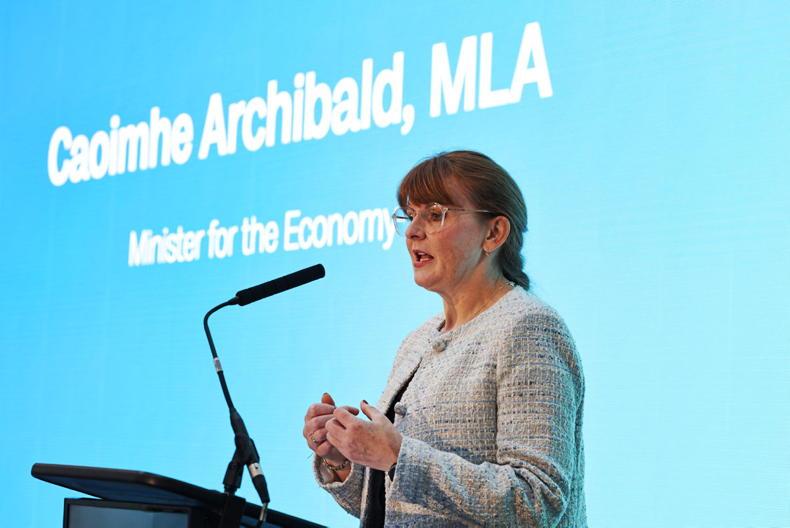
Last week, the Department for the Economy (DfE) and the Department of Agriculture, Environment and Rural Affairs (DAERA) launched Northern Ireland’s first joint Biomethane Strategy and Policy Framework consultation.
Announced at the NI Renewable Gas Conference 2026, the consultation addresses financial support, agricultural feedstocks, nutrient management, gas-network connections and environmental regulation.
Northern Ireland’s three gas distribution network operators, Evolve, Kinecx Energy and Phoenix Energy, jointly welcomed the announcement, describing it as an important milestone and an opportunity to establish a thriving domestic biomethane sector.
The enthusiasm is understandable. Biomethane can replace natural gas within existing infrastructure, offering a potentially valuable route to decarbonising industrial heat, without requiring businesses to replace their equipment.
However, welcoming a consultation is considerably easier than establishing an industry.
The question is whether Stormont can translate these discussions into commercially viable projects rather than allowing another renewable-energy opportunity disappear into years of policy development.
What is being proposed?
The consultation presents 12 policy questions covering the foundations of a potential biomethane industry.
It proposes moving beyond viewing AD exclusively as an energy-producing technology. Instead, future policy could recognise three interconnected services, renewable-energy production, nutrient management and carbon utilisation.
This could see AD facilities recovering phosphorus and nitrogen from digestate, producing commercial fertiliser products and capturing biogenic carbon dioxide.
For existing AD operators, one particularly relevant proposal is a hub-and-spoke model, allowing smaller plants to supply biogas or digestate to centralised upgrading and processing facilities.
In principle, this could provide a route into biomethane without requiring every operator to develop expensive, individual upgrading and grid-injection infrastructure.
Centralised upgrading, however, would not eliminate the costs of collection, compression, transport and processing. It would also not necessarily remove need for investment at individual plants. The economic assumptions underpinning such arrangements will ultimately determine whether they attract meaningful participation.
A chance to grow?
Perhaps the most consequential element concerns financial support. DfE is considering allocating approximately £13m annually in residual Annually Managed Expenditure funding towards a limited biomethane-support scheme.
The proposed mechanism would subsidise biomethane used for industrial heat, with payments calculated per kilowatt-hour and subject to volume and price caps.
The available funding window, however, extends only to 2035 and the proposal remains subject to business-case approval.
For developers considering investments running into millions of pounds, this raises immediate questions about long-term revenue. If support payments themselves cease in 2035, a developer making an investment decision in 2027 or 2028 could face only seven or eight years of revenue certainty.
That is a relatively short period against which to finance infrastructure expected to operate for considerably longer.
Much will depend on the final scheme design, including support levels, contract duration and whether developers can secure predictable revenues. This is welcome, and would be helpful to the industry, but would be a mere stop gap towards a bigger scheme.
Other proposals include socialising certain strategic gas-network reinforcement costs, harmonising oxygen limits and potentially removing compulsory propane enrichment, which could reduce production costs by approximately £7–£9/MWh. All are welcome considerations, but reducing technical barriers cannot compensate for an inadequate long term commercial model.
Potential
If there is one word that dominates biomethane discussions on either side of the border, it is potential, and that potential is undoubtedly considerable.
The recent Green Gas Taskforce report estimated that Northern Ireland’s biomethane industry could generate £5bn in Gross Value Added and support 3,000 jobs by 2050.
It also suggested that available local feedstocks could produce more than two and a half times the gas currently consumed by homes connected to Northern Ireland’s gas network.
Yet only 2.5%, approximately, of the region’s organic farm waste currently enters anaerobic digestion.
These figures illustrate the scale of the opportunity, but they also expose the distance between theoretical resources and commercially deliverable production.
Agricultural feedstock availability does not automatically translate into economically viable biomethane. Collection, transport, processing, nutrient management, upgrading and grid connection all carry costs.
The Republic of Ireland offers a useful warning to Northern Ireland.
Ambitious production targets, detailed strategies and repeated declarations of potential have not, by themselves, delivered the investment conditions required for large-scale deployment.
Northern Ireland risks repeating precisely the same mistakes.
The elephant in the room
Perhaps the biggest unanswered question concerns Northern Ireland’s existing AD industry.
More than 80 plants are already operating, many developed under the Northern Ireland Renewables Obligation scheme.
These are established businesses, with proven technologies, operational experience and, crucially, existing revenue arrangements.
For some operators, index-linked, state-backed Renewables Obligation support continues until 2037. Why would an operator abandon or fundamentally restructure a functioning, financially secure business to enter an immature biomethane market?
Converting an existing AD facility could require substantial additional investment, potentially involving plant expansion, new planning permissions, upgrading equipment and gas-grid connections.
Although a hub-and-spoke model could reduce individual infrastructure requirements, participation may still involve considerable additional expenditure.
Uncertain
All this would be undertaken against an uncertain revenue proposition.
The assumption that Northern Ireland’s established AD sector will naturally transition towards biomethane is, therefore, questionable. For many operators, the most rational commercial decision may simply be to continue generating electricity under their existing arrangements and leave the question of what comes next until those supports expire.
Ultimately, the measure of success will not be another strategy, consultation or ambitious projection.
It will be whether farmers, existing AD operators and investors can see a compelling commercial reason to participate. However, no one is expecting meaningful progress until the next term of Stormont.