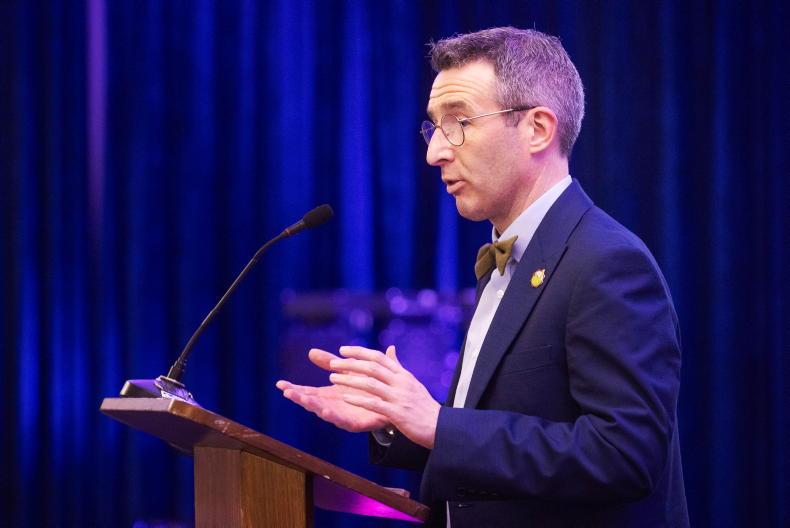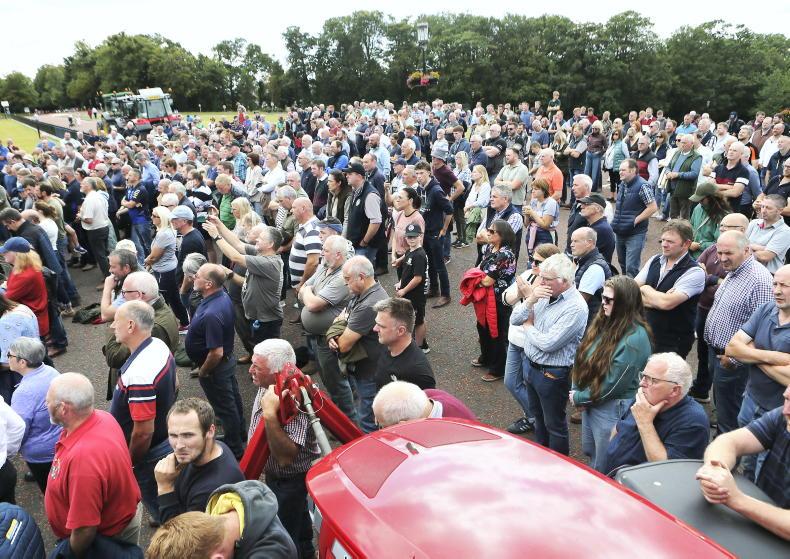
An 89-page review of the controversial cull of 51 cattle on a farm outside Fivemiletown has been completed by Dr Martin Blake.
Since his appointment in early August, the former Irish chief vet has examined more than 300 individual records and submissions, had discussions with over 50 individuals and been given “full access” to all relevant documentation held by DAERA. He also met politicians and farm lobby organisations as part of his information gathering.
His final report makes 10 recommendations, all of which have been accepted by DAERA and which are designed to ensure a legally robust operational framework is in place for the future.
Perhaps most notably, Dr Blake is clear that the decision to cull cattle in the field by shooting was appropriate, but he also identifies where mistakes were made and how a “well-intentioned” decision complicated the overall operation. His report is critical of how DAERA seemed unprepared for the resultant media attention, although he also describes as “unacceptable” the naming and intimidation of some DAERA staff involved in the cull. These people were operating “lawfully and under established procedures”, notes the review.
There are only a small number of redactions (blanked out words) in his report, mainly to protect the identity of some individuals.
Cull background
The herd keeper involved in the case had been convicted of multiple animal welfare offences and given a lifetime disqualification by the court, with a deprivation order put in place. As a result, DAERA was under “a strict legal obligation to execute the judicial order without undue delay,” notes the Blake review.
However, the herd presented “a complex enforcement challenge”, with DAERA unsure of the exact number or type of cattle on the farm. Approximately 40% of animals recorded in the herd had unresolved identification restrictions, limiting entry into the human food chain.
Seizing the cattle and retaining them under the ownership of DAERA was not a realistic option. An issue raised a number of times in the review was an historic case between 2012 and 2015, when DAERA had seized around 100 cattle from a farm on welfare grounds.
The cattle ended up in the possession of the department for an extended period and with very limited market outlets available, the costs incurred far outweighed the money eventually recouped. The review points out that the department received “significant criticism” at the time for not protecting the public purse. The option of seizing to immediately cull, limits any financial exposure.
There were also various practical reasons why the herd wasn’t rounded up and taken away. The Blake review notes that many of the adult cattle were horned and many adult males were uncastrated, with the herd “generally nervous and unaccustomed to management by strangers”.
Recent TB testing had been “problematic” and across the four land parcels (in three locations) where cattle were kept, only one had “structurally robust” handling facilities. In addition, fencing was “weak” and the terrain was “expansive and exceptionally challenging”.
In the circumstances, gathering the cattle into a yard and subsequent transport would have caused significant distress for the animals.
“From an animal welfare and veterinary science standpoint, the choice of in-situ culling of livestock at pasture using free bullets was an appropriate method,” states the Blake review.
However, his report also acknowledges that what happened during the actual cull caused a lot of public distress and the department did not sufficiently anticipate and plan for the full impact of a large-scale open-field cull in mid-summer.
The three-week period pre-cull
The deprivation order from the court was issued on 8 June 2026 and the disposal operation was deferred for three weeks to give the herd keeper an opportunity to sell some or all of his stock.
According to the Blake review, that was DAERA’s “preferred method” of deprivation and there was “much evidence of engagement” between a DAERA official and the herd keeper over this three-week period.
Only six animals were sold, although on the morning of the cull on 29 June, there were 15 cattle in a shed, with the herd keeper in his local department office sorting movement documents.
It was agreed these 15 animals would be excluded from the cull, although one had escaped from the shed by the time the cattle were being loaded by the buyer.
The Blake review sets out a chronology of events relating to the cull, based on interviews, records kept by some DAERA officials and evidence from members of the public present on 29 and 30 June.
On the morning of 29 June, 13 officers from DAERA, including from its Humane Slaughter Team (HST) went to the three different sites where the cattle were located and after a conversation with the herd keeper, culling operations started at approximately 11.25am.
At site one, cattle were culled in accordance with procedures. By 1pm the HST reported that there may be up to four remaining animals on the holding, but not currently in view.
At site two, the HRT reported it was cleared by 1pm, with 14 animals culled. At site three, there were two land parcels (named 3.1 and 3.2). A neighbouring farmer was cutting silage close to site 3.1, so 3.2 was cleared first, with eight animals successfully culled by 12.15pm.
Officials returned to site 3.1 and by 1pm, eleven animals were culled, with “five or six” remaining alive. At approximately 12.30pm a neighbour arrived at the entrance to site 1 and said he wanted to purchase the remaining animals. After some phone calls, it was agreed to suspend the cull to accommodate the prospective buyer – he was told all remaining cattle would have to be gathered and removed by the evening of the 29 June.
During the afternoon, DAERA officials searched site 1 for the unaccounted-for animals, and during this period, a group of three were found and subsequently culled (despite the operation being “suspended”). By late afternoon, a number of staff were stood down and the remainder relocated to site 3.1 to monitor the private gathering of the remaining live cattle.
Five cattle were enticed towards a loading point using a feed bucket, but broke away. A number of further attempts were made to corral the cattle, however, during a final attempt, they escaped onto a public road.
By this stage between nine and 12 members of the public had gathered on the road and as well as seeing dead cattle in fields, the impression being given was that DAERA staff were actively chasing the remaining live animals.
“While this impression was mistaken, it is nonetheless understandable,” notes the Blake review.
At a junction in the road, a cow and three calves went one way and a bull the other. Two neighbours on the scene wanted to direct the cow and calves onto their property to spare them from being shot, but this was not facilitated by DAERA. After getting the cow and calves back into a field, a member of the HRT culled the cow and one calf – the other two calves could not be located as the light was fading.
The bull ended up a “significant distance” away in a dense area of forestry owned by another farmer and it was successfully culled around 9pm.
By the close of operations on 29 June there were three animals not accounted for – one on site one and two at site three. One of the calves at site three was found the next day and culled.
Collection
A fallen animal contractor arrived at approximately 1pm on 30 June to collect fallen stock, with 51 animals lifted. However, because of the location and terrain, the trucks were parked on the side of the road in full view of the public. The contractor finished operations at around 7.30pm.
On 3 July, the herd keeper found a calf at site 3.1 and it was transferred to another herd, while the following day a second calf was found, which had a wound on its neck. It was moved to the same herd on 6 July. A third calf was found on 7 July and its movement was also facilitated by DAERA.
Of the animals culled, most were killed instantaneously by a single shot, with a second shot administered “in a small number of cases”. However, the Blake review notes that records were not kept of these secondary actions. Also, while most tag numbers of shot cattle were recorded at the time, this didn’t happen in all cases.
In his conclusions, Dr Blake said the cattle were “killed humanely” although he accepted that doing it in public view is “fundamentally unpalatable”.
He added that DAERA had “under-appreciated” the impact on the public of animal carcasses left in a field and this was exacerbated by the sight of animals being chased around for a sustained period. This decision to allow a private sale mid-cull was made “with the best of intentions” but it was already a “complex multi-site enforcement operation” and it was a situation that had not been planned for.
He also said that the review was unable to ascertain why three additional animals were culled at site one when the cull had been suspended, although it might have been due to a miscommunication or “a tactical decision by the field team that was not documented”.