



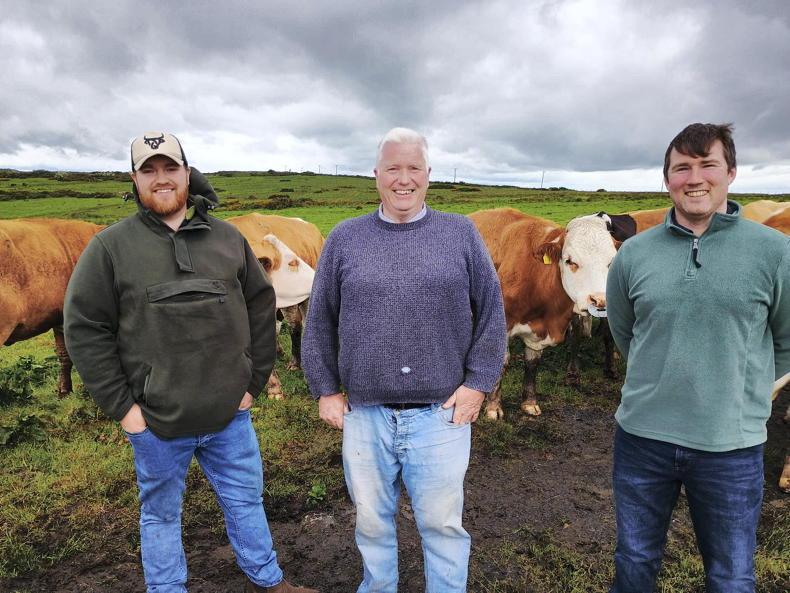
Taking on some expert advice has helped to ensure a suckler herd in the Belfast Hills has turned around cow fertility on the farm.
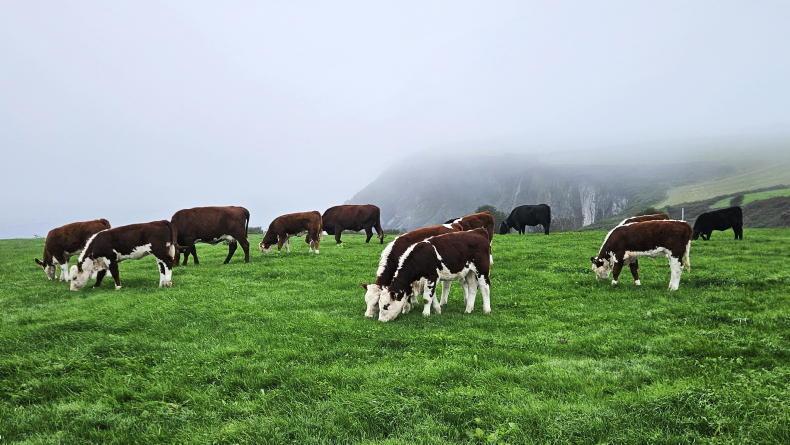
Father and son, Eugene and Martin Cunningham currently run 75 mainly Simmental-bred cows on around 240 acres of owned and conacre land close to Divis Mountain.
The aim on the farm has traditionally been to sell high-quality store cattle about one year old and weighing around 400kg, with cows calved between Christmas and St Patrick’s Day, and as many as possible back in calf before turnout at the end of April.
Achieving quite a tight turnaround is reliant on a lot of different variables falling into place, so slippage can easily happen.
“It got to a point where calving was dragging out to July in the worst cases. We had six bulls on the farm at one stage to try to tighten the calving season,” recalls Martin Cunningham.
In recent years the Cunninghams have been working with Patrick Finnegan from FarmVet Services, after the Clogher-based vet established a nearby base in Templepatrick.
Effectively, all breeding work has been passed over to Patrick and that has led to a transformation in fertility – the average calving interval for cows calving this year is 339 days.
That figure is slightly misleading, given the work done to pull late calving cows back into line. With the calving pattern now tightened up, the aim is to settle around the 365-day mark going forward.
Pre-breeding
Patrick is a strong advocate of pre-breeding scanning of all cows who are calved at least 21 days.
When checking cows, he said you “get a variety of things”, with some already cycling normally and ready for inseminating at the next heat. Others have no corpus luteum (which forms after ovulation) so hormone treatment might be required.
“Then there are those with cysts – they are treated accordingly – and those that are dirty which need to be washed out,” he said.
In the first year doing fertility work on the Cunningham farm, between one quarter and one third of cows needed washing out and Patrick believes this is also partly influenced by nutrition.
“These cows were under-conditioned so we needed to change the nutrition – this year there are fewer cows needing treatment,” he added.
AI
There has also been a significant switch to using AI when breeding indoors and when the Cunninghams first started working with Patrick all three stock bulls on the farm were lame.
Most cows get one or two straws before turnout and only the last 10 cows to calve this season were not AI’d.
A teaser bull is used to help identify heats and the Cunninghams have a reliable technician who does their insemination work – cows in standing heat in the morning are AI’d that evening and vice versa.
All inseminations and other breeding data are recorded on a HerdWatch app.
The bulls used are from Elite Pedigree Genetics and include the Limousin sire, Ballinloan Jaegerbomb as well as Aughalion Prince.
There are some fantastic Jaegerbomb calves on the farm, although at £70 per straw, it is important to have the cow in good order.
However, poor fertility isn’t just about the cost of the straw, but the extra feed and the lost weight gain in subsequent calves.
“I would argue everyone should be doing pre-breeding checks – it does come down to economics. Your cow could have a problem and if you don’t check, you don’t know. Late calvers cost money,” said Patrick.
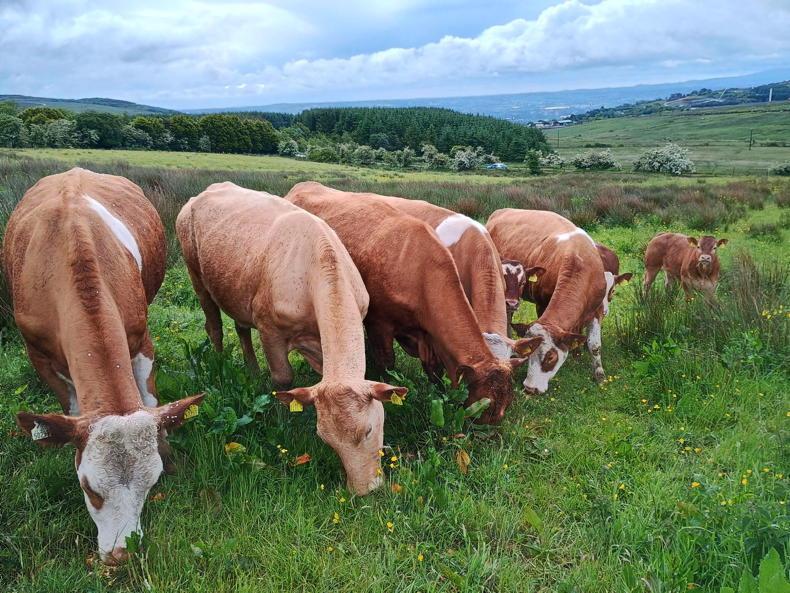
Pregnancy checks at three months
Many suckler farmers will routinely check pregnancy status at the end of the breeding period and while it is worthwhile, Patrick argues that there is actually little action that can be taken on the back of the results, other than to cull empty cows.
“When you are pre-breeding scanning you can make a difference. Checking for pregnancies, there is really nothing much you can do at that stage,” he said.
When pregnancy scanning, his advice is to do it three months after the start of breeding – most cows carrying twins will be picked up at that stage.
There were six sets of twins born on the Cunningham farm this year.
Nutrition and mineral status
The Cunninghams have recently bought their own silage equipment and aim to make higher quality silage going forward.
In the meantime, they have had to rely on higher concentrate feeding this past winter to help ensure cows got back in calf.
The area is also deficient in key minerals, with calves treated with a Multimin injection at turnout and again at housing.
Dry cows get pre-calving minerals and all cattle on the farm are given iodine – last year, a pour-on was used, but the Cunninghams have now switched to an injectable product.
Simmental base to the herd
The cows on the Cunningham farm are mainly Simmental-bred, with bulling heifers normally bought in from specialist sales in the Republic of Ireland.
There was a slight change in that policy over the past year, with 11 of the 16 replacements being already in-calf.
However, with AI now being used on the farm, there is the option of retaining some heifers for breeding, although that does add another group of animals which would potentially complicate the system.
There are two stock bulls on the farm, with a Simmental tending to get “the pick of the cows” and the Limousin used on heifers and to sweep up after AI. Both bulls cost around the £7,000 mark a couple of years ago.
Some Belgian Blue semen has also been used on the farm, although the Cunninghams are unsure whether the breed is well-suited to the hill environment.
“The Belgian Blue calves are not as robust. The young calf doesn’t follow the cow as well as a Limousin,” said Eugene.
All calves are creep fed at grass and for the first time, a group of 15 bulls were retained for finishing this year. There are just three left for slaughter, with the first group averaging around 400kg and mostly E and U grades.
Despite having two top quality sires on the farm, the bulls out of AI are still half a grade better at slaughter, confirmed Martin Cunningham. He is keen to continue with bull beef, although switching to young bulls did impact cash flow in the first year.
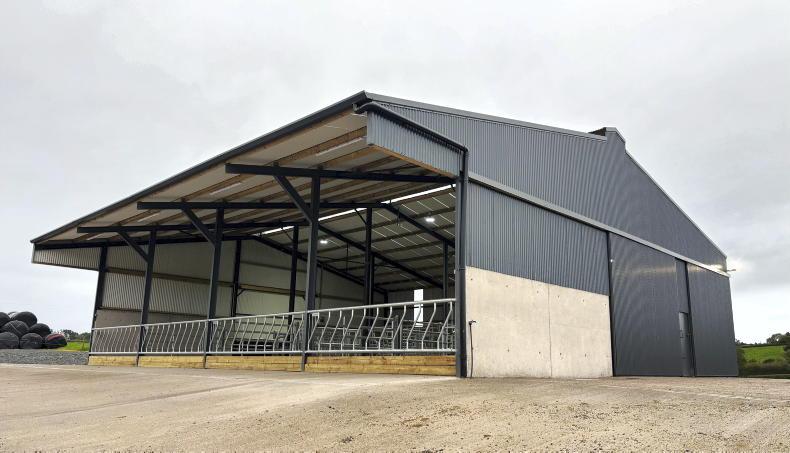
With the system bedded in and a recent investment made in housing on the farm, he hopes to get to 100 to 120 cows in the next couple of years.
Farm facts



SHARING OPTIONS