The agri food sector in Ireland suffers from a chronic misrepresentation of its economic and environmental contribution across two sets of national accounting systems:
Under the GDP-based national accounts system, agri food accounts for about 5% of Irish economy output while supporting 350,000 or 16% of the employment in the country.Under the national carbon emissions accounting calculations, agri food counts for 19m tonnes of CO2 equivalent, or around 30% of total national emissions. However, the carbon sequestration capability from our almost 4.1m hectares of grassland of over 30m tonnes CO2 equivalent, is not included in our national greenhouse gas measurement process.Furthermore, Irish agriculture, while accounting for only 3% of EU emissions, is in the climate spotlight because historically Ireland did not have a major coal, steel or manufacturing sector to close down to accrue carbon credits like every other western European country.Despite having the lowest carbon emitting dairy sector in the northern hemisphere, Ireland has the only dairy sector that has specific pressure to reduce emissions
In my last piece, I highlighted how the growth in the dairy sector following the removal of quotas in 2015, spending of an additional €2bn annually, represented dairy's most important sectoral contribution to the Irish economy.
Clearly companies based in Ireland, Apple, Google, Microsoft, etc. have seen their own businesses grow by a greater amount, but the footprint of these companies in Ireland is about 10% of their gross growth.
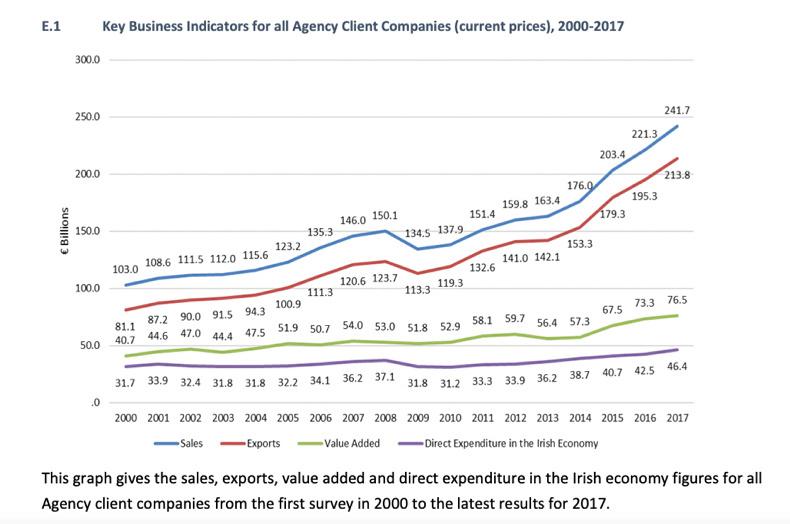
According to the Department of Business, Enterprise and Innovation's Irish Economy Expenditure Survey, while GDP increased by in excess of €100bn between the low point of 2008 and the latest figures in 2018 (blue line), Irish economy expenditure by the foreign direct investment sector had only increased by €7bn, from a low of €14bn in 2008 to €21 bn in 2018.
On the climate change/environmental side, Ireland's grass-based beef and dairy sectors are being miscast under a non-scientific accounting system as emitting approximately 16m tonnes of carbon annually (80% of agri emissions) while the balancing, scientifically-correct 30m tonnes of CO2 the land sequesters is being ignored or not captured by the chosen accounting system.
Misrepresentation
This misrepresentation of Irish agriculture means that despite having the lowest carbon emitting dairy sector in the northern hemisphere, Ireland has the only dairy sector that has specific pressure to reduce emissions.
Moreover, while government can rightly point to its embracing of the Teagasc MACC curve as a science-based arbiter of emissions management, the huge damage done to the reputation of the beef and dairy sector by the misreporting of IPPC climate change reports has undermined demand, as seen in the beef price row of last year, while, at the same time, creating the perverse impression that government is indulging Irish agriculture because of parish pump politics.
Dairy diversification
Current planning appeals delaying much needed investment in dairy processing plants by Dairygold, Carbery and others as part of a crucial market diversification response to Brexit-based loss of UK markets are all being framed on the basis that the plants represent facilitation of increased emissions.
Very clearly the negative reputational impact of the misrepresentation of Ireland's grass-based production system is manifested in an opposition to dairy growth.
Ireland's dairy export value exceeded over €5bn in 2019, up over €2.5bn on 2009 levels, according to the CSO. Very clearly there is increased global demand for our products.
The Green Party being part of a new government, insisting on definitive reductions in Irish emissions of a minimum of 7% per annum is to be welcomed
Rebooting the economy
The task to re-emerge from COVID-19 lockdown and reboot the Irish economy in the short- to medium-term presents both a challenge and opportunity.
Indeed the possibility of the Green Party being part of a new government, insisting on definitive reductions in Irish emissions of a minimum of 7% per annum, is to be welcomed, providing that real science and real economics informs the implementation process.
Using current approaches, both economic and environmental, will deliver weaker climate change outcomes while undermining the unique rural and national economic contribution that the sector offers.
Science and economics
Using science and economics rather than accounting will involve a number of core facts outlined below:
Sequestration from Irish grassland, though not yet properly measured, is higher than emissions from our grass-based system.Ireland has chosen a burden-sharing accounting system that favours increased forestry planting and rewetting of peatlands, rather than embracing a grass sequestration rebalancing system which has been adopted by France and Germany among others.Closing down/restricting Ireland's grass-based beef and dairy production capability when global demand for beef and dairy products is increasing means leaking production to higher emitting countries like Brazil and the US and therefore increasing global emissions.The agri food sector is the largest single contributor to the Irish economy in real expenditure terms (CSO, DEBE).Foreign direct investment does not come to rural Ireland.In the absence of a thriving dairy and beef sector, which account for 80% of current Irish agri output, rural Ireland will implode with more and more people moving to the east coast/Dublin area.Dublin does not have the transport or housing capability to handle the current population (ESRI 2018).The enforced lockdown period has created a huge and very real economic challenge for the Irish economy while also reframing a sense of economic and social priorities.
Rebooting the Irish economy based on factual economic and scientific insights rather than rehashing superficial accounting-based misrepresentations of reality, is the only sure way of properly meeting the new challenge in a balanced sustainable fashion.
The agri food sector in Ireland suffers from a chronic misrepresentation of its economic and environmental contribution across two sets of national accounting systems:
Under the GDP-based national accounts system, agri food accounts for about 5% of Irish economy output while supporting 350,000 or 16% of the employment in the country.Under the national carbon emissions accounting calculations, agri food counts for 19m tonnes of CO2 equivalent, or around 30% of total national emissions. However, the carbon sequestration capability from our almost 4.1m hectares of grassland of over 30m tonnes CO2 equivalent, is not included in our national greenhouse gas measurement process.Furthermore, Irish agriculture, while accounting for only 3% of EU emissions, is in the climate spotlight because historically Ireland did not have a major coal, steel or manufacturing sector to close down to accrue carbon credits like every other western European country.Despite having the lowest carbon emitting dairy sector in the northern hemisphere, Ireland has the only dairy sector that has specific pressure to reduce emissions
In my last piece, I highlighted how the growth in the dairy sector following the removal of quotas in 2015, spending of an additional €2bn annually, represented dairy's most important sectoral contribution to the Irish economy.
Clearly companies based in Ireland, Apple, Google, Microsoft, etc. have seen their own businesses grow by a greater amount, but the footprint of these companies in Ireland is about 10% of their gross growth.
According to the Department of Business, Enterprise and Innovation's Irish Economy Expenditure Survey, while GDP increased by in excess of €100bn between the low point of 2008 and the latest figures in 2018 (blue line), Irish economy expenditure by the foreign direct investment sector had only increased by €7bn, from a low of €14bn in 2008 to €21 bn in 2018.
On the climate change/environmental side, Ireland's grass-based beef and dairy sectors are being miscast under a non-scientific accounting system as emitting approximately 16m tonnes of carbon annually (80% of agri emissions) while the balancing, scientifically-correct 30m tonnes of CO2 the land sequesters is being ignored or not captured by the chosen accounting system.
Misrepresentation
This misrepresentation of Irish agriculture means that despite having the lowest carbon emitting dairy sector in the northern hemisphere, Ireland has the only dairy sector that has specific pressure to reduce emissions.
Moreover, while government can rightly point to its embracing of the Teagasc MACC curve as a science-based arbiter of emissions management, the huge damage done to the reputation of the beef and dairy sector by the misreporting of IPPC climate change reports has undermined demand, as seen in the beef price row of last year, while, at the same time, creating the perverse impression that government is indulging Irish agriculture because of parish pump politics.
Dairy diversification
Current planning appeals delaying much needed investment in dairy processing plants by Dairygold, Carbery and others as part of a crucial market diversification response to Brexit-based loss of UK markets are all being framed on the basis that the plants represent facilitation of increased emissions.
Very clearly the negative reputational impact of the misrepresentation of Ireland's grass-based production system is manifested in an opposition to dairy growth.
Ireland's dairy export value exceeded over €5bn in 2019, up over €2.5bn on 2009 levels, according to the CSO. Very clearly there is increased global demand for our products.
The Green Party being part of a new government, insisting on definitive reductions in Irish emissions of a minimum of 7% per annum is to be welcomed
Rebooting the economy
The task to re-emerge from COVID-19 lockdown and reboot the Irish economy in the short- to medium-term presents both a challenge and opportunity.
Indeed the possibility of the Green Party being part of a new government, insisting on definitive reductions in Irish emissions of a minimum of 7% per annum, is to be welcomed, providing that real science and real economics informs the implementation process.
Using current approaches, both economic and environmental, will deliver weaker climate change outcomes while undermining the unique rural and national economic contribution that the sector offers.
Science and economics
Using science and economics rather than accounting will involve a number of core facts outlined below:
Sequestration from Irish grassland, though not yet properly measured, is higher than emissions from our grass-based system.Ireland has chosen a burden-sharing accounting system that favours increased forestry planting and rewetting of peatlands, rather than embracing a grass sequestration rebalancing system which has been adopted by France and Germany among others.Closing down/restricting Ireland's grass-based beef and dairy production capability when global demand for beef and dairy products is increasing means leaking production to higher emitting countries like Brazil and the US and therefore increasing global emissions.The agri food sector is the largest single contributor to the Irish economy in real expenditure terms (CSO, DEBE).Foreign direct investment does not come to rural Ireland.In the absence of a thriving dairy and beef sector, which account for 80% of current Irish agri output, rural Ireland will implode with more and more people moving to the east coast/Dublin area.Dublin does not have the transport or housing capability to handle the current population (ESRI 2018).The enforced lockdown period has created a huge and very real economic challenge for the Irish economy while also reframing a sense of economic and social priorities.
Rebooting the Irish economy based on factual economic and scientific insights rather than rehashing superficial accounting-based misrepresentations of reality, is the only sure way of properly meeting the new challenge in a balanced sustainable fashion.





SHARING OPTIONS