


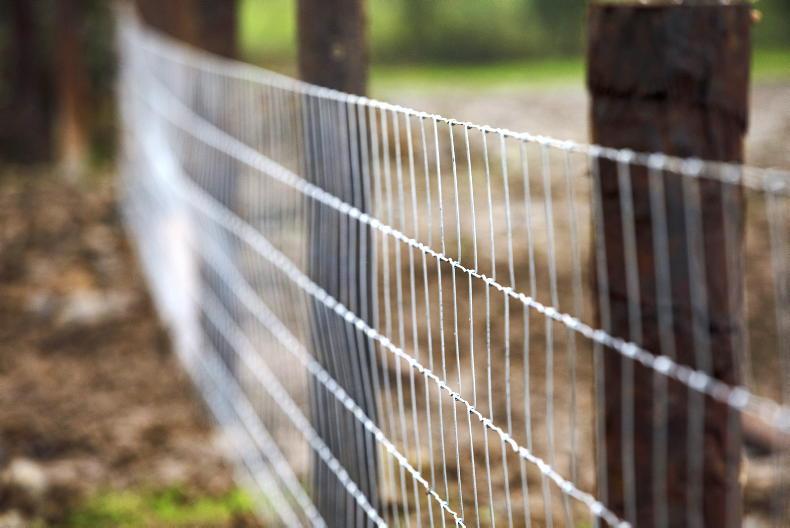
The banning of creosote as a preservative of timber fencing for agricultural and domestic use in April 2023 was regarded by many has a step backwards in creating long-life fencing.
Creosote was long seen as the gold standard in preservation of fencing for damp Irish conditions, with reasonable pricing associated with the long-life posts. While increases during inflation did impact timber prices, the overall affect on post costs was acceptable.
However, since then, the costs of alternatives to creosote posts that have received Department approval have exceeded considerably in many, but not all, cases. While there are cheaper alternatives in place that satisfy the minimum Department specifications, those that carry the longest guarantee and expected working life, far exceed the reference costs given.
Sheep fencing specifications
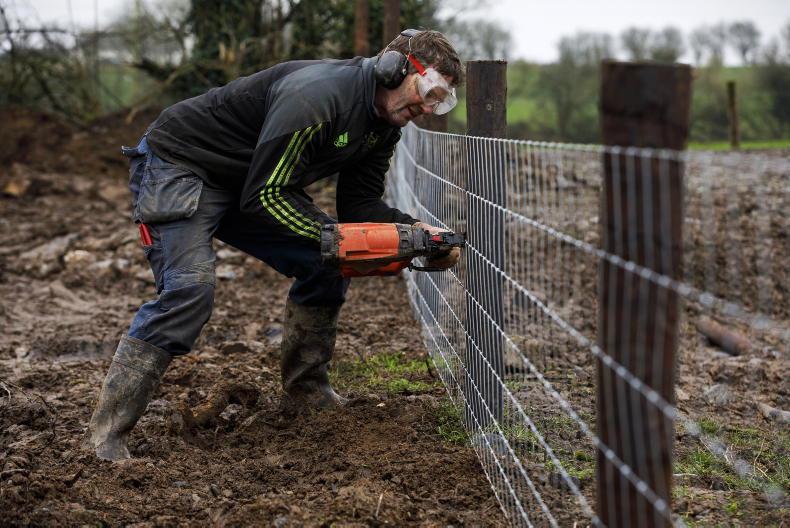
Strainer posts must be at least 2.1m (7ft) long with a minimum diameter of 175mm (7in) and driven at least 900mm (3ft) into the ground.
It is required to erect a strainer “at the beginning and end of every length of fencing, at gaps or openings, at every change of direction where the angle is greater than 30o and to accommodate any significant change in gradient”.
Intermediate posts are required to be at least 1,800mm (6ft) long and a minimum of 100mm (4in) diameter and shall be driven at least 600mm (2ft) into the ground. Intermediate posts shall be spaced at no more than 5m intervals.
For the use of sheep wire combined with one line of barbed wire, the fence shall have a minimum height of 1,000mm, with the barbed wire set above the sheep mesh. The lowest line of the sheep mesh shall be between 50mm and 100mm above ground level.
Creosote was long seen as the gold standard in preservation of fencing for damp Irish conditions, with reasonable pricing associated with the long-life posts
Some farmers question if there is separate specification for mountain versus lowland fencing. There is actually no difference in the specifications of mountain and lowland sheep fencing; the increased payment given towards mountain sheep fencing (€8.81/linear m versus €6.75/m) is due to the increased labour associated with working on the difficult terrain.
Pricing
Taking this specification in to consideration, we can take a price on TAMS spec sheep fencing.
After researching prices of TAMS spec (meeting NSAI requirements) we found 6ft (1,800mm) x 4in (100mm) posts for sale from merchants from as low as €6.80/post + VAT, right up to €14.70/post + VAT; over double the price. Straining posts are a similar tale; we received quotes of €21.30/post, right up to €33.74+ VAT.
Grant-eligible high tensile sheep wire came to between €150 and €189.92+ VAT for 100m rolls, with 200m rolls of barbed wire priced at €52.84+ VAT.
High tensile electric wire clocks in at €60.92 per roll (sold on weight not length). For added measure, a 200-pack of staples will set you back €16+ VAT.
Case study one: cheap and cheerful
It’s a bit tongue-in-cheek to say ‘’cheap and cheerful’’, but we will use the lower price on all items as an example.
Our sample distance is 500m. This will require six straining posts, placing one every 100m from start to end, and using a spacing of one intermediate post every 4m (1m less than minimum) will require 120 posts.
Five rolls of sheep wire, two and a half rolls of barbed wire and one roll of high tensile electric wire will all be required.
Case study two: no expense spared
If we go the other end of the scale price wise, costs increase dramatically. While the cheaper options all qualified under NSAI and Department standards, it is worth noting that they did this but no more. NSAI standards require a guarantee of 15 years working life, which the cheaper option gave, but the more expensive option listed gave a guarantee of 25 years with a life expectancy of 35-40 years.
Difference versus reference costs
The difference between both the cheapest and dearest is staggering; €1,217.63 for the 500m run, or €243.52/100mm.
The majority of this price increase is attributed to the cost of the more expensive intermediate posts, with a differential of €948 between cheap and expensive.
Reference costs for lowland sheep fencing come to €6.80/m + VAT. For the 500m run of fencing above, our reference cost would be €3,400 + VAT.
This appears to amply cover both the expensive and cheaper options, but we have omitted labour costs with both.
Taking a labour cost of €2/m, we can add an additional €1,000 onto each of the case studies. While the reference cost will still cover cheaper options, it will fall far short of covering the higher end products to the tune of €784.46, or roughly 23%.
It is also worth noting that we have been on the lighter side regarding straining posts every 100m.
While this will work fine where we have flat land with straight lines, jagged ditches or sharp rises and falls will put increased pressure on wire and will require additional posts.
We could easily add another five straining posts to the list, which will add an additional €202.44 to our bill. At this type of differential, farmers are at a loss to the tune of €400.



SHARING OPTIONS