



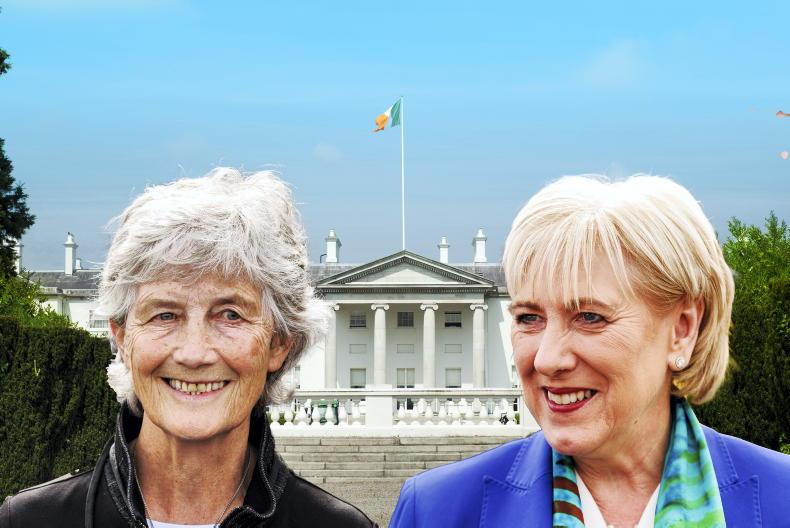
With six days to go to polling day in the presidential election, Catherine Connolly has a healthy lead over Heather Humphreys in the opinion polls.
However, previous experience has told us that there is still time for an 'October surprise'.
In 1990 and again in 2011, the presidential election was turned upside down in the final days.
So the next few days - in particular Tuesday night's televised debate on RTE - mean there is still the opportunity for a momentum shift.
The challenge for Heather Humphreys is clear. Her support levels in a succession of opinion polls have closely tracked her party's level of support among the voting public.
And Fine Gael votes alone will not see her become that party's first nominee to gain the presidency.
Humphreys needs to convince Fianna Fáil supporters to turn out and support her next Friday.
Former rivals now political partners
Having been in Government together - either formally in coalition or in the confidence and supply agreement from 2016 to 2020 - for over a decade, Fianna Fáil and Fine Gael are now transfer friendly to each other.
The two great political rivals of Irish politics for most of the life of the State are now quite aligned ideologically - and they're aligned strategically.
Jim Gavin and Heather Humphreys needed each other to poll credibly and then to transfer strongly, to guarantee that one of them would get the presidency.
With Jim Gavin's withdrawal, Heather Humphreys faces an uphill battle to become the next president of Ireland in what is a straight shoot-out with Catherine Connolly.
Connolly has been endorsed by Sinn Féin, the Green Party and the Social Democrats, having gained the Labour Party.
That endorsement from a pan-left coalition is not without consequence. We've seen Brian Leddin become the most high-profile defection from the Green Party, but not the only one.
A member of the soft-left, he felt his party's endorsement of Connolly represented an unacceptable manifestation of the Green Party's journey from one focused on the politics of the environment to a broader leftist political platform.
Nominee
Meanwhile, within Labour, the party Connoly was a member of for many years, people such as Alan Kelly are also supporting Humphreys rather than their own nominee.
Kelly is a former leader and, crucially, a current TD. That suggests internal issues are about to come to a head within Labour soon.
Former Labour TDs such as Brendan Howlin (another former leader) and Willie Penrose have been seen out and about with Heather Humphreys.
One big question that will decide the outcome when votes are counted next Saturday is whether these defections from Connolly's support base will fracture the vote among people who tend to vote Labour or Green.
But the big question is whether Humphreys can convince enough Fianna Fáil voters to support her.
Micheal Martin's announcement that he would vote for her is hardly surprising - they are recent cabinet colleagues.
But Bertie Ahern coming out in favour of Humphreys is interesting and perhaps significant.
Changed alliances
Times have changed in regard to how transfers trend in Irish politics. In 1990, Mary Robinson trailed Brian Lenihan by over 82,000 votes after the first count.
When Fine Gael's Austin Currie was eliminated, Robinson received 205,000 of his transfers, while Lenihan only picked up 37,000.
In percentage terms, the Labour nominee gained almost 77% of the Fine Gael candidate's transfers, while the Fianna Fáil candidate gained less than 14%.
Back then, of course, a Fine Gael/Labour coalition was effectively the only alternative government to Fianna Fáil.
While Fianna Fáil hadn't had an overall majority since 1977, they had governed twice with the support of independents and from 1987 to 1989 in a confidence and supply-type arrangement with Fine Gael, known as the 'Tallaght Strategy' in honour of the location of a speech by Fine Gael leader Alan Dukes outlining his willingness to support a government from the opposition benches as long as the government adopted prudent economic policies.
That 1990 election made Robinson the first woman president, but also the first left-of-centre president in the country's history.
Step-change
It was a step-change in Irish politics, a seismic result that gained headlines worldwide.
And the disastrous remarks by Padraig Flynn on the Saturday before polling - referring to Mary Robinson's "new-found interest in her family" - compounded the problems Brian Lenihan faced over remarks made years earlier on tape to an academic researcher.
Lenihan was accused of having intervened in asking then-president Patrick Hillery not to dissolve the Dáil when the government fell in 1982.
Lenihan was sacked as a minister during the campaign in a spectacular fall from grace for a man who was - and always remained - warmly regarded by politicians of every hue and affiliation and among the general public.
In 2011, Michael D Higgins was in a tight contest going into the final days. By the last debate, clear front-runner Sean Gallaher faced accusations from Sinn Féin nominee Martin McGuinness.
It turned the election on its head and Michael D became our president, comfortably gaining a second term in 2018.
Front-runner scrutiny
As the candidate leading in opinion polls, Catherine Connolly is facing fair scrutiny in terms of her past political positions.
And Heather Humphreys is placing significant emphasis on her stance on issues that could be categorised as rural.
She has depicted her opponent as anti-live export of livestock, highlighting Connolly's call in the Dáil for the suspension of live exports to Libya in 2020.
It has the distinction of being one of the handful of questions Dara Calleary responded to in his brief tenure as minister for agriculture.
The Humphreys campaign have also highlighted Connolly's position on hunting, in particular foxhunting, and her previous statements opposed to greyhound racing.
If Heather is to break the Fine Gael presidential election famine, she needs these issues to become central to the debate in the final week.
And whether she does or not, Billy Kelleher and Bertie Ahern will be asking questions within Fianna Fáil.
Labour will need an internal inquest. The rifts in the Green Party have again been exposed.
In addition to all this, Sinn Féin, riding high at 27% in the latest opinion poll examining party support, must be wondering why it didn't put someone forward.
This election will leave more questions than answers, whatever the outcome.
Get out and vote next Friday, It is your privilege as a citizen of a free country and your civic responsibility.



SHARING OPTIONS