



Food security begins on the farm. If we fail to secure the next generation of farmers, we fail to secure Ireland’s ability to feed itself.
That is not alarmism. It is the reality facing every country in Europe. The last decade has shown just how fragile the global trading system can be. Brexit, the COVID-19 pandemic, the war in Ukraine and, most recently, the collapse of peace talks between the United States and Iran, have all demonstrated how quickly international supply chains can come under pressure. In an increasingly uncertain world, the ability to produce our own food is no longer simply an agricultural issue. It is a strategic national priority.
While EU food supply chains have proved resilient, especially within the Single Market, the disruption has had an impact. We saw a sharp rise in grain prices following Russia’s illegal invasion of Ukraine, and, more recently, the closure of the Strait of Hormuz to private shipping companies has caused fuel prices to jump.
For both Ireland and the EU, the recent instability has laid bare the importance of maintaining our own food supply. We need to bolster our farming sector to protect our food security and to shield us from future trade shocks.
There is no doubt that our agricultural sector is vulnerable. A 2025 Department of Agriculture, Food and the Marine report found that the age distribution of farm holders has shifted markedly toward older groups. The median age of a farm holder in Ireland now stands at 60 and the mean age at 59.4, with the number of farm holders aged 65 or above growing by one third in the decade 2013 to 2023. Worryingly, farmers under the age of 35 make up only 4.3% of the farming population in Ireland.
Coupled with the decline in the number of young farmers, is the shrinking of the sector; the CSO recorded 133,174 farms in Ireland in 2023, compared with 139,600 in 2013, a loss of 6,000 in a decade.
Barriers to farming
In Ireland, we are all familiar with the barriers to young people entering farming; lack of access to finance, to machinery, and to land, which is a particular issue for young female farmers. But what some may not know is that most EU member states have a similar story to tell. The average age of a farmer in the bloc is now 57. Figures released last year by Eurostat, the EU’s statistics agency, show that compared with 2015, pig numbers were 8.9% lower in 2025, bovine animals 9.7% lower, sheep 12.2% lower and goats 17.5% lower.
This data leaves me in no doubt that safeguarding of Europe’s agri-food system must be high on the EU’s agenda. This is where Ireland’s presidency of the Council of the EU provides an opportunity.
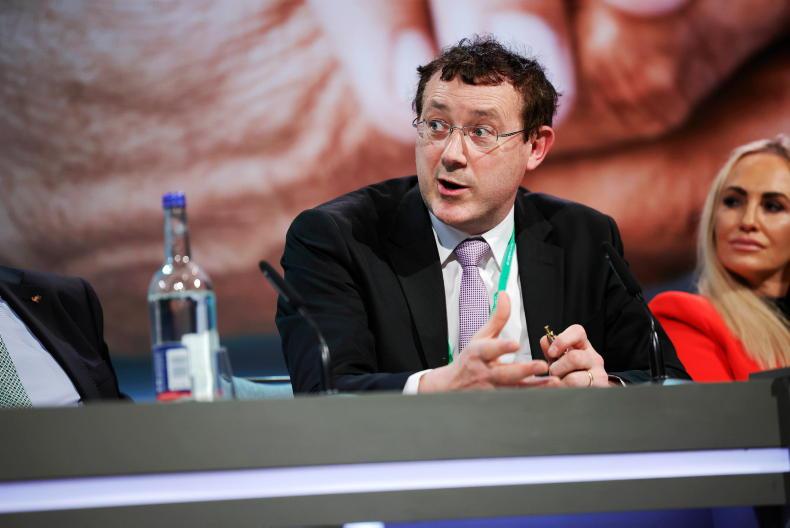
A fortnight ago, as part of the presidency, I had the opportunity to chair an inter-parliamentary conference on agriculture on securing the future of farming, from policy to practice – generational renewal, women in agriculture and food security in Dublin Castle. The conference brought together policymakers from each national parliament of the 27 member states, as well as representations from the European Parliament.
There was broad agreement amongst the participants from right across Europe that the next Common Agricultural Policy (CAP) must have more focus on attracting and retaining a new generation of farmers, both women and men.
In our submission to the Department of Agriculture’s public consultation on CAP post 2027, Fianna Fáil called for funding to be ring-fenced under the CAP to support generational renewal. We proposed the introduction of a minimum allocation of 6% per member state for young farmers, with the possibility for member states to increase that allocation where needed. The conference has reinforced my belief in the need for this. The representatives of the member states were in agreement that failure to act now risks not only the future of EU agriculture but also our long-term food security.
However, previous experience shows us that there is a tendency to pay lip service to an issue rather than make any effort to address it. For example, the current CAP promotes women’s participation in farming. Member states were given “scope to introduce targeted measures including enhanced financial support for women farmers” yet, only two of the 27 member states, Ireland and Spain, implemented women specific supports in their national CAP strategic plans.
Policies mean nothing unless they are implemented. Draw down of CAP funding by any member state should be conditional on that same member state providing support for young farmers, and this must be robustly monitored by the European Commission.
The EU presidency can sometimes feel distant from people’s everyday lives. But the decisions made across Europe have a direct impact on Irish farmers, our rural communities and our food security, and the presidency puts Ireland at the centre of discussions that will shape the future of European policy. It gives us the chance to bring Irish perspectives to the table while working with our European partners on the shared challenges of food security and supporting the next generation of farmers.
Irish farming has a proud history, but if we want family farming to remain at the heart of rural Ireland, we need to start thinking seriously about who will be farming the land in 20- or 30-years’ time. That is why during the presidency, I will continue to re-iterate calls for ringfenced funding under the next CAP for men and women.


SHARING OPTIONS