



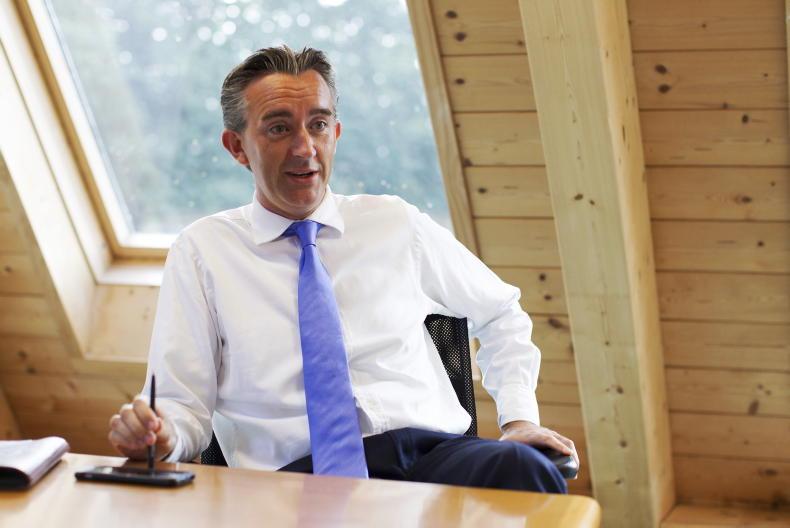
On Friday evening, Sarah McInerney interviewed Simon Coveney on RTE Radio's Drivetime programme.
The current Minister for Enterprise, Trade and Employment was sent out to bat for Fine Gael from their Limerick think-in.
Inevitably, housing was the first focus of the conversation - it's the country's biggest problem.
But later, Coveney was quizzed on the news that had broken from a meeting earlier in the day between the Irish Farmers' Association (IFA) and Fine Gael.
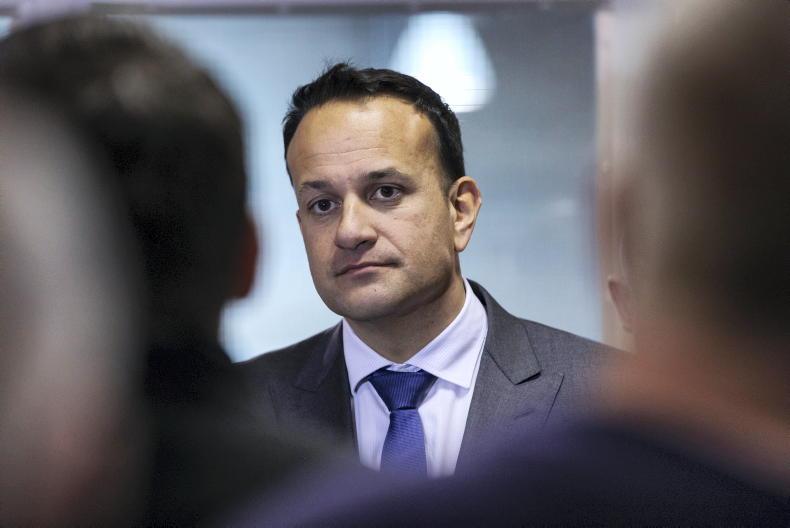
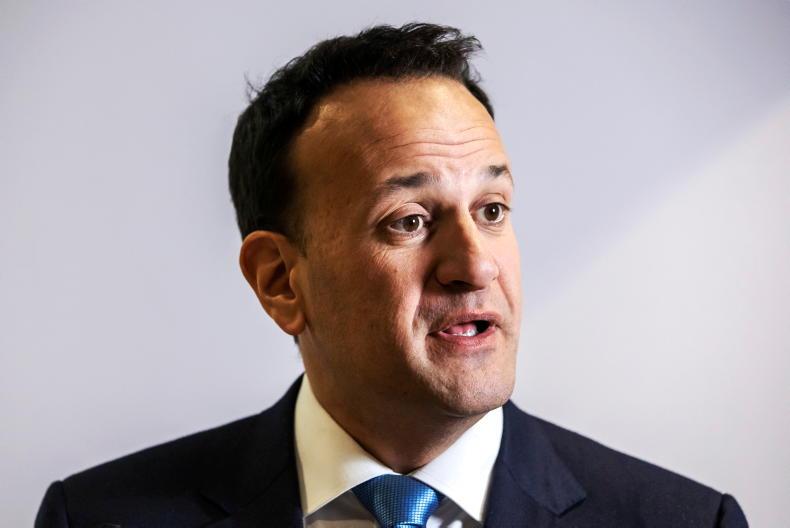
Following a week of IFA protests over the changes to the nitrates derogation, An Taoiseach Leo Varadkar had agreed to invite European Commissioner for the Environment Virginijus Sinkevicius to Ireland.
Harry McGee, the Irish Times political correspondent, broke the story with the headline 'Taoiseach overrules McConalogue and pledges to re-engage with EU Commission over nitrates allowance'.
That is hard to read as anything other than a slight by the Fine Gael Taoiseach to the Fianna Fail Minister for Agriculture.
And it followed hot on the heels of open criticism of the Government's acceptance of the European Commission's position from Fine Gael MEP Colm Markey and Fine Gael Senator Tim Lombard. This is how coalitions fall.
Ennis and Berlin
I've twice watched coalitions fall in front of my eyes. In 1992, I was at the Macra rally in Ennis in 1992 where then-Taoiseach Albert Reynolds was the guest of honour at the Sunday banquet.
There was significant pressure on the coalition Government (which Reynolds had once referred to as a "temporary little arrangement") over proceedings within the Beef Tribunal.
Accounts of previous events by himself and his coalition partner, the Progressive Democrats leader Dessie O'Malley, differed so much as to be irreconcilable.
I don't recall what Albert Reynolds said that evening, but I remember thinking that the Government could not survive much longer. It fell the next week.
Then, in January 2011, I was in Berlin, covering Green Week for the Irish Farmers Journal , but I was keeping a close eye on events at home within the Oireachtas Agricultural Committee.
They were deliberating legislation prepared by environment minister, Green Party leader John Gormley. When chair and Fianna Fáil TD Johnny Brady opened the meeting by saying he could not support the bill, I reckoned I should check if I was on the electoral register as soon as I got home. There was an election within a month.
Reconcilable differences
On Friday morning, as the IFA was meeting with Fine Gael's hierarchy, Charlie McConalogue was addressing the same Oireachtas agriculture committee.
He repeated there what he had told the IFA on Tuesday, that the derogation negotiations had been concluded and would not - could not - be reopened.
He said he would consider supports for affected farmers and that there could be upward movement back to 250kg for "red-map" areas that showed an improvement in water quality in the years ahead.
But there was an inferred contradiction between McConalogue's insistence that the negotiation process had been exhausted and the Taoiseach's decision to invite the commissioner to Ireland.
It looked like the Taoiseach had, indeed, undermined his own Minister; that party politics was potentially damaging Government relations.
Within hours, Harry McGee's story was updated to read 'Nitrates decision will not be revisited despite engagement pledge, McConalogue says'.
Farmers would be entitled to ask what the hell is going on. Perhaps the best indicator that it is, to quote Bertie Ahern, "smoke and mirrors" comes from the Coveney interview.
While skillfully building a bridge between the Taoiseach's statement and the Minister's stance, he also intimates that there is very little prospect of a derogation renegotiation.
This is the entire transcript of that part of the interview; I think it's worth close inspection.
Simon Coveney: “We had a meeting with the IFA leadership this morning, it was a good meeting, it was a constructive meeting. We went through the issues in some detail, the proposed changes to the nitrates derogation in Ireland is (sic) going to impact on thousands of farmers and their businesses. The one clear ask from the farmer leaders that we spoke to this morning was to invite the Commissioner to Ireland to see for himself the Irish family farm model, to see what they are doing to protect water quality, what they’ve already implemented and how it’s working in some parts of the country. I think that was a very reasonable ask from the farm leadership, they will have I hope an opportunity…"
Sarah McInerney interrupts: “Did anyone from Fine Gael speak to Minister Charlie McConalogue before that announcement was made?"
Simon Coveney: “Yes, absolutely. Minister of State Martin Hayden, who works in the Department of Agriculture with Minister McConalogue, rang him and Charlie had no issue at all with an invitation to the Commissioner to come to Ireland. Look, relationships within the Government are important and nothing happened without us first of all contacting Charlie McConalogue, who was just out of an Oireachtas committee meeting actually, and he was perfectly OK with that invitation going to the Commissioner. “
Sarah McInerney: “OK, because at that Oireachtas committee meeting, he said that he was clear on the position that there is no possibility of reopening those discussions with the European Commission on the nitrates derogation reduction. Are you also clear on that position - that you can invite the European Commissioner to Ireland all you want, there’s no possibility of reopening the discussions - that’s what Charlie McConalogue says. Do you agree?"
Simon Coveney: "Well, there’s more than one discussion going on here Sarah, just to be clear. In a couple of years’ time, our current derogation runs out at the end of 2025. We have to make sure that we can maintain a derogation beyond 2025. We may be the only country in Europe at that point that has a derogation - there’s only two right now, Ireland and Denmark, [note - there’s actually four - Denmark, Netherlands, Ireland and some of Belgium), but we have a very different agricultural model to most other European countries, and that’s why we believe the derogation is appropriate here.”
Sarah McInerney, interrupting: "I understand that, but my question is, do you agree with Minister Charlie McConalogue’s position. He is clear, he said, that there is no possibility to reopen and renegotiate the derogation. Do you agree with that statement?"
Simon Coveney: “Well, I hear it. I hear what Minister McConalogue has said, but I do think that the ask from farm leaders to actually meet the key decision maker here and to show him what they are doing in terms of protecting water quality in Ireland is not an unreasonable ask, given the decisions that have been made, and that’s what we’re going to follow up on now.
Sarah McInerney: “OK, so you think there is a possibility?”
Simon Coveney: “No, no, no, no, I’m not the Minister for Agriculture, and I’m not going to pretend to be, but I have been in that ministry for five years and I understand agriculture pretty well. What’s being asked of dairy farmers, about 3,000 or so of them, is a significant ask and I think their ask to meet the key decision maker, ie, the Commissioner for the Environment, to explain what they’ve been doing and to outline the kind of flexibilities that they would like him to consider, I think is not an unreasonable request and we’re going to facilitate it.”
Bill and Ted face the music
Of course, Charlie McConalogue was not alone when he faced the agriculture committee on Friday.
The Minister was flanked by two senior officials at the Department for Agriculture - Bill Callanan and Ted Massey.
You may remember the wonderful Bill & Ted’s Excellent Adventure, featuring a young Keanu Reeves, a film that’s almost 30 years old now.
In it, the intrepid pair of music-obsessed high-school slackers accidentally discover the secret of time travel through their guitars, allowing them complete a history project. They brought a bemused Genghis Khan, Socrates and Napoleon to their school to help them pass their assignment.
I have a feeling that Commissioner Sinkevicius may be just as bemused as he is brought around Irish dairy farms in a few weeks' or months’ time.
There was a sequel - Bill & Ted’s Bogus Journey. As hard as I have tried to avoid extending this analogy, it is just impossible to resist.
A close inspection of what Simon Coveney said reveals that while he paid lip service to the idea of farmers trying to convince the commissioner of flexibilities around the derogation reduction, he knows that the game now is about retaining the derogation in 2026.
That isn’t far away at all - any heifer dairy calf born next spring will be calving down for the first time under the next derogation regime - if there is one.
So, bringing the Commissioner to see the family farm nature of Irish dairying and the outdoor grazing system that predominates is certainly worthwhile. The argument must be that asking farmers to absorb the cut to 220kg is very challenging and that these small businesses must be given time to adjust to that change.
A further cut in 30 months would be a hammer blow, particularly as most dairy farms will probably have to invest in extra slurry storage capacity over that time period.
But insisting that there be substantive negotiations around the derogation changes would make that visit a bogus journey, in my opinion.
After almost a 30-year gap, Keanu Reeves and Alex Harvey reconvened as Bill and Ted to complete the trilogy.
Bill & Ted Face the Music is mainly remarkable for the fact that Keanu Reeves seems immune to the passage of time, but the movie’s title allows me to strain my analogy still further.
Bill Callanan and Ted Massey faced the music alongside their Minister before the Oireachtas committee on Friday - how could our senior officials have presided over a reduction in the derogation? The arguments, most strongly presented by Independent Senator Victor Boyhan, mirrored those of the IFA.
Significant steps
The first is that farmers have already taken significant steps to minimise the impact of their dairy herds on water quality and indeed they have.
These include the adoption of low emissions slurry spreading, with a comprehensive mandatory nutrient management plan in place for the farm at the start of each year.
There is a requirement to include clover in any reseeding and the adaptation to multi-species swards that don’t require bagged nitrogen, lowering the overall N loading on-farm.
A soil liming programme is mandatory, enhancing nutrient efficiency, soil activity and nutrient retention. Derogation participants must undertake and environmental training course and must undertake at least one biodiversity measure from the all-Ireland pollinator plan.
The final argument is that our water quality remains good
Then second is that the complex nature of Irish soils mean that there is a considerable lag-time between actions taken and results delivered.
This means that rising nitrates levels in waterways could be due to the sins of the past and that we need time to see if current measures are sufficient to improve water quality before reducing the limit to 220kg.
The final argument is that our water quality remains good. Only 2% of Irish waterways are in “poor condition”, compared with 29% in the Netherlands.
That would be a compelling argument if 250kg/ha was the baseline for nitrates levels. But it isn’t.
The baseline across Europe is 170kg/ha.
The derogation is a dispensation and reducing the level of that dispensation 19 years into its existence because nitrates levels are rising is an understandable position.
And while water quality in Ireland is good relative to most other European countries, the clear objective of the nitrates directive is to improve water quality. So, the argument, while valid, is not compelling.
Indeed, Charlie McConalogue was clear in the Oireachtas committee hearing that it was a battle to keep the reduction to 220kg, that the Commission wanted to go much lower and that he, Bill, Ted and all the negotiating team had to work extremely hard to get the deal we have.
Too little too late
Tim Lombard took a slightly different angle. He was more critical of the fact that it was July of this year before farmers were made aware that they would face cuts in their stocking rate next year. That’s a valid criticism.
Farmers had completed their breeding programmes and had made decisions and investments based on being stocked at up to 250kg/ha. And on their neighbours being stocked at up to 250kg/ha.
It's too late to unspend that money; farmers needed clear guidance from the very beginning of the year that it was likely they would be at 220kg/ha due to nitrates levels in water in their area not falling.
It‘s later than it should have been, but it should not be now made any later again by any misguided optimism that this cup can pass from the lips of the vast majority of farmers.
Yes, there will be a review of the maps, but the clear impression coming from Friday’s Oireachtas committee was that this review would benefit no more than dozens of farmers, certainly not thousands. And that farmers currently in 'white areas' will remain on 250kg, which is good. But....
The 'but' being that maps will continue to be updated as testing continues, with the clear likelihood that further results will see more areas turn red.
I'll make a confident prediction that more areas will turn red than will change back to white.
The one bit of good news is that where this happens, it will be 2025 before the 220kg limit applies, giving farmers a full year to adjust. As it should be and should have been for everyone.
Amid all the confusing claims being made, farmers in derogation would do well to plan for 220kg for 2024. And to push for understanding from the Commission that this will be difficult - and costly - and that a period of stability in the 220kg/250kg regime is essential to allow their businesses to adjust.
Time to face the music, I fear.



SHARING OPTIONS