Cashel,
Co Tipperary
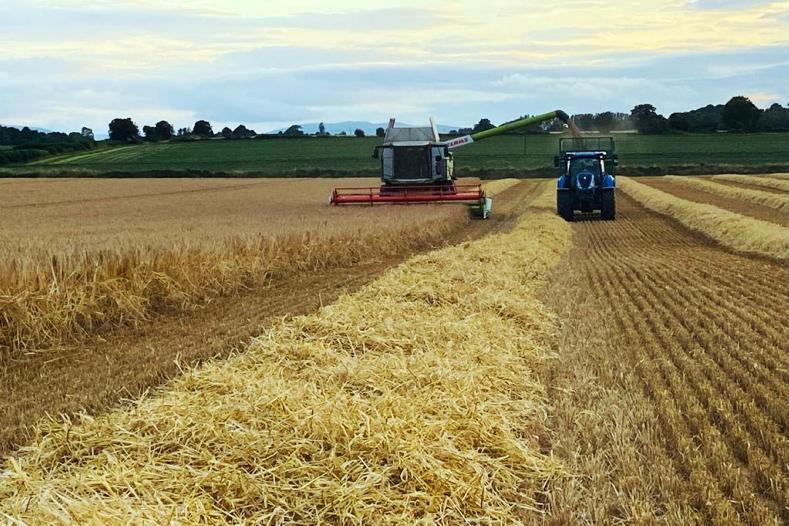
There have only been two full days of cutting in Tipperary since the harvest began nearly a month ago. Mark has been trying to take every opportunity between the showers to make some progress.
When talking to Mark on Monday, he said he was hoping to finish the last 15ac of winter barley that evening and start the winter oats on Tuesday. These oats are still standing and the straw will be chopped.
The winter barley that has been harvested has yielded between 3.5 and 4t/ac. The moisture has ranged between 16 and 22%, averaging around 20%. The hectolitre weight is excellent, ranging between 64 and 68kph for both two- and six-row varieties.
Belfry
Mark says that the six-row hybrid Belfry has stood up very well to the heavy rain. Losses have been lower than expected so far, but this may rise in the last 15ac after a lot of rain over the weekend.
No straw has been baled yet and the straw has been chopped on the headlands of all fields.
He has also decided to chop the straw on the last of the winter barley, as it will be very difficult to get it baled. Mark notes that straw will be scarce this year, between lower straw yields and a lot of chopping taking place.
There have been no stubble cultivations carried out or cover crops planted due to unbaled straw and fields becoming saturated.
Lodging
Away from the harvest, there is a bit of lodging in the spring barley, but Mark is happy with the crop. It thickened up very well and should produce a reasonable yield. The winter wheat should be ready to harvest in under two weeks.
The spring beans are just beginning to turn black and die off. This should mean that harvest will not be late. The fodder beet looks quite good and is very clean. The maize is just beginning to tassel.
Balbriggan,
Co Dublin
Preparations are being made for harvest by Tony. He is servicing the combine this week and getting up-to-date on record-keeping and paperwork.
There has not been as much rain by the coast in north Dublin as there’s been in the rest of the country. In fact, Tony says that his maize was still affected by a lack of moisture up to two weeks ago.

The strip-till maize is now 6ft tall after poor growth in June.
He thinks that his locality must be one of the driest in Ireland.
In the past couple of weeks, there has been a huge upturn in growth, and the maize is now a vibrant green colour. Tony applied his final spray to the maize last week. This consisted of 25l/ha of N16, 2l/ha of amino acids, and a seaweed extract.
He hopes this will give the crop a boost after growth has slowed in the dry weather. Some crops are waist-high, while better crops are 6ft tall.
Strip-till establishment
Tony admits that his strip-till establishment system has not been a huge success this year, due to the soil conditions for drilling and the weather that followed.
However, due to lower establishment costs, he thinks he would not be better off by using a plough and plastic on his maize.
The weather has had a massive effect on Tony’s business this year, as wet and dry periods have arrived at the wrong times.
Tony does not expect good yields, but there is still a long way to go until harvest so the maize could still surprise him.
The spring beans look good and are just beginning to senesce. Tony predicts that some spring beans could be harvested in late August or early September.
The winter wheat will be the first crop that Tony has to harvest. He expects this to be ripe in about two weeks.
There has been excellent grain fill. Some of the wheat is entered into the Straw Incorporation Measure.
Tullow,
Co Carlow
Jack is happy and relieved that his crops are still green and not ready to harvest in the current poor weather. He thinks that his harvest is three or four weeks away.
The spring wheat is starting to fill its grains very nicely. However, the crop is a bit thin and Jack says he should have increased the seeding rate – especially considering the crop was drilled later than planned.

Jack's organic multi-species sward is over 2m tall and will be cut for silage or haylage soon.
Weeds have persisted in the wheat, especially mayweed and fat hen. The drought in June prevented Jack from removing all the weeds with his harrow before the wheat reached stem extension. The rain after the drought then led to a new flush of weeds.
Spring oats
The spring oats are cleaner than the wheat. There are some small charlock plants near the ground, but Jack thinks the combine will be able to harvest the oats above the level of the weeds to help produce a clean sample of oats. The grains are filling out and the oats are starting to turn.
Jack had planned to cut hay off his multi-species sward in July, but the weather has obviously prevented this. He will now try to cut silage or haylage next week.
The crop is very tall, especially the chicory. He is unsure how the chicory will cope with being tedded or raked, or if it will wrap around the tines because of its height.
Agroforestry
The agroforestry trees are enjoying the mild, damp weather of the past six weeks. There are plenty of apples, hazelnuts and berries forming on the trees.
It will be a few years before the trees produce large saleable crops of fruit and nuts, so Jack plans to give away some of his produce to family and friends in the intervening period.
In the past month, Jack has erected owl boxes and ordered organic cover crop seed from Germany for ACRES.
Cashel,
Co Tipperary
There have only been two full days of cutting in Tipperary since the harvest began nearly a month ago. Mark has been trying to take every opportunity between the showers to make some progress.
When talking to Mark on Monday, he said he was hoping to finish the last 15ac of winter barley that evening and start the winter oats on Tuesday. These oats are still standing and the straw will be chopped.
The winter barley that has been harvested has yielded between 3.5 and 4t/ac. The moisture has ranged between 16 and 22%, averaging around 20%. The hectolitre weight is excellent, ranging between 64 and 68kph for both two- and six-row varieties.
Belfry
Mark says that the six-row hybrid Belfry has stood up very well to the heavy rain. Losses have been lower than expected so far, but this may rise in the last 15ac after a lot of rain over the weekend.
No straw has been baled yet and the straw has been chopped on the headlands of all fields.
He has also decided to chop the straw on the last of the winter barley, as it will be very difficult to get it baled. Mark notes that straw will be scarce this year, between lower straw yields and a lot of chopping taking place.
There have been no stubble cultivations carried out or cover crops planted due to unbaled straw and fields becoming saturated.
Lodging
Away from the harvest, there is a bit of lodging in the spring barley, but Mark is happy with the crop. It thickened up very well and should produce a reasonable yield. The winter wheat should be ready to harvest in under two weeks.
The spring beans are just beginning to turn black and die off. This should mean that harvest will not be late. The fodder beet looks quite good and is very clean. The maize is just beginning to tassel.
Balbriggan,
Co Dublin
Preparations are being made for harvest by Tony. He is servicing the combine this week and getting up-to-date on record-keeping and paperwork.
There has not been as much rain by the coast in north Dublin as there’s been in the rest of the country. In fact, Tony says that his maize was still affected by a lack of moisture up to two weeks ago.

The strip-till maize is now 6ft tall after poor growth in June.
He thinks that his locality must be one of the driest in Ireland.
In the past couple of weeks, there has been a huge upturn in growth, and the maize is now a vibrant green colour. Tony applied his final spray to the maize last week. This consisted of 25l/ha of N16, 2l/ha of amino acids, and a seaweed extract.
He hopes this will give the crop a boost after growth has slowed in the dry weather. Some crops are waist-high, while better crops are 6ft tall.
Strip-till establishment
Tony admits that his strip-till establishment system has not been a huge success this year, due to the soil conditions for drilling and the weather that followed.
However, due to lower establishment costs, he thinks he would not be better off by using a plough and plastic on his maize.
The weather has had a massive effect on Tony’s business this year, as wet and dry periods have arrived at the wrong times.
Tony does not expect good yields, but there is still a long way to go until harvest so the maize could still surprise him.
The spring beans look good and are just beginning to senesce. Tony predicts that some spring beans could be harvested in late August or early September.
The winter wheat will be the first crop that Tony has to harvest. He expects this to be ripe in about two weeks.
There has been excellent grain fill. Some of the wheat is entered into the Straw Incorporation Measure.
Tullow,
Co Carlow
Jack is happy and relieved that his crops are still green and not ready to harvest in the current poor weather. He thinks that his harvest is three or four weeks away.
The spring wheat is starting to fill its grains very nicely. However, the crop is a bit thin and Jack says he should have increased the seeding rate – especially considering the crop was drilled later than planned.

Jack's organic multi-species sward is over 2m tall and will be cut for silage or haylage soon.
Weeds have persisted in the wheat, especially mayweed and fat hen. The drought in June prevented Jack from removing all the weeds with his harrow before the wheat reached stem extension. The rain after the drought then led to a new flush of weeds.
Spring oats
The spring oats are cleaner than the wheat. There are some small charlock plants near the ground, but Jack thinks the combine will be able to harvest the oats above the level of the weeds to help produce a clean sample of oats. The grains are filling out and the oats are starting to turn.
Jack had planned to cut hay off his multi-species sward in July, but the weather has obviously prevented this. He will now try to cut silage or haylage next week.
The crop is very tall, especially the chicory. He is unsure how the chicory will cope with being tedded or raked, or if it will wrap around the tines because of its height.
Agroforestry
The agroforestry trees are enjoying the mild, damp weather of the past six weeks. There are plenty of apples, hazelnuts and berries forming on the trees.
It will be a few years before the trees produce large saleable crops of fruit and nuts, so Jack plans to give away some of his produce to family and friends in the intervening period.
In the past month, Jack has erected owl boxes and ordered organic cover crop seed from Germany for ACRES.
SHARING OPTIONS