



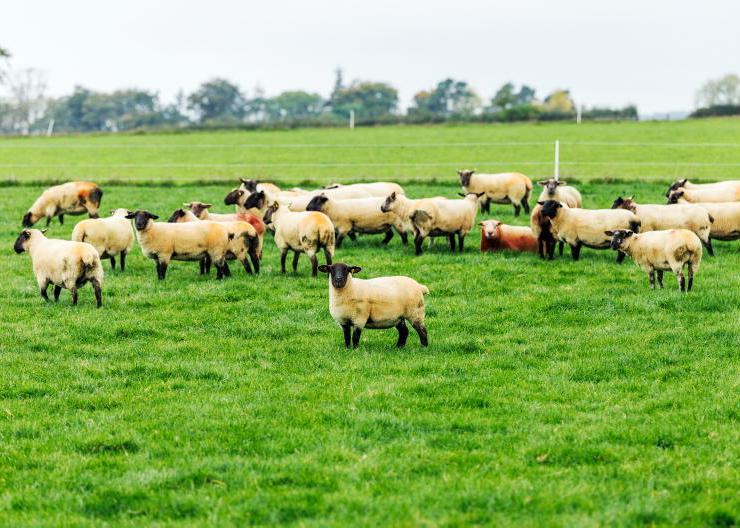
Eddie Gavin’s mixed farm, encompassing a mid-season lambing lowland sheep flock, tillage and dairy-calf-to-beef enterprises, was the host venue for last week’s Teagasc BETTER farm sheep programme event.
Eddie, who farms approximately 44ha of grassland and 34ha of tillage in Fenniscourt, Co Carlow with his wife Laura, and two children – Isabella and Ted, has been a participant in the programme for over four years.
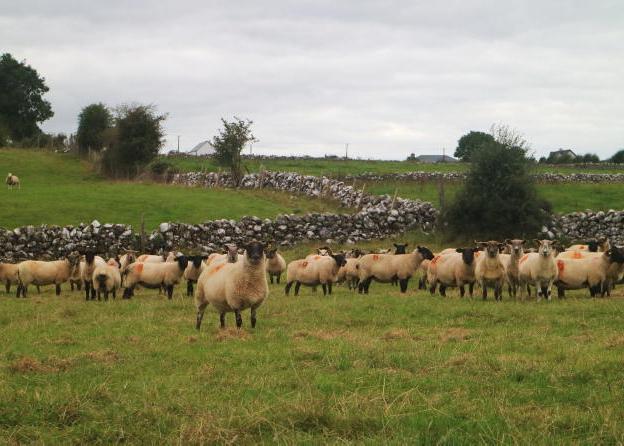
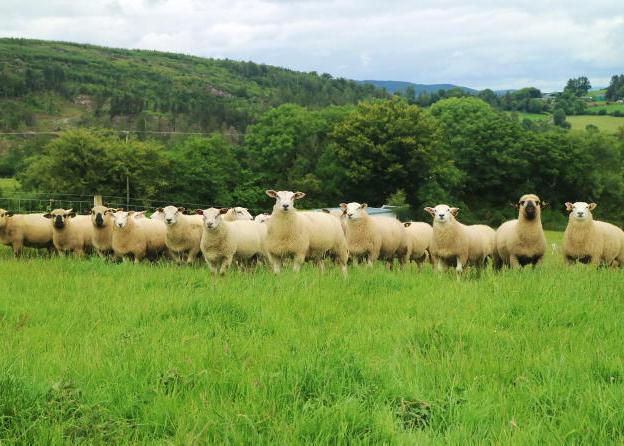
A flock of 260 mid-season lambing ewes are run alongside a dairy-beef enterprise and store lamb finishing.
There have been many changes to the system during this timeframe including a move away from split early and mid-season lambing flocks and the introduction of a store lamb finishing enterprise.
Previous to joining the programme replacements were sourced from a mixture of purchasing replacements and retaining ewe lambs bred within the flock.
One of the first tasks undertaken with his then-Teagasc advisor Eoin Woulfe and sheep specialist Ciaran Lynch (and carried forward by current advisor Peter Lawrence) was the implementation of a defined breeding policy.
A closed flock policy was introduced to reduce the risk of bringing disease on to the farm while also giving Eddie more control over the genetics entering the flock.
A criss-cross breeding programme utilising maternal Belclare and Suffolk genetics is used to breed replacements with the best-performing ewes mated.
Ewes deemed to be poorer-performing are bred to terminal rams with all of these progeny sold.
Eddie works off farm machinery contracting and does not want to progress too far down the high prolificacy route and is targeting a litter size of 1.9 to two lambs per ewe joined.
The reproductive performance of the flock in recent years is detailed in Table 1. A big focus has been placed in the last two years on addressing ewe condition pre-mating. While the average condition of ewes has been on target a higher than desired percentage of ewes falling below a target body condition score (BCS) of 3.5 at joining with rams has been attributed to a higher barren rate.
This reduced significantly in 2025 to just 2% barren rate and the foundation has been set again this year to repeat this performance. This has not been easy to achieve in 2025 with two prolonged drought periods reducing grass supplies.

A big emphasis was placed on ewe condition post-weaning with ewes requiring preferential treatment receiving as good a grass allocation as possible while ewes above target body condition were fed high feed-quality silage.
Ewe condition has also been influenced by lameness issues in the past with contagious ovine digital dermatitis present in the flock. Great care is now placed on preventing scald/foot-rot and minimising the opportunities for CODD to get a foothold in the flock.
A batch footbath is in place and Eddie is a big believer in providing ewes with access to lime in specially designed units that entice ewes to walk in lime while scratching their backs. This is shown in the picture on the far right and is in place during the main grazing season.
Lamb performance from mature ewes is detailed in Table 2. Another area highlighted for attention in the five-year farm plan is driving performance from grass. Larger fields have been split with electric fencing and mixed grazing is practiced with a batch of 15 Friesian bullocks run with each batch of 125 ewes and their lambs.
Eddie explains that in spring ewes and lambs are released to fields as soon as possible after lambing in small batches. He says that he typically batches ewes and their lambs in to their grazing groups quickly and aims to have grazing mobs established after about three to four weeks. During this timeframe ewes and lambs are grazed on their own with bullocks added in early April once ewes and lambs are settled in their groups.
The larger grazing groups allows paddocks to typically be grazed out within two to three days meaning animals are continually moving in to high feed-value grass.
Grass measuring and budgeting has also given Eddie the confidence to take surplus grass out of the rotation which also greatly helps in maintaining grass quality at a high level.
This focus on grass-quality pre-weaning has lifted pre-weaning performance with lambs hitting targets as detailed in Table 1.
The performance was achieved despite grass quality and supply being curtailed by drought.
The farm can quickly suffer from a soil moisture deficit and Eddie explains that growth rates approaching weaning were hit hard by a lack of rainfall for several weeks.
Growth appeared to be just coming back on track when a longer dry spell spanning over seven weeks hit and as already touched upon resulted in the farm having to take quick steps to keep on track.

A batch of 15 bullocks were sold and Eddie comments that the timing in this regard was positive with cattle prices at close to the peak of the summer increase. These animals had achieved cheap weight gain so still left a margin despite being sold much earlier than planned.
A lamb finishing group was established and lambs weighing upwards of 38kg to 40kg were transferred in to this. At its high point this numbered about 140 head.
Normally such lambs would receive 500g to 700g concentrate supplementation but as high as 1kg was fed at a stage to conserve grass supplies and maintain performance at a high level.
As lambs were drafted from the group more were added with the group balancing out at about 100 head.
The tight grass supplies had an effect on performance with 60% of lambs drafted at the middle of October.
This figure is expected to rise to 80% plus by the end of the month with a lot of lambs on the point of slaughter. The remaining lambs were not pushed and will be finished on rape with purchased store lambs.
Good grazing infrastructure is a key cornerstone of utilising grass but a key driver of grass growth is addressing soil fertility. This is not an easy task which is demonstrated by the fact that 33% of the farm is viewed at an optimum level for soil pH and phosphorus (P) and potassium (K).
In terms of soil pH, over 50% of the farm is above pH of 6.5, 25% ranges from pH 6.2 to 6.5 with another 20% from 5.9 to 6.2.

This leaves just 4% at a pH of 5.5 to 5.9. For P levels, 27% is classified at index four, 32% at index three, 32% at index two and 9% at index one. While for K, 16% is index 4, 46% at index three, 33% at index two and 5% at index 1.
This analysis is carried out across the entire farm including grassland and tillage ground.
Organic nutrients are targeted at fields that need it most while a fertiliser and liming programme is aimed at maintaining good fertility in areas with satisfactory soil fertility and addressing any areas where there is a deficit.
A store lamb finishing enterprise has been operated on the farm in two of the last three years with no lambs purchased in 2024 due to weather curtailing sowing. The crop was sown this year in ideal conditions in late July and has grown excellently.
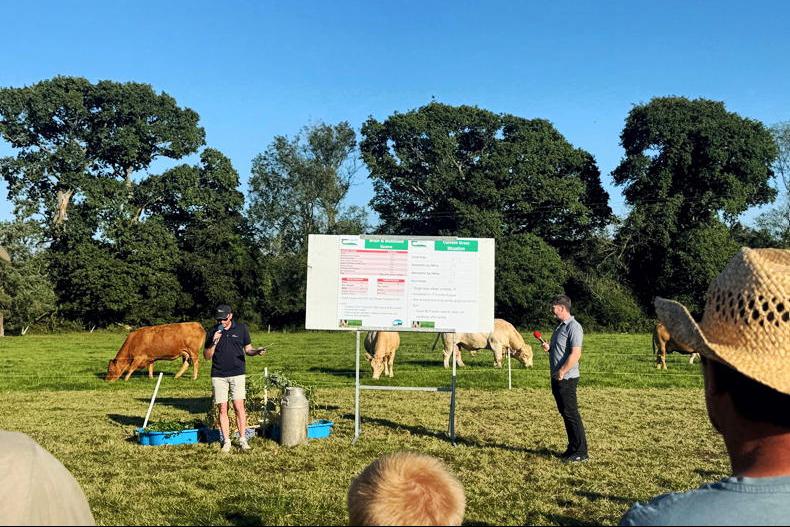
At last week’s event Frank Campion, Teagasc research officer told farmers that the starting point to transferring sheep on to a forage crop or deciding on how many lambs to purchase is to quantify the volume of forage present.
Three simple tools are needed: a shears/clippers to cut the crop, a quadrant or measuring tape to mark out a 1m2 area and a weighing scales. A bag such as a fertiliser bag is also useful to hold cuttings for weighing.
Where there is variability in the crop, it is advisable to take two to three cuts at different areas in the field to give a more accurate assessment of the volume of forage available.
Where dealing with a mixed forage and root crop then roots will also need to be factored into the weighing but this is not a factor in this case. Once the fresh weight of forage is available, this figure is multiplied by 10,000 as there is 10,000m2 in a hectare. Note that this is the volume of forage available on a fresh weight basis.

The dry matter content of forage rape or hybrid brassicas is typically 12% to 13%. This can be a percentage point higher in a prolonged spell of good weather or likewise a percentage point lower during periods of sustained rainfall.
Using the example from the farm walk of 3.6kg fresh weight in 1m2 and a dry matter of 13% gives 4.68t DM/ha (3.6kg x 10,000 x 13%).
The next factor that needs to be taken into account is the level of utilisation and carrying capacity which was covered by Michael Gottstein, Teagasc’s head of Sheep Knowledge Transfer Programme.
In good weather with low levels of rainfall and dry underfoot conditions, a typical level of utilisation can be taken at about 75%.
This can drop to as low as 40% to 50% during periods of inclement weather and difficult ground conditions.
Continuing with the example from Eddie’s farm and taking 75% utilisation gives 3.5t of available dry matter (4.68t x 75% utilisation).
Michael outlined that lowland lambs weighing in the region of 35kg to 44kg have a dry matter intake potential of 1.4kg DM while light hill lambs weighing 28kg to 35kg have an intake potential about 70% lower (0.9kg to 1kg) with mature ewe intake much higher at 1.6kg DM.
Taking an average of 3.5t and lambs consuming 1.4kg DM delivers about 2,500 grazing days.
Lambs will typically gain an average of 140g daily on forage crops.
The lambs purchased on the Gavin farm are coming in at approx 30kg liveweight and being brought through to a finishing weight of 45kg to 50kg liveweight. At an average of 48kg, lambs will be on the farm for about 130 days.

This means that one hectare of crop will sustain about 20 lambs for such a period.
If there is a lower volume of forage available then fewer lambs will need to be purchased or heavier lambs that require a shorter finishing period.
This measurement does not take in to account that 30% of the diet should ideally be of an additional forage or fibre source to help digestion.
This can be a grass lie-back or forage / concentrates offered where lambs have access to a tillage lie-back.
Lambs will be keen for a source of additional forage when getting accustomed to the crop but once accustomed to the crop intakes will drop.
The exception to this is if the dry matter of the crop drops significantly.
The following are useful tips that will improve the success of grazing forage crops.
Eddie Gavin farms 44ha of grassland and 34ha of tillage in Fenniscourt, Co Carlow.
A flock of 260 mid-season lambing ewes are run alongside a dairy-beef enterprise and store lamb finishing.





SHARING OPTIONS