



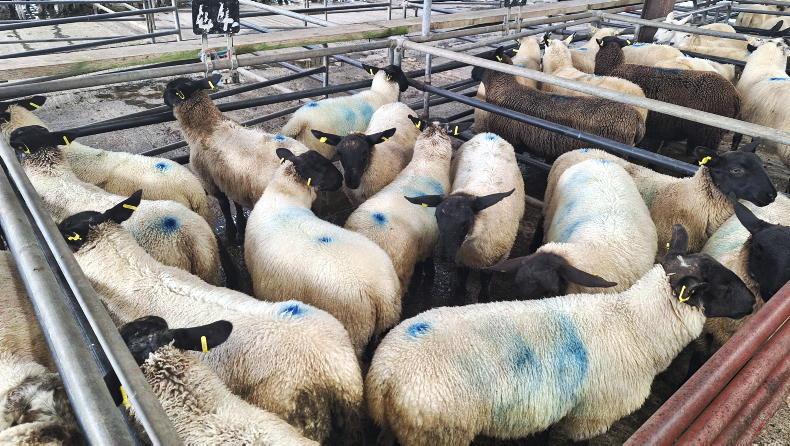
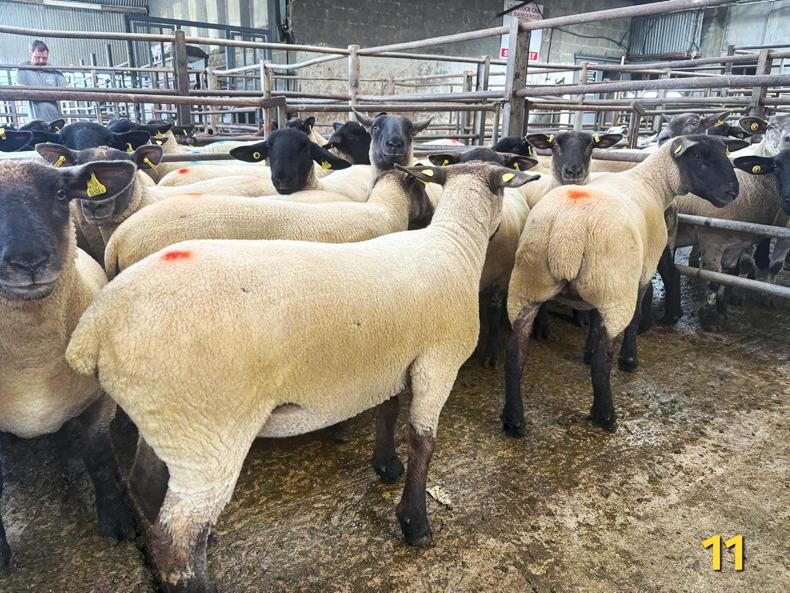
Store lamb trade: Keen demand for store lambs and positive prices are a welcome feature of the sheep trade at present. There are many queries being raised by farmers on whether or not it is a good time to sell stores and what way prices may react if there are higher numbers coming on to the market.
The trade for stores and buyer sentiment is typically influenced by finished lamb prices, grass supplies and weather. Finished lamb prices are favorable, with deadweight prices running €1.10/kg ahead of the corresponding period in 2024 and resisting the sharp seasonal decline.
Grass supplies are variable depending on the part of the country but demand for lambs is being boosted by farmers with surplus grass. This is due to a combination of factors – less ewes and lambs on farm, more winter forage taking the pressure off to make second-cuts and cattle farmers out earlier looking for stores due to high cattle prices.
It is impossible to predict what way the trade will go, but at present it is looking positive with supplies tighter and hill lamb producers in particular witnessing a sharper trade. As mentioned last week it is worth both lowland and hill lamb producers taking stock of the type of lambs on farm and categorising them on weight.
Even splitting lambs into weight brackets of 40kg plus, 35kg to 40kg, 30kg to 35kg and anything less than 30kg will give an idea of where lambs lie in terms of performance and likely finishing time.
For some farmers it suits to sell more forward lambs at a higher price while for others the best fit may be to sell any light longer-keep lambs which may compete for grass supplies later in the year.
The upshot of carrying out this practice is that decisions can be made in good time when there are more options available. Where the decision is to sell then put the best foot forward and make sure lambs are presented well and any additional factors such as health treatments (blowfly control, clostridial vaccination etc) are used to market lambs optimally.
Dip supply issues: The manufacturers of Cyperguard and Ecofleece non-organophosphate sheep dip, Bimeda, have announced that there is a stock supply issue at present on all sizes of Cyperguard and Ecofleece products.
The company says that it hopes to have new stock available on the market in mid-September. The products are the only sheep dips with a tick claim in Ireland and are also suitable for use on organic farms.
ACRES landscape actions: The full list of the Agri-Climate Rural Environment Scheme (ACRES) landscape actions (LAs) are detailed here. The actions are available to a high number of sheep producers farming in ACRES Co-operation (CP) areas.
There have been some queries since the actions were announced regarding the maximum level of support available to farmers. This varies depending on the payment rates under the core payment and whether or not farmers have drawn down funding under non-productive investments (NPIs).
A maximum payment of €52,500 is available to farmers over the five-year contract. The maximum core payment is €7,000 for CP participants. However, where this is not utilised, farmers can receive the shortfall through NPIs or LAs and landscape bonus payments. It is worth talking to your adviser or the CP Teams if you have an interest in availing of support.



SHARING OPTIONS