



The latest European Commission sheep market information published shows lamb prices running 7% to 8% higher than the corresponding period in 2025.
Heavier lamb carcases weighing over 13kg are currently trading on average at €9.18/kg for week 39 of 2026, 7.5% higher than the corresponding period in 2025, 2.5% higher than the previous month and 2% higher than the previous week.
The parallel figures for light lamb carcases weighing less than 13kg carcase weight are an average price of €10.23/kg.
This is running 8% higher than the corresponding period in 2025, 2.9% higher than the previous month and 2.7% up on the previous week.
The increase in price is being driven by tighter domestic supplies across the EU and higher cost imports with global prices currently running from 5% to 10% higher year-on-year.
Figure 1 details sheep production data from the EU Commission for the first six months of the year.
Production in Spain continues on a downward trend with longer periods of drought and extreme temperatures reducing output.
In contrast production in France is running 3% higher but, along with increases in Italy, Germany and Netherlands, it is not enough to compensate for the combined reduced output in Spain, Ireland, Greece and Romania.
Reports indicate that production trends are following a broadly similar pattern in recent months which is helping to boost farmgate prices.
The tight supplies in Spain have altered normal market dynamics where France has tended to be the highest price of the significant sheep producing nations.
Prices in Spain have been trending upwards of €10/kg, as reported in the Bord Bia lamb price dashboard, since the start of September.
This is an increase of about 70c/kg compared to the corresponding period in 2025.
These prices are typically paid for a lighter lamb carcase with the balance of production in many Mediterranean countries and particularly those with a dominance of milking and hill-type flocks being light lamb production.
French farmgate lamb prices are running upwards of €9.10/kg with farmgate returns running about 40c/kg higher year-on-year.
In contrast to Spain production in France was trending 3% higher for the first six months of 2026.
Irish, Northern Ireland and British prices have firmed in recent weeks with prices in Northern Ireland rising by the highest figure.
The latest base quotes offered to farmers in Northern Ireland are upwards of £7/kg (€8.43/kg). Price is being helped by export competition from Ireland and Britain.
Northern Ireland prices are significantly ahead of the Irish lamb price. If we take an Irish lamb price of €8.30/kg and deduct the flat rate VAT top up for unregistered farmers it leaves Irish prices running at shy of €8/kg.
Bord Bia report prices running about 35c/kg higher than the corresponding period in 2025.
British prices are also trending well ahead of 2025 with the latest Livestock and Meat Commission report showing prices running in the region of £7.24/kg which is the equivalent of €8.50/kg. This is an increase of about 70c/kg on September 2025 levels.
Unfortunately the increase in value is being eroded by risng costs.
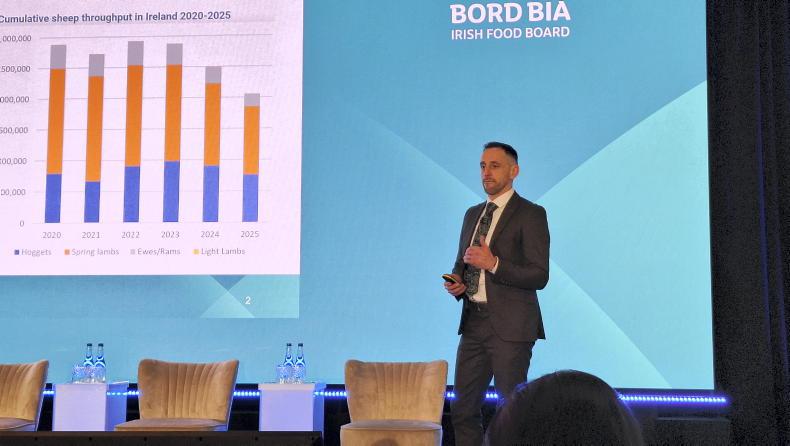
As mentioned already, sheep production in EU is trending on a sharp downward curve. Figure 2 is European Commission data detailing historic and forecast sheepmeat and goatmeat production for the period 2016 to 2026.
Production forecasts have been revised downwards on a number of occasions in the last 12 to 24 months.
Net production is forecast to fall by a big figure of almost 25,000t or 5% in 2026.
To put the scale of this reduction in context it is almost half the volume of sheepmeat exported from Ireland in the last two years.
The sharp decline in production over the last 10 years has fed directly in to an equivalent reduction in consumption.
This has been underpinned by consumers having lower access to sheepmeat and goatmeat and a significant increase in price over the last decade.
According to DG Agri forecasts the EU will be just 83.6% self-sufficient in sheep and goat meat in 2026. This is down from the initial forecasts of being over 90% self-sufficient.
Sheepmeat imports are running on a par to 2025 for the first six months of the year. This is despite increased demand in the market and is reflective of the tight global supplies.
Production is on a downward trend in the UK and while imports are up slightly on the back of higher imports from southern hemisphere countries there is low potential to bring about an immediate significant increase in volumes imported.
Imports from New Zealand are being curtailed by sharp reductions in production while imports from Australia are tempered by a combination of a dip in production and solid demand from markets closer to hand such as the US, China and Middle Eastern nations.
Exports are also less attractive given the challenges facing shipping logistics due.
Lamb prices in Australia and New Zealand are trending significantly higher on the back of tighter domestic production and reduced global supplies.
Prices in Australia are averaging €6.79/kg for the week of 26 September, 32c/kg higher than the corresponding period in 2025. While prices in New Zealand of €6.09/kg are 86c/kg higher year-on-year.



SHARING OPTIONS