



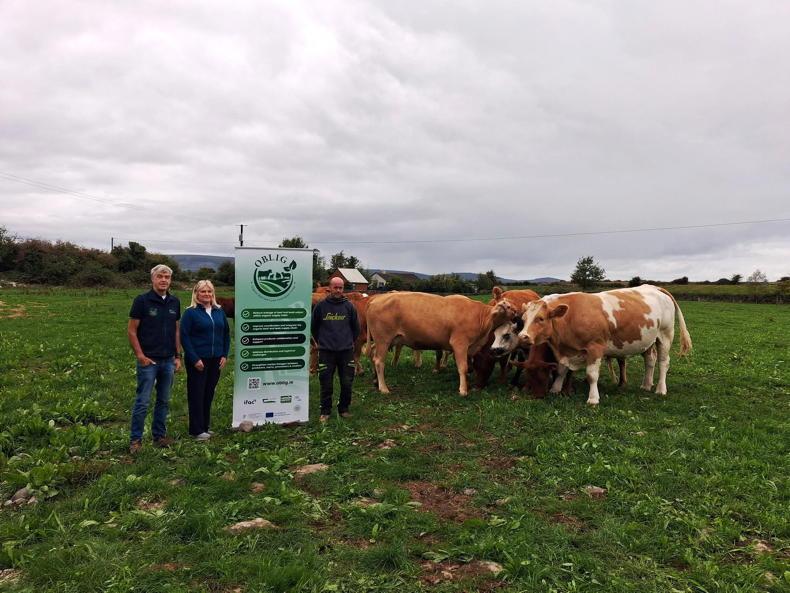
A new five year European Innovation Project (EIP-Agri) called the Organic Beef and Lamb Innovation Group (OBLIG) has commenced and aims to tackle the significant challenge of reducing leakage from organic production systems to the conventional supply chain. The project, with funding of €1.44m, is co-funded by the European Union and Department of Agriculture, Food and the Marine and was touched upon briefly in last week’s edition.
This raised a number of queries seeking further information on what exactly will be involved and how interested farmers can become involved. Stemming leakage and finding routes to market for organic lamb was also a regular discussion point from an attendance of over 150 farmers at last week’s Growing Organic Prospects for Livestock roadshow event held in Ballinasloe.
OBLIG is coordinated by Declan Pyne in the West of the country and Julian Pawlowski in the East and is supported in a collaborative manner by a number of parties including Teagasc, IFAC, the National Organic Training Skillnet and Leitrim Organic Farmers.
Stemming leakage from organic sheep systems is likely to be more challenging with a high percentage of sheep located on the western seaboard and on hill sheep farms where there is less scope to finish lambs while the main processing plant in Irish Country Meats is in the East of the country. Current estimates put leakage from organic production systems at upwards of 70%.
The company has a five-point plan or five objectives which it outlined at recent roadshow meetings and these are summarised as follows.
1. Reduce leakage
Develop solutions to target 100% of output from participating farmers remains within the organic supply chain.
2. Improve supply chain coordination
Create a well-integrated supply chain by addressing fragmentation and enhancing communication among key stakeholders, including marts.
3. Enhance producer collaboration
Build collaboration capacity and knowledge among producers to strengthen capabilities and provide a social outlet, reducing isolation.
4. Address distribution challenges
Identify and solve logistical bottlenecks hindering organic lamb and beef from reaching markets efficiently.
5. Strengthen market linkages
Develop robust connections between producers, marts, processors, retailers and food service operators.
Recruitment of coordinators has already been completed while comprehensive stakeholder mapping is underway.
This will be followed by regional consultations and collaboration handbook development.
A significant challenge in curtailing leakage will be to encourage farmers to transport animals to organic processing sites / marts etc.
This will be achieved in part by providing ready routes to market and a transport feasibility study will scope out how best to achieve this target.
John Brennan, manager Leitrim Organic Farmers said good success has already been achieved by linking with existing producer group and this view was echoed by James Smyth, general manager ICM who pointed out that ICM have links with a number of producer groups in Donegal for example and that this could be a means of improving transport feasibility from such areas.
A pilot project will be put in place in year one and a process of identifying farmers will commence shortly.
Declan Pyne said that farmers interested in becoming involved can contact him at West@Oblig.ie or Julian at East@Oblig.ie or speak with any of the supporting stakeholders.
Information updates will also be shared on the project website – www.oblig.ie.
The project will support a number of attractive initiatives such as contributing towards the following: transports costs, crop establishment costs, sowing forage crops for lambs and weanlings to graze over the winter and applications costs for fencing under the Targeted Agricultural Modernisation Scheme (TAMS).
It will also provide support towards weighing equipment and the building of networks and provide access to expertise in the supply chain.
The final meeting of the Growing Prospects for Organic Livestock roadshow takes place on Wednesday 15 October in the Abbey Hotel in Donegal town.
The meeting in Ballinasloe heard numerous calls for the establishment of light lamb markets as a route to market for high numbers of lambs born on hill farms.
James Smyth, general manager Irish Country Meats said that at present the only markets available for organic lambs is at a carcase weight of 18kg to 22kg with all lambs produced via the Bord Bia Sustainable Beef and Lamb Assurance Scheme (SBLAS).
He said that ICM will continue to explore all market opportunities and pointed out that the marketing of organic lamb is based on trying to leverage a premium price which could be passed back on to the producer.
He added that ICM operates a 15% pricing premium over conventional lamb to a maximum payment top-up of €1/kg. James said that there is good opportunities in high-value European markets but stressed that to leverage such markets requires a consistent 52 week supply.
He said that it is not a case of dipping in to markets when product is available and utilising such supply chains will require greater security of supply.
He told farmers in attendance that ICM is committed to working with farmers to expand organic markets, including exploring opportunities for light lambs, and added that the company has a dedicated organic office and producer groups / agent nationwide network in place.
Finishing blueprints
Frank Campion Teagasc outlined plans for year two of finishing trials for organic hill lambs.
He said that the quality of red clover silage was much improved on 2024 and added that the feeding quality of wholecrop silage should also be improved by undersowing a barley / pea mix with a red clover grass mix.
The concentrate mix is also being tweaked by buying straights and blending in to a higher-quality ration.
Growing demand
Tara Bane, Organic Specialist with Bord Bia presented details of plans to grow the supply and demand of organic produce. She highlighted that the foundation for the increased supply of raw product is already in place in the case of lamb and beef with a sharp increase in participation in the Organic Farming Scheme.
The goal now is to retain this product in the supply chain and grow demand in premium markets.
She highlighted details of a €2.3m ‘More-ganic’ Irish consumer campaign to grow domestic demand while in export markets Ireland can tap in to a €2.7m EU Organic Beef and Lamb Business-to-Business promotional campaign.



SHARING OPTIONS