



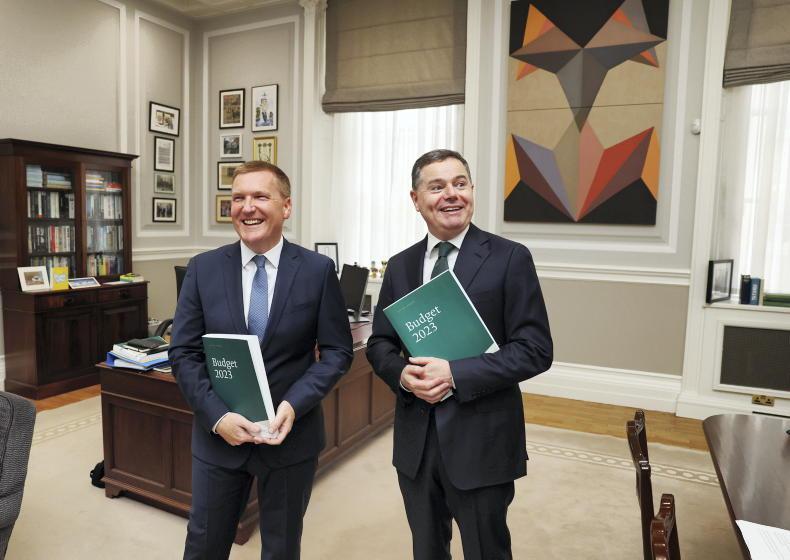
The Ministers for Finance and Public Expenditure and Reform, Michael McGrath and Paschal Donohoe, published their summer economic statement this week, which gives an outline of the tax and spending levels in October’s budget.
While the statement gives no breakdown on what the money will be spent on, it does say how much extra money will be available in the pot, come budget time.
This year, that will amount to €5.2bn of additional spending and a €1.1bn reduction in the tax take, making for an overall budget package of €6.4bn, or an increase of 6.1%. That is a slight decrease on last year’s summer economic statement, which was an overall package of €6.7bn.
The devil is, as always, in the details when it comes to judging what these numbers mean for agriculture.
The budget announced in September of 2022 did show an increase in spending by the Department of Agriculture.
However, as we pointed out at the time, much of that spending increase was based on one-off funding, such as the Brexit Reserve Fund, rather than forming part of “core spending” which becomes essentially locked-in for years to come.
Agriculture must ‘lobby hard’
This means agriculture will have to lobby hard to get a larger share of the newly expanded core spending budget. Signs aren’t great that this will be an easy task, as the summer statement says the increase in core spending will be to “deliver improvements in public services”.
There is additional capital expenditure that can be allocated to the Climate Action Fund, but that will only total €250m in 2024.
Further, the amount of proposed extra spending which is yet to be allocated, is much lower at €2bn coming into the next budget than the €3.2bn of unallocated expenditure that could be argued over ahead of last year.
The statement says that the key measures integrated into the Government’s economic policy are to boost housing supply, to build more resilient public finances and decarbonise the Irish economy.
Greenhouse gas emissions
The figure for reducing greenhouse gas (GHG) emissions is put at 7.5%/year for the rest of the decade. The Government highlighted the 1% drop in GHG between 2018 and 2021 as a sign of the scale of the task involved in achieving that target.
It seems likely therefore that any extra funding for agriculture will have to have a large GHG reduction payoff to get approval in this year’s budget.



SHARING OPTIONS