Tillage and suckler farmer Simon Best from just outside Newry on the Armagh-Down border is one of seven farmers who has taken a detailed look at carbon as part of the Accelerating Ruminant Carbon to Zero (ARCZero) project.
This project measures and manages carbon flows across seven different Northern Ireland farms, allowing participating farmers to make positive changes towards carbon zero farming.
It is important, however, to stress the words of Professor John Gilliland, the man spearheading the project: “Net zero does not mean zero emissions.”
Essentially, if a farm does get to carbon zero, it does not mean it doesn’t produce any emissions but that it sequesters enough carbon to offset what it is producing.
Carbon stocks held in soils, hedgerows and trees are big players in all of this and ARCZero gives these farmers the opportunity to “know their numbers”.
On the Best farm, where Simon is farming with his father John and brother Rory, a carbon calculator called Agrecalc is used to assess carbon both above and below the ground.
While there are 60-plus carbon calculators on the market, Agrecalc is one of the few that has the ability to take into account carbon sequestration, as well as carbon output. The amount of carbon held in trees and hedgerows is assessed using light detection and ranging (LiDAR), which is also responsible for driving assist found in modern cars.
With farmers under pressure to do their bit to cut emissions, Gilliland highlighted the importance of “knowing your numbers” and described carbon calculating as a “galloping horse coming at us”.
As it stands, Simon is managing just under a quarter of a million tonnes of carbon dioxide equivalent (CO2e) on his 1,200ac farm.
In terms of carbon itself, there is a total of 66,778t on Simon’s Acton House Farm. The majority of this is found in the top 30cm of the soil (65,004t) while 1,77tt of this carbon is stored in trees and hedgerows around the farm.
CO2e stands for carbon dioxide equivalent and allows for the fact that each major greenhouse gas has a different global warming potential (GWP).
For example, methane from ruminants has a GWP of 25, meaning that for every 1t of methane released, it is the equivalent of 25t of CO2.
Although trees and hedgerows account for less than 10% of carbon held on the Best farm, and 90% of the carbon is stored in the soil, Simon is very proud of his space for nature on his farm.
He has 68km of hedgerows and trees and 10% of the farm is in habitats.
Simon grows winter wheat, winter barley, winter and spring oats, oilseed rape and spring beans. He also breeds pedigree Angus suckler cattle.
Between the two enterprises, 90% of his produce travels within a five-mile radius of the farm.
A pig farm, three miles away, buys all Simon’s wheat and barley.
“This accounts for 90% of their total feed requirement, yet they get no benefit from producing pork with local ingredients,” Simon said.
All of Simon’s oats go to White’s Oats in Tandragee, just five miles away.
Simon has been an advocate for increasing biodiversity where he can on-farm for a number of years.
He has been involved in several environmental schemes over the last 23 years. However, his current agreement comes to an end this year, and it looks likely there will be a break before a new scheme becomes operational.
This, Simon said, is completely contrary to where Northern Ireland should be going.

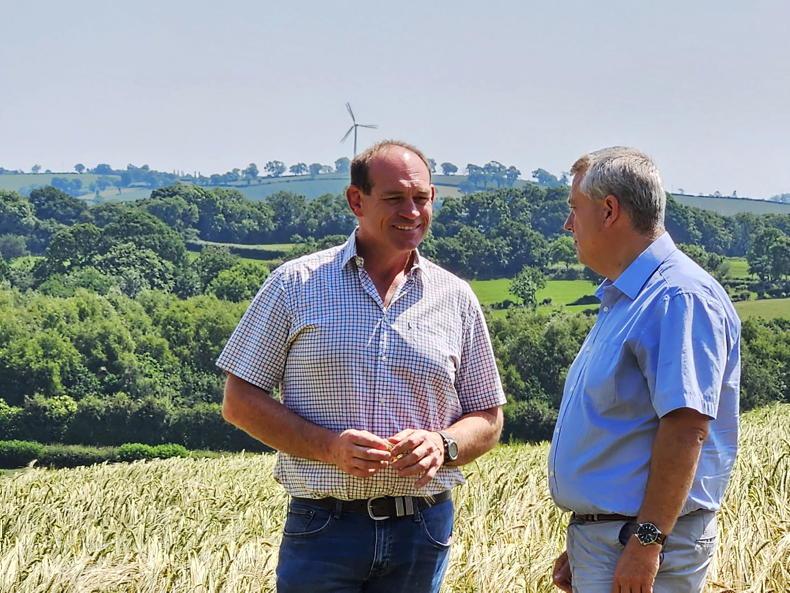
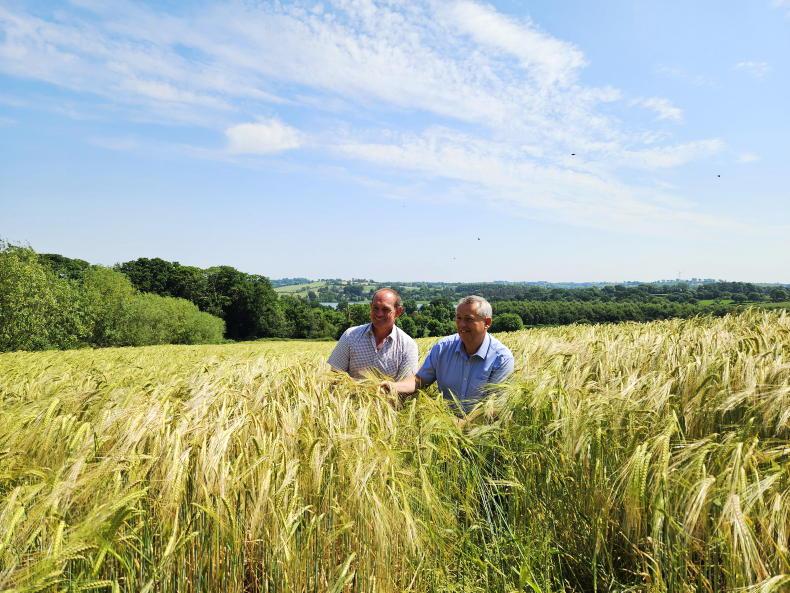
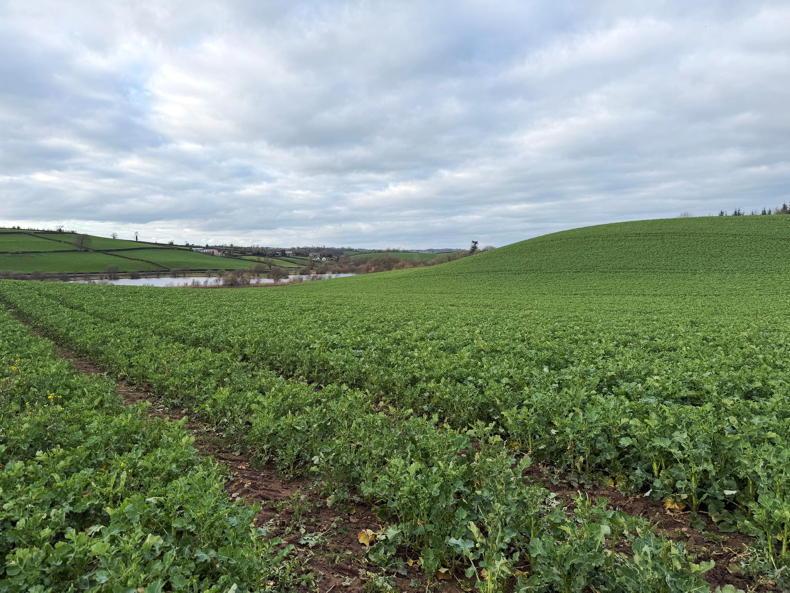
Simon Best's farm in Pontzpass, Co Armagh. Simon is one of seven farmers who participated in the ARCZero project.
“It’s all aligned. If you invest in farming, you invest in carbon, you invest in the understanding of where we can get to in terms of a carbon baseline. That surely should be the direction of travel,” he said.
“Our ethos here is the production of high-quality food in a sustainable and environmental manner,” he said.
Since the start of the project and in order to move towards net zero farming, Simon has improved nutrient use efficiency, increased nutrient management planning, used 90% protected nitrogen products, sown cover crops, used minimum tillage, sown legumes within rotations and followed proper hedgerow management.
His LiDAR map also shows areas of the farm where there is the greatest risk of run-off of nutrients into waterways, so he has looked at planting trees to potentially catch these nutrients.
Simon has reduced fertiliser use significantly over the last two years, although he admits that price was a key driver.
“We haven’t seen any reduced yields. We were using too much fertiliser anyway,” Simon said.
He also has access to significant amounts of compost via a diversification business on the farm that takes in green wheelie bin waste from local homes.
Sources of emissions
The arable side of the Best farm accounts for 66% of all emissions, while the beef side accounts for the remaining 34%.
The main sources of emissions were fertiliser (56%), enteric fermentation (16%), fuel (18%) and manure management (5%). Gilliland believes that carbon in soils, trees and hedgerows should be measured every five years, which will give an accurate assessment of how much is being sequestered, as well as highlighting the impact of differing management practices on the process.
At present, all Northern Ireland soils are currently being assessed for nutrient status and carbon stocks as part of a four-year Government-funded project.
Farmers involved in ARCZero
Roger and Hilary Bell – sheep.Simon Best – arable and beef.Patrick Casement – sheep and drystock.John Gilliland – willow and drystock.Hugh Harbison – dairy.Ian McClelland – dairy.
Tillage and suckler farmer Simon Best from just outside Newry on the Armagh-Down border is one of seven farmers who has taken a detailed look at carbon as part of the Accelerating Ruminant Carbon to Zero (ARCZero) project.
This project measures and manages carbon flows across seven different Northern Ireland farms, allowing participating farmers to make positive changes towards carbon zero farming.
It is important, however, to stress the words of Professor John Gilliland, the man spearheading the project: “Net zero does not mean zero emissions.”
Essentially, if a farm does get to carbon zero, it does not mean it doesn’t produce any emissions but that it sequesters enough carbon to offset what it is producing.
Carbon stocks held in soils, hedgerows and trees are big players in all of this and ARCZero gives these farmers the opportunity to “know their numbers”.
On the Best farm, where Simon is farming with his father John and brother Rory, a carbon calculator called Agrecalc is used to assess carbon both above and below the ground.
While there are 60-plus carbon calculators on the market, Agrecalc is one of the few that has the ability to take into account carbon sequestration, as well as carbon output. The amount of carbon held in trees and hedgerows is assessed using light detection and ranging (LiDAR), which is also responsible for driving assist found in modern cars.
With farmers under pressure to do their bit to cut emissions, Gilliland highlighted the importance of “knowing your numbers” and described carbon calculating as a “galloping horse coming at us”.
As it stands, Simon is managing just under a quarter of a million tonnes of carbon dioxide equivalent (CO2e) on his 1,200ac farm.
In terms of carbon itself, there is a total of 66,778t on Simon’s Acton House Farm. The majority of this is found in the top 30cm of the soil (65,004t) while 1,77tt of this carbon is stored in trees and hedgerows around the farm.
CO2e stands for carbon dioxide equivalent and allows for the fact that each major greenhouse gas has a different global warming potential (GWP).
For example, methane from ruminants has a GWP of 25, meaning that for every 1t of methane released, it is the equivalent of 25t of CO2.
Although trees and hedgerows account for less than 10% of carbon held on the Best farm, and 90% of the carbon is stored in the soil, Simon is very proud of his space for nature on his farm.
He has 68km of hedgerows and trees and 10% of the farm is in habitats.
Simon grows winter wheat, winter barley, winter and spring oats, oilseed rape and spring beans. He also breeds pedigree Angus suckler cattle.
Between the two enterprises, 90% of his produce travels within a five-mile radius of the farm.
A pig farm, three miles away, buys all Simon’s wheat and barley.
“This accounts for 90% of their total feed requirement, yet they get no benefit from producing pork with local ingredients,” Simon said.
All of Simon’s oats go to White’s Oats in Tandragee, just five miles away.
Simon has been an advocate for increasing biodiversity where he can on-farm for a number of years.
He has been involved in several environmental schemes over the last 23 years. However, his current agreement comes to an end this year, and it looks likely there will be a break before a new scheme becomes operational.
This, Simon said, is completely contrary to where Northern Ireland should be going.
Simon Best's farm in Pontzpass, Co Armagh. Simon is one of seven farmers who participated in the ARCZero project.
“It’s all aligned. If you invest in farming, you invest in carbon, you invest in the understanding of where we can get to in terms of a carbon baseline. That surely should be the direction of travel,” he said.
“Our ethos here is the production of high-quality food in a sustainable and environmental manner,” he said.
Since the start of the project and in order to move towards net zero farming, Simon has improved nutrient use efficiency, increased nutrient management planning, used 90% protected nitrogen products, sown cover crops, used minimum tillage, sown legumes within rotations and followed proper hedgerow management.
His LiDAR map also shows areas of the farm where there is the greatest risk of run-off of nutrients into waterways, so he has looked at planting trees to potentially catch these nutrients.
Simon has reduced fertiliser use significantly over the last two years, although he admits that price was a key driver.
“We haven’t seen any reduced yields. We were using too much fertiliser anyway,” Simon said.
He also has access to significant amounts of compost via a diversification business on the farm that takes in green wheelie bin waste from local homes.
Sources of emissions
The arable side of the Best farm accounts for 66% of all emissions, while the beef side accounts for the remaining 34%.
The main sources of emissions were fertiliser (56%), enteric fermentation (16%), fuel (18%) and manure management (5%). Gilliland believes that carbon in soils, trees and hedgerows should be measured every five years, which will give an accurate assessment of how much is being sequestered, as well as highlighting the impact of differing management practices on the process.
At present, all Northern Ireland soils are currently being assessed for nutrient status and carbon stocks as part of a four-year Government-funded project.
Farmers involved in ARCZero
Roger and Hilary Bell – sheep.Simon Best – arable and beef.Patrick Casement – sheep and drystock.John Gilliland – willow and drystock.Hugh Harbison – dairy.Ian McClelland – dairy. 





SHARING OPTIONS