The Irish Farmers Journal estimates that Irish farmers will produce approximately 2.252m tonnes of wheat, barley and oats this year.
That’s an increase of about 157,000t on the five-year average of 2.095m tonnes and an increase of 334,000t from the 1.918m tonnes produced in 2024.
This estimate comes from a survey of agronomists across the country carried out by the Irish Farmers Journal. See Table 3 for more information.
The cereal area increased by approximately 1,840ha this year, but within those figures, the spring cereal area dropped about 31,842ha and winter cereal area increased by approximately 43,245ha.
Winter cereals generally bring higher yields, which has come through in our estimated figures.
The planting season started off well for most crops. Both winter and spring crops were generally planted in great conditions and got off to a good start, but dry weather in April and May hampered crops, and the potential seen at sowing was cut back somewhat.
Our biggest crop, spring barley at 115,000ha, was hit badly by dry weather.
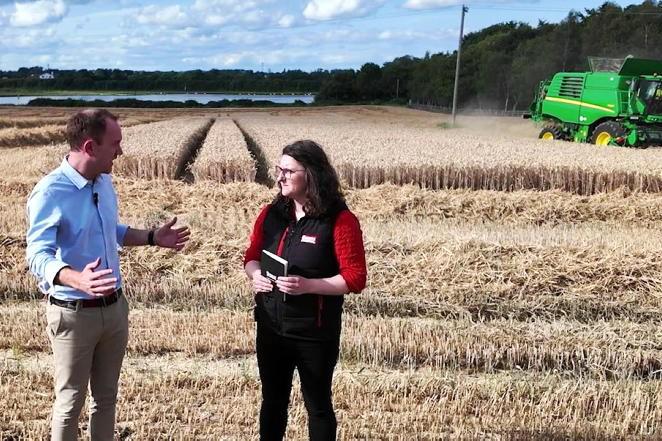
This week, the Irish Farmers Journal’s Crop Tour supported by BASF’s Farming the Biggest Job on Earth campaign is examining crops across the country and estimating yields.
In this article, we break down the results of the agronomists’ survey for each crop and estimate total production.
Spring barley does not look like it will hit any records and many farmers are looking at very disappointing crops. Harvest is underway for some farmers, which is extremely early for the crop.
Nationally, the survey estimated spring barley will average 2.75t/ac, but the range in that yield is 1.5-3.9t/ac.
The average yield changes for the different areas of the country reaching 2.9t/ac in the south, 2.7t/ac in the southeast, 2.6t/ac in the midlands, 2.8t/ac in the northeast and 2.5t/ac in the northwest.
Dry soil conditions were a big issue for spring barley and led to thin crops.
Tillers were lost from plants and some of those plants now have secondary growth. Some barley yellow dwarf virus (BYDV) was also reported.
Reports vary across the country, while early sown crops are reported to be excellent and going over 3t/ac, in some places; they have suffered badly from drought in other areas.
Similarly, some mid-sown crops appear to be doing well in places, but others did not take up fertiliser properly and struggled in the early stages of growth.
In some cases, crops were hit with heavy rain after planting. Many crops have already been harvested.
Winter wheat has been estimated at an average yield of 4.28t/ac and a range of 3.5-5.5t/ac (see Table 2). In the northeast, winter wheat yields have been estimated at around 4.17t/ac, this figure is 4.25t/ac in the midlands and the south of the country and 4.24t/ac in the southeast. A number of agronomists commented that there is good potential in winter wheat. Yellow rust was a big issue this year, but the majority of it was dealt with early in the season and septoria control was relatively good in what was a lower pressure year than recent times. Timings looked to be easier to manage and so control was better.
4.28t/ac national yield estimate
Take-all is visible in some crops, but its impact on yield will vary and BYDV is also visible in some crops. While drought reduced disease pressure it has also impacted a number of crops’ performances. It is less evident on heavier land. There was good grain filling weather, but some also commented that crops have been coming in too early due to that drier weather.
Winter barley
Agronomists estimated that winter barley has an average yield this year of 3.8t/ac. Most winter barley was cut at the time of the survey and the yield range was placed at 2-4.7t/ac.
3.8t/ac national yield estimate
Agronomists commented that take-all was an issue in crops, particularly early-sown crops.
One agronomist reported it was taking about 0.5t/ac from yield, but other crops were worse affected. Some reported good control of BYDV with aphicides in November.
Crops in a good rotation performed better. The dry weather in April was reported as having a big impact on some crops as nitrogen uptake and mineralisation were issues.
There were comments that crops on stronger ground did best in the drier conditions.
A number of agronomists also commented on the consistency that BYDV tolerant varieties have brought to winter barley.
Winter and spring oats look like they will continue their generally consistent run of form on yields, according to agronomists’ reports. Winter oats are expected to average about 3.6t/ac nationally this season, but the range in yields is from 2.5t-4.5t/ac. Some crops were hit by frost damage and in many cases, this was reported to be more so on the early-sown crops planted in October. One agronomist noted that there are less grains per panicle, but KPH levels are excellent so this may have been the balance.
3.6t/ac: winter oats average yield estimate
The spring oats average estimate is 2.88t/ac, but the range is 2-3.6t/ac. Many participants in the survey commented that dry weather impacted on spring oat crops. Growth regulator also hit crops at times. In the northwest mildew and virus were reported to affect crops. In the south and southeast, spring oats looked to be more positive, with yield predictions of up to 3.6t/ac and reports of clean crops with very few issues.
One agronomist in the southeast commented spring oats “were a pleasure to watch”.
2.88t/ac the spring oats average yield estimate
Estimates for spring wheat yields are around 3.1t/ac, with a range of 2-4t/ac. One Cork agronomist commented that there is late septoria in crops, and mildew and rust were issues along the southeast coast. The drier weather has impacted crops.
3.1t/ac national yield estimate
Spring beans are estimated to have a national yield of about 2.38t/ac, but this is very hard to predict at this time of the year. The range in expected yields is 1-3.5t/ac. Drought was reported to have hit many crops. One agronomist wrote that they would assume drought has taken from yield and that “pod numbers aren’t as high as you would need for maximum yield”. Another agronomist said that drought has hit some crops so hard that they could be harvested in the middle of August. Disease pressure had been very low, but has come into crops now with chocolate spot and downy mildew present. There were also some reports of aphid damage.
Nationally agronomists estimated that approximately 4.618m round 4x4 bales of straw will be produced. This figure takes the June Straw Incorporation Measure (SIM) applications out of the total hectares.
It should be noted that some farmers have withdrawn from this scheme (or still can), or swapped parcels. It should also be noted that some farmers have and will chop straw that is not in the measure. Spring barley with little straw will be better chopped.
Spring barley straw yields were estimated to range from four to 10 4X4 bales/ac. They estimated winter wheat at eight to 14 bales/ac.
The survey was carried out when most winter barley was harvested and agronomists placed average winter barley straw yields at 10 bales/ac, but this ranged from seven to 12.
Less than half of the spring wheat straw will be chopped under the SIM.
Of the surveyed agronomists, 73-75% estimated that winter and spring oat straw would be chopped, while the remaining 23-25% said some or all of the oat straw will be baled.
We don’t have the areas accounted for by the agronomists, so looking at oat area in the SIM, approximately 60% of oat straw is in the SIM for chopping under the measure.
Thank you to all the agronomists who took time to take this survey and give such great detail on what they have seen in crops throughout the season.
You can view videos from the Irish Farmers Journal Crop Tour where we meet with agronomists and farmers in the fields by clicking here.