



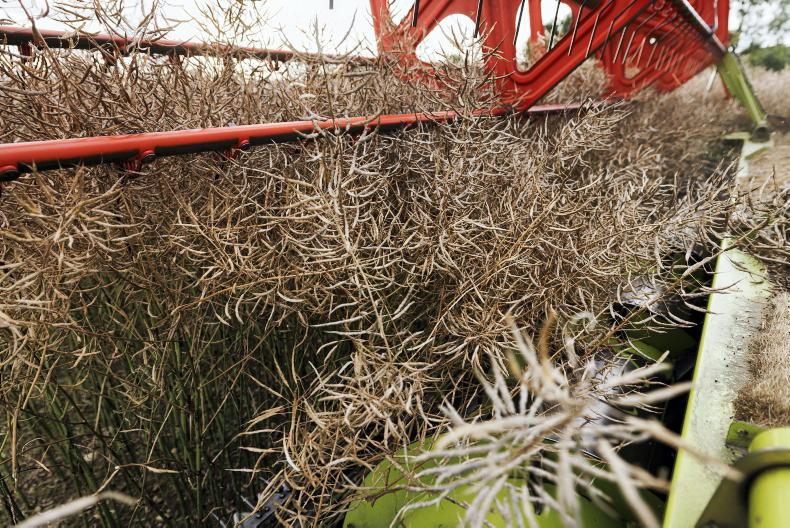
The harvest is continuing at pace across the country, as crops come in quickly in the high temperatures.
Winter barley and winter oats are now wrapped up and large amounts of winter oilseed rape have been harvested, but there is still plenty to be cut.
Winter wheat has been cut in a number of counties. Kildare, Kilkenny and Tipperary were among the first counties to see winter wheat cut.
Automatically, people may assume because crops are cut early that they may have lower yields, but that is not necessarily the case, with reports of some wheat crops cut so far coming in over 4t/ac and hitting 4.5t/ac in some cases.
Many crops so far are on earlier, lighter ground and the recent hot spell has probably resulted in these crops drying in quickly.
They are very reasonable yields this year. Of course, people will wonder would crops have done better if temperatures had not been so high and were cut later.
There were some initial reports of early oilseed rape being harvested at low yields, but over the past week, yield reports improved with 2t/ac and 2.2t/ac being reported.
Moisture contents are very low and the crops needed to be cut, with some hitting as low as 6% moisture content.
Oilseed rape rotation
Earlier this week, we caught up with Quinns of Baltinglass agronomist James O’Loughlin. James gave a full run down on the harvest so far in Quinns, where winter barley and oats are all harvested and oilseed rape and winter wheat have been cut.
James said oilseed rape is a good news story in Ireland at the minute and he hopes people keep it that way by keeping the right space between crops in their rotation.
James said you need at least four or five years between oilseed rape crops and would prefer that gap to be five years to prevent the development of clubroot, which can decimate oilseed rape crops.
Oilseed rape is making a good return for farmers, but James warned growers not to tighten the rotation because it is making a profit to get more into the ground.
“Definitely do not tighten your rotation on oilseed rape and carry out your due diligence if you are taking on new land that it hasn’t had oilseed rape in the last couple of years or it hasn’t had stubble turnips or forage rape,” James warned.
To listen to the full interview with James and hear all about the harvest coming in, tune into this week’s Tillage Podcast or listen wherever you get your podcasts.


SHARING OPTIONS