In difficult autumns, crop establishment can be challenging for all systems, but systems differ.
Those practising min-till and direct drill can be more challenged than plough-based systems, not because their soils are in poorer condition or wetter (they may often be better), but because the less deep or absent tillage, prior to, or during sowing may not create optimal conditions for growth in a wet autumn.
Many of those who practise non-inversion tillage avoid this by sowing earlier when conditions are usually better and longer days help drying. Early sowing is not without other challenges, however.
So far, 2023 has proven difficult for sowing; unless very early opportunities were taken (when high-output systems can get through work quickly), most growers are now facing a weather-dependent uphill battle to get sowing completed.
In difficult autumns, the plough and one-pass can often work and get good establishment in conditions where other systems would not.
While some would say this is because the power-harrow drill combination “forces” a seedbed in conditions that soil should not be worked, this is an over simplification.
The plough can bring up drier soil in the autumn and provided the furrow bottom or furrow slice is not being smeared, the risk of damage from the cleaving and turning action is limited, and on a good day, further drying of the surface will occur and the “one pass” will work quite
well.
But this system can abuse soils if worked when excessively wet; and while this “mucking in” may establish crops, soil damage may result in these crops running out of steam quickly, particularly if the following season is dry.
And the soil damage may extend longer than one season.
So assuming we can avoid using the plough and one-pass in these “too-wet” conditions, does use of the one-pass system in a tricky season destroy any good that we have done by adopting a non-inversion system?
The answer is not a simple one; some impacts are considered here.
Impact on soil carbon
Shallow, less intensive tillage, by aerating the soil less, may reduce carbon loss via soil respiration.
But in Ireland’s cooler climate with moist soils, the rate of C loss is probably a lot less than in a hot climate, where non-inversion systems were developed.
Also to achieve good near-surface drainage, many Irish min-till operators are working to depths of 150mm (six inches) and more, in which case the level of soil disturbance and C loss is close to that of ploughing.
While C near the surface may have some functional benefits, it is also more prone to loss
Interestingly, research reviews of European soils rarely find any measured differences in total soil organic C content between soils established with plough and non-inversion systems – partly because differences are likely to be very small.
There will be differences in where carbon is deposited in the soil profile though; direct-drilled soils and to a lesser extent min-till soils, will have most of the carbon near the surface, with plough systems having it spread through the plough layer.
While C near the surface may have some functional benefits, it is also more prone to loss.
While it is often quoted that one year’s intensive tillage can stimulate massive C loss, this really applies to high organic matter grassland soils, where what was stable C in permanent pasture rapidly declines to a new level when annually cropped.
This is not the situation with annual cropping, even where we are retaining as much C as possible; C levels are much lower and less prone to further losses.
From a carbon perspective, ploughing a min-tilled soil (eg for wet season establishment or as a grass weed control measure) is unlikely to have a significant impact on soil C.
Deeper placement
Ploughing a direct-drilled soil may tend to release more C, but this may be somewhat balanced by the deeper placement of the high C top layer where it may be more stable when mixed with C-deficient soil.
Impact on min-till soil structure and avoiding a pan in seedbed drainage
When we cultivate a soil, we mechanically restructure the elements we cultivate, altering the aggregate size and making it less dense. But the cultivation action can also smear and compact the soil, particularly beneath the cultivating tool, forming pans.
For those practising deeper min-till from 100mm to 175mm, choosing to plough for a season will primarily just alter the depth to which it is loosened. This, as well as turning up drier soil, may improve in seedbed drainage resulting in better establishment.
It may also loosen a harder pan beneath the min-till depth.
Wet conditions
But if ploughing is carried out in very wet conditions it may create a plough-pan at a greater depth that may take time (or in some cases other action) to resolve.
And as indicated earlier, if the plough/one-pass combination is used in very bad conditions, it will do more harm.
The impact of ploughing a direct-drilled soil is more serious – see panel on facing page.
Avoid ploughing where direct
drilling has been successful
Ploughing a true direct-drilled soil is certainly a more drastic decision to take if the path to direct drilling has been progressing successfully to date.
From a soil structure perspective, direct drilling aims to allow a vertical fissuring to develop, to facilitate drainage and root growth.
This takes time (and protection from compaction) so that a once-off ploughing operation will effectively reset the entire operation, losing any structure benefits that may have occurred.
So unless there are already soil structure/compaction/other issues in the direct-drilled field, that raises doubt about the ability to persist with direct drilling, ploughing should be avoided.

Cathal Slattery and Eoin Quigley of PH Farms, Fethard, Co Tipperary, ploughing maize ground ahead of sowing triticale for Richard and Bill Donovan, Brensha, Co Tipperary. \ Donal O'Leary
Impact on machine carrying capacity and field levelness
True reductions in tillage depth and intensity will generally result in more consolidated soils that are less impacted by machinery traffic, although this should not be necessarily interpreted as being more resistant to compaction as compaction avoidance is critical where deeper cultivation is avoided.
Ploughing to depth will result in a soil that will not support machinery traffic as well; resulting in ruts, poor/no crop in the rut area, and water channelling in the field.
Also, many min-till practitioners have much more level fields than they had when ploughing and on some sites, can use this to good effect to reduce water logging.
Ploughing is much more uneven – both beneath the plough (the tip works deeper than the share) and at ‘ins’ and ‘outs’, headlands, etc.
The power required for crop establishment is directly proportional to cultivation depth and consequently for given labour availability and tractor size, shallow min-till and direct-drill systems can be very fast and efficient, getting through the work.
A return to ploughing can reduce work rate dramatically.
Horsepower
The temptation to throw massive horsepower at a ploughing operation can result in huge axle loads (>12t) where growers resort to linkage-mounted folding power harrow combinations of 5m to 6m working width, greatly increasing the risk to the soil.
Alternative approaches: moving to a spring crop
The real alternative to making a decision about ploughing is to wait for conditions to improve; normally planting a spring crop.
For those direct drilling, this may involve a further yield penalty on many soils as crops will be slower to establish.
For min-till operators, those working shallow with low intensity, may choose to work the soil a little more in the spring to allow the soils dry and heat up quicker and to give faster establishment.
Moving to spring establishment needs to be carefully considered as in some situations there will be little overall impact on profitability, whereas in others, there may indeed be a significant challenge depending on crop, soils and climate/weather.
Finally
We must remember that establishment systems are used to get crops established and to provide soil conditions for subsequent crop growth, and to impact on weed control too.
The questioning and exploration of crop establishment methods over the last 20 years has been positive, but we need to be careful about adopting a simple, often “polarised” view about the various systems as there is a risk that we may “box ourselves” into a corner and not act pragmatically.
These decisions are not simple.
While we do need to look at the immediate impact on likely yield and profit in one year, we also need to take into account the longer-term effect of any decision taken; whether positive or negative.

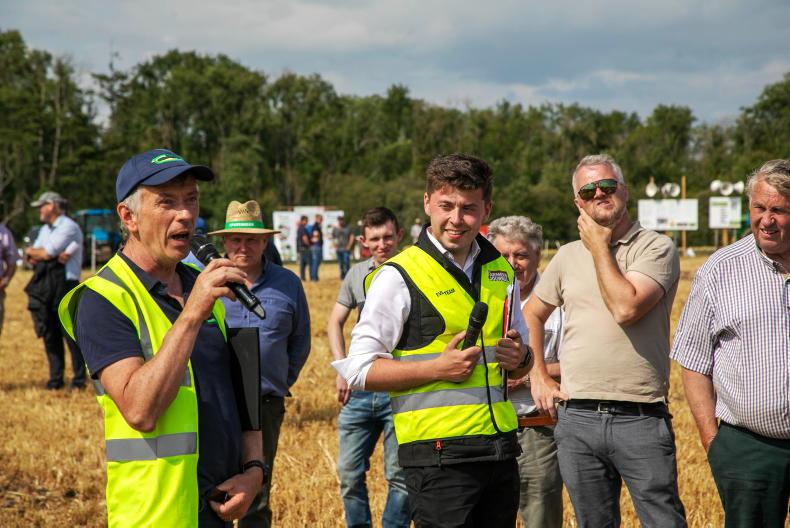
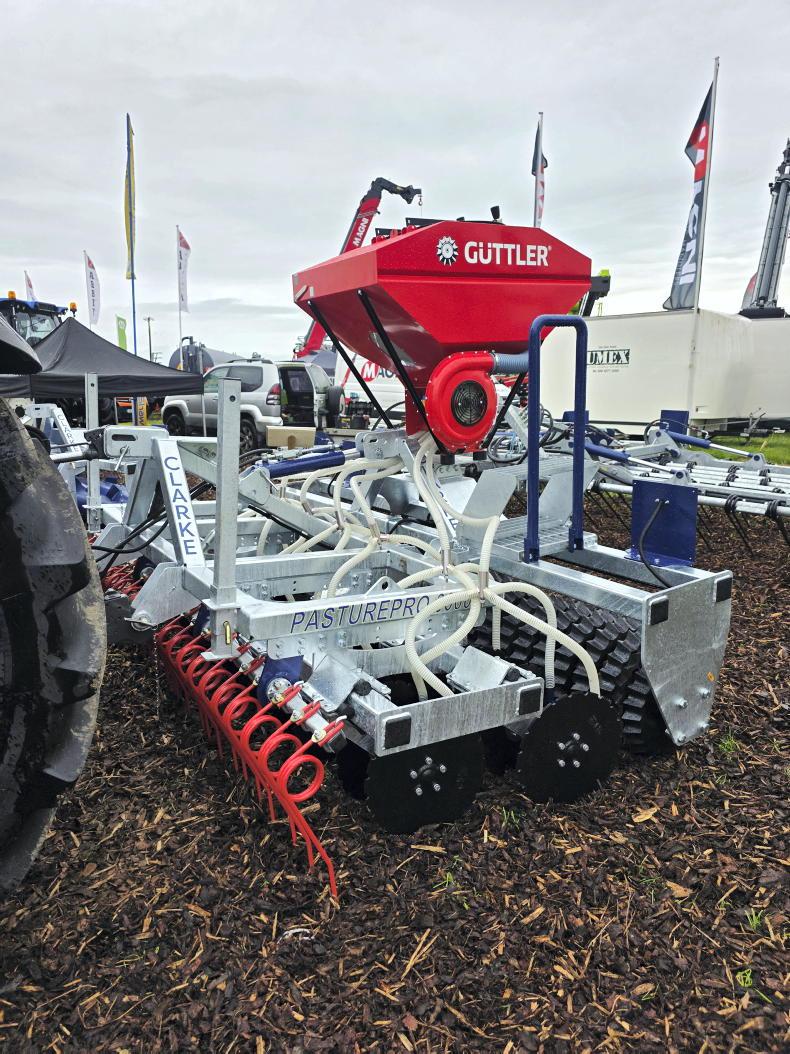
The Crops and Cultivations 2023 event at Oak Park, Co Carlow. \ Claire Nash
While bad weather may be driving these considerations now, in the future, more flexible approaches may also have to be considered, to deal with increasing weed control challenges and also for compaction issues in a wetter climate.
In difficult autumns, the plough and one-pass can often work and get good establishment in conditions where other systems would not. Working the plough in wet conditions can seriously harm soil structure.Moving from a successful min-till or direct-drill system to ploughing in one wet year is a drastic decision which should not be taken lightly.Min-till or direct drill land is generally more level and less subject to waterlogging.
In difficult autumns, crop establishment can be challenging for all systems, but systems differ.
Those practising min-till and direct drill can be more challenged than plough-based systems, not because their soils are in poorer condition or wetter (they may often be better), but because the less deep or absent tillage, prior to, or during sowing may not create optimal conditions for growth in a wet autumn.
Many of those who practise non-inversion tillage avoid this by sowing earlier when conditions are usually better and longer days help drying. Early sowing is not without other challenges, however.
So far, 2023 has proven difficult for sowing; unless very early opportunities were taken (when high-output systems can get through work quickly), most growers are now facing a weather-dependent uphill battle to get sowing completed.
In difficult autumns, the plough and one-pass can often work and get good establishment in conditions where other systems would not.
While some would say this is because the power-harrow drill combination “forces” a seedbed in conditions that soil should not be worked, this is an over simplification.
The plough can bring up drier soil in the autumn and provided the furrow bottom or furrow slice is not being smeared, the risk of damage from the cleaving and turning action is limited, and on a good day, further drying of the surface will occur and the “one pass” will work quite
well.
But this system can abuse soils if worked when excessively wet; and while this “mucking in” may establish crops, soil damage may result in these crops running out of steam quickly, particularly if the following season is dry.
And the soil damage may extend longer than one season.
So assuming we can avoid using the plough and one-pass in these “too-wet” conditions, does use of the one-pass system in a tricky season destroy any good that we have done by adopting a non-inversion system?
The answer is not a simple one; some impacts are considered here.
Impact on soil carbon
Shallow, less intensive tillage, by aerating the soil less, may reduce carbon loss via soil respiration.
But in Ireland’s cooler climate with moist soils, the rate of C loss is probably a lot less than in a hot climate, where non-inversion systems were developed.
Also to achieve good near-surface drainage, many Irish min-till operators are working to depths of 150mm (six inches) and more, in which case the level of soil disturbance and C loss is close to that of ploughing.
While C near the surface may have some functional benefits, it is also more prone to loss
Interestingly, research reviews of European soils rarely find any measured differences in total soil organic C content between soils established with plough and non-inversion systems – partly because differences are likely to be very small.
There will be differences in where carbon is deposited in the soil profile though; direct-drilled soils and to a lesser extent min-till soils, will have most of the carbon near the surface, with plough systems having it spread through the plough layer.
While C near the surface may have some functional benefits, it is also more prone to loss.
While it is often quoted that one year’s intensive tillage can stimulate massive C loss, this really applies to high organic matter grassland soils, where what was stable C in permanent pasture rapidly declines to a new level when annually cropped.
This is not the situation with annual cropping, even where we are retaining as much C as possible; C levels are much lower and less prone to further losses.
From a carbon perspective, ploughing a min-tilled soil (eg for wet season establishment or as a grass weed control measure) is unlikely to have a significant impact on soil C.
Deeper placement
Ploughing a direct-drilled soil may tend to release more C, but this may be somewhat balanced by the deeper placement of the high C top layer where it may be more stable when mixed with C-deficient soil.
Impact on min-till soil structure and avoiding a pan in seedbed drainage
When we cultivate a soil, we mechanically restructure the elements we cultivate, altering the aggregate size and making it less dense. But the cultivation action can also smear and compact the soil, particularly beneath the cultivating tool, forming pans.
For those practising deeper min-till from 100mm to 175mm, choosing to plough for a season will primarily just alter the depth to which it is loosened. This, as well as turning up drier soil, may improve in seedbed drainage resulting in better establishment.
It may also loosen a harder pan beneath the min-till depth.
Wet conditions
But if ploughing is carried out in very wet conditions it may create a plough-pan at a greater depth that may take time (or in some cases other action) to resolve.
And as indicated earlier, if the plough/one-pass combination is used in very bad conditions, it will do more harm.
The impact of ploughing a direct-drilled soil is more serious – see panel on facing page.
Avoid ploughing where direct
drilling has been successful
Ploughing a true direct-drilled soil is certainly a more drastic decision to take if the path to direct drilling has been progressing successfully to date.
From a soil structure perspective, direct drilling aims to allow a vertical fissuring to develop, to facilitate drainage and root growth.
This takes time (and protection from compaction) so that a once-off ploughing operation will effectively reset the entire operation, losing any structure benefits that may have occurred.
So unless there are already soil structure/compaction/other issues in the direct-drilled field, that raises doubt about the ability to persist with direct drilling, ploughing should be avoided.

Cathal Slattery and Eoin Quigley of PH Farms, Fethard, Co Tipperary, ploughing maize ground ahead of sowing triticale for Richard and Bill Donovan, Brensha, Co Tipperary. \ Donal O'Leary
Impact on machine carrying capacity and field levelness
True reductions in tillage depth and intensity will generally result in more consolidated soils that are less impacted by machinery traffic, although this should not be necessarily interpreted as being more resistant to compaction as compaction avoidance is critical where deeper cultivation is avoided.
Ploughing to depth will result in a soil that will not support machinery traffic as well; resulting in ruts, poor/no crop in the rut area, and water channelling in the field.
Also, many min-till practitioners have much more level fields than they had when ploughing and on some sites, can use this to good effect to reduce water logging.
Ploughing is much more uneven – both beneath the plough (the tip works deeper than the share) and at ‘ins’ and ‘outs’, headlands, etc.
The power required for crop establishment is directly proportional to cultivation depth and consequently for given labour availability and tractor size, shallow min-till and direct-drill systems can be very fast and efficient, getting through the work.
A return to ploughing can reduce work rate dramatically.
Horsepower
The temptation to throw massive horsepower at a ploughing operation can result in huge axle loads (>12t) where growers resort to linkage-mounted folding power harrow combinations of 5m to 6m working width, greatly increasing the risk to the soil.
Alternative approaches: moving to a spring crop
The real alternative to making a decision about ploughing is to wait for conditions to improve; normally planting a spring crop.
For those direct drilling, this may involve a further yield penalty on many soils as crops will be slower to establish.
For min-till operators, those working shallow with low intensity, may choose to work the soil a little more in the spring to allow the soils dry and heat up quicker and to give faster establishment.
Moving to spring establishment needs to be carefully considered as in some situations there will be little overall impact on profitability, whereas in others, there may indeed be a significant challenge depending on crop, soils and climate/weather.
Finally
We must remember that establishment systems are used to get crops established and to provide soil conditions for subsequent crop growth, and to impact on weed control too.
The questioning and exploration of crop establishment methods over the last 20 years has been positive, but we need to be careful about adopting a simple, often “polarised” view about the various systems as there is a risk that we may “box ourselves” into a corner and not act pragmatically.
These decisions are not simple.
While we do need to look at the immediate impact on likely yield and profit in one year, we also need to take into account the longer-term effect of any decision taken; whether positive or negative.

The Crops and Cultivations 2023 event at Oak Park, Co Carlow. \ Claire Nash
While bad weather may be driving these considerations now, in the future, more flexible approaches may also have to be considered, to deal with increasing weed control challenges and also for compaction issues in a wetter climate.
In difficult autumns, the plough and one-pass can often work and get good establishment in conditions where other systems would not. Working the plough in wet conditions can seriously harm soil structure.Moving from a successful min-till or direct-drill system to ploughing in one wet year is a drastic decision which should not be taken lightly.Min-till or direct drill land is generally more level and less subject to waterlogging.
SHARING OPTIONS