



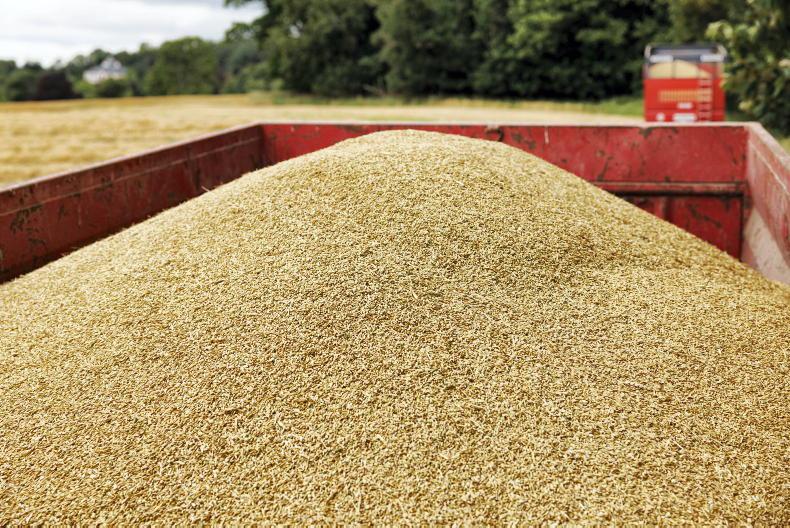
Tirlán has announced prices of €190/t for feed barley and €200/t for feed wheat, including all bonuses for 2025. This equates to base prices of €180/t and €190/t respectively.
Dairygold set a price of €188/t for feed barley and €198/t for feed wheat, including a €5/t trading bonus, which equates to €183/t and €193/t base prices respectively. These prices are based on a moisture content of 20%.
A midlands merchant told the Irish Farmers Journal they will pay base prices of €190/t for feed barley, €200/t for feed wheat, €180/t for feed oats and €220/t for beans, with “no hoops” to jump through to get the full price. Some merchants in the northeast are reported to be paying €180/t for barley and €190/t for wheat, while barley price moves to €185/t and €195/t for wheat in the southeast and parts of the midlands. These merchants have not officially released prices.
The general mood among farmers this week is disappointment in the current prices, which are below the cost of production for many, but an admittance that this is where markets are.
Centenary Thurles Co-op was the first to announce grain prices in September, with prices of €198/t for feed barley and €208/t for feed wheat, these prices include the full bonus of €9/t and growers who deliver to the feed mill can receive another €2-7/t for transport.
Analysis: what’s the profit for growers?
When you look at Table 2 it is clear to see why farmers are extremely disappointed with prices. Using Teagasc cost figures and Irish Farmers Journal predicted crop averages, farmers on their own land are losing money on all the prices quoted for spring feed barley, which is the tillage crop covering the largest area in Ireland at about 115,000ha.
Those being paid €180/t for spring feed barley will be down €46/ac on grain. If that farmer receives €100/ac from the Straw Incorporation Measure then their profit is €54/ac on owned land. At the highest price of €198/t, farmers will only make €103.50/ac from straw and grain on owned land. It should be noted that farmers who did not opt into the Straw Incorporation Measure may have brought in less than €100/ac from straw, depending on yields.
Costs will no doubt change from farm to farm and some farmers will have lower costs than the Teagasc figures, but some will have higher costs. In the same way, some farmers will have lower yields than the average and some will have higher. Many spring barley growers had yields of around 2.25t/ac, while others moved over 3t/ac.
The farmer will also receive their BISS payment, which is most likely declining if you are a tillage farmer. However, there are fixed costs to pay such as stubble cultivation, hedge cutting, advisory fees, ESB, phone and pre-sowing glyphosate. Teagasc places fixed costs at about €83/ac (€204/ha), but this does not include stubble cultivation which is another €40/ac (excluding VAT).
Looking at the winter barley figures it is less likely that tillage farmers lost money on this crop. It offers higher yields, but is more costly to grow.
Winter wheat growers were also in the green, but still at low levels. If you take the highest price of €200/t and a profit from grain of €156/t and straw payments at €100/ac that gives a profit of €256/ac on winter wheat at average yields.
Many have been wondering why tillage farmers are planting this autumn when prices are poor, but winter crops are among the most profitable. Malting barley will bring further profit to spring barley growers, but contracts are much lower than they were and the premium has declined.
Land rental
Land rental is the big factor in costs for tillage farmers.
About 40% of the tillage land in the country is rented.
At the profits calculated here, it is clear to see that most farmers renting land are not making money and many are losing money depending on what prices they are paying.
Few will be paying less than €200/ac, with many paying €250-300/ac and higher.



SHARING OPTIONS