



Getting a calf off to a good start is half the battle when it comes to rearing replacement animals or any stock for that matter.
Calf housing is an essential component of achieving this good start and can sometimes get overlooked.
Developing additional calf housing can ease some of the spring headaches for farmers. In this article, we’ll be outlining some of the costs associated with that development.
Shed
This investment in reality carries very little risk when it’s compared to some of the other Twenty Ways we’ve looked at.
More herds are getting locked up with TB every day and the potential for greater red tape around the export of calves always looms in the distance.
In any case, extra accommodation will insulate the business from these potential issues.
The majority of farms will already have some level of housing in place for at least half the herd’s calves.
To fully futureproof the business against the risks discussed, increasing accommodation to rear all the calves born in a year is a sensible approach.
This won’t suit every farm, but the costs of constructing additional calf housing will still be applicable to any farmer.
As an example, take a farm with 150 cows and accommodation for 80 calves at present. This farm would be looking to build housing for 70 more calves if they are to accommodate each animal.
Area needed
In terms of the area needed, calves under 150kg are required by law to have a minimum of 1.5m2 of space per calf. This is low and it is recommended to have closer to 1.8m to 2m2 per animal up to weaning.
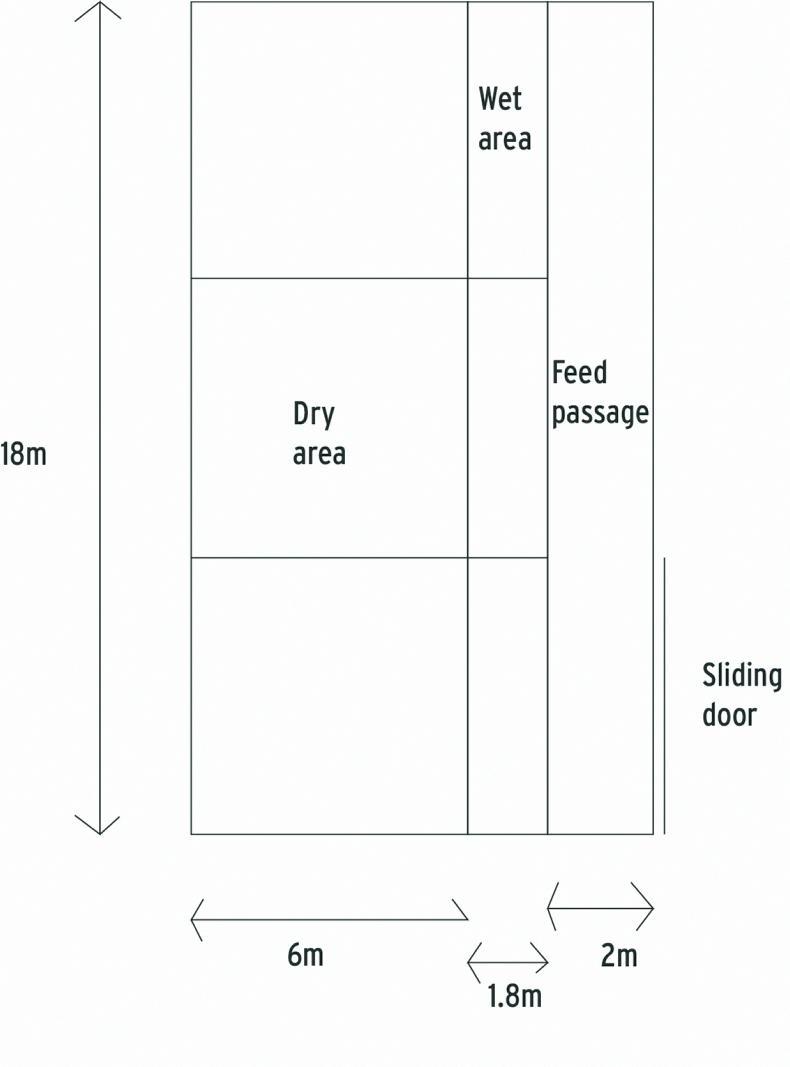
The sample shed in Figure 1 gives a rough idea of what a simple new calf shed could look like. It has three bays, with a dry area for bedding, a feed passage and a wet area to bridge the two.
This shed is TAMS spec and will hold between 60 and 70 calves up to weaning. The shed also allows for the option to install an automatic calf feeder in the future.
Costs
For the shed above including penning, the total cost of the build based on reference costs is €45,150 plus VAT. TAMS reference costs were increased by 20% on calf sheds and they’re seen to be much closer to the actual figure.
With the 40% TAMS grant on the build, the price is €27,090 plus VAT. For qualifying young farmers and women, there is a 60% TAMS grant which would reduce the spend to €18,060 plus VAT.
Return on investment
The main areas of return from having extra accommodation are better calf health and performance, with fewer headaches for the farmer in spring when space starts getting tight.
The real return of this investment will only be possible to calculate in the future, if live calf exports were stopped or farms were forced to keep calves until 28 days.
Similarly, if TB was an issue on a farm, the extra space is a huge benefit to the business, but it’s difficult to put a figure on this that can apply to everyone.
This investment really is a way of futureproofing the business and, as a result, it’s difficult to define a fair return. For that reason, we’re not going to put a figure on that.
My rating
I’m giving this investment a 3.5/5 rating for the simple reason being I don’t think it’s an essential investment that needs to be made on every farm right now.
The issues around calf exports have gone a bit quieter for now and this has meant the rush for building these additional sheds has eased for the time being. However, there’s no doubt the topic will rear its head at some point in the future.
On top of this, TB has been a serious worry and burden for many farmers over the last number of years and it’s never too far away from any herd.
I’d imagine a farmer who has had to go through the rigmarole of being locked up will argue that this is an essential investment and that’s understandable too.
Without doubt, this is an investment that needs to be considered in the next couple of years for all farms, hence the reason the rating is not any lower.
Calf health and welfare should be a priority on farms and if an investment could improve this, I wouldn’t hesitate to follow through on it.
For farmers who are considering it, there are several excellent articles available on the Irish Farmers Journal website around potential designs and costings from farmers who have done it.




SHARING OPTIONS