



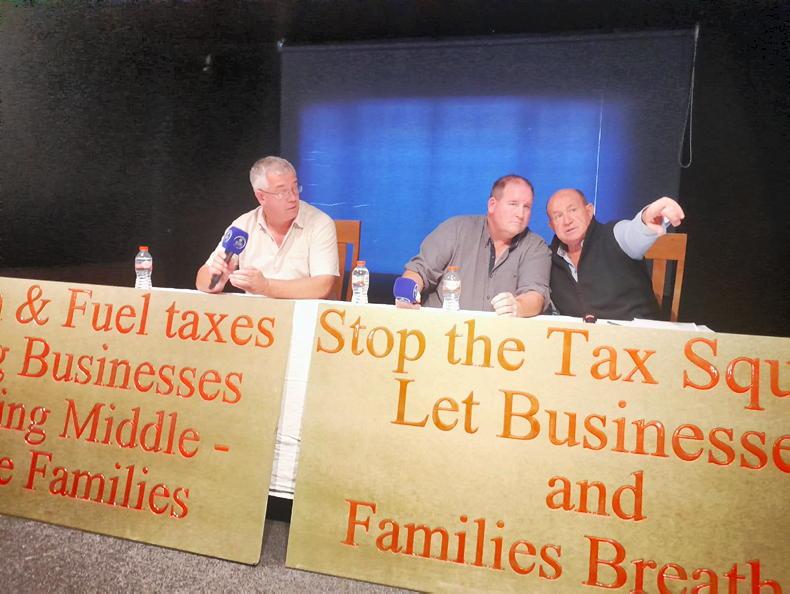
The principal participants in the blockades two weeks ago were identified in media coverage as farmers and hauliers, and their success in securing reductions in fuel taxes pleased many people not directly involved.
But farmers and truck operators make an unlikely pairing – there are reasons why farmers should enjoy low taxes on green diesel, but no such case can be made for hauliers. Heavy trucks, as every county engineer will confirm, are the major source of the high maintenance and repair costs on Ireland’s 100,000km of public roads and very little is raised through tolls, the only direct charges for road use.
The fuel taxes should be seen as a method of raising revenue to meet road system bills, unless you believe that the Exchequer can be financed out of thin air.
Those that impose the greatest costs to the road system should pay the most, through whatever tax channel is most practical. It is complex to have different rates for the same fuel, but simpler to have graduated annual license fees for larger vehicles.
It is no coincidence that the total annual cost of road construction, maintenance and renewal, plus traffic policing and enforcement, add up to roughly the revenue from taxes on automotive fuel, annual vehicle registration taxes and other levies.
In an approximate way, these revenue sources, while not formally earmarked for paying the costs of the road system, work that way and are in practice a form of user charging. The protesters did not see them that way, but more as impositions inflicted arbitrarily on all purchasers of petrol and diesel.
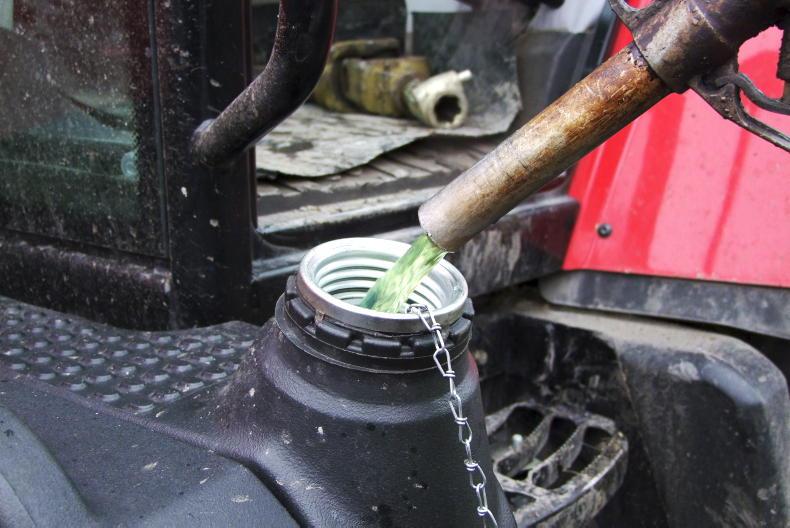
In the inclusion of farmer-taxpayers in the large spread of concessions, the Government appeared complicit in the popular notion that the lower rate of excise on green diesel is a conscious concession to the agricultural community and to be counted as part of farm subsidies. This is highly misleading.
Figures from the Central Statistics Office (CSO) show that total per-litre taxes on regular white diesel are about three times the figure for green diesel, and the gap is regularly reported as a large part of the annual bill, supposedly around €4.8 billion, for ‘fossil fuel subsidies’.
A part of the total tax on both green and white (road) diesel is carbon tax, meant to discourage emissions, and this naturally applies to all combustible fossil fuels.
But the overall tax on green diesel is much lower because the excise component is quite small. So it should be, since the overall tax is a form of cost-recovery from road system users.
The reality is that farm tractors spend almost all of their time on the farm, not on the roads, and the discount on taxes for green diesel reflects the fact that on-road mileage for these vehicles is very low.
The same is true for operators of stationary engines and other non-road users of petrol and diesel. The case for a low rate of tax on fuel for farm tractors is rarely made, but it is perfectly straightforward.
But the overall tax on green diesel is much lower because the excise component is quite small. So it should be, since the overall tax is a form of cost-recovery from road system users
They use the roads very little, despite which many writers classify the preferential rate of tax on green diesel as a subsidy to agriculture. An example is Hannah Daly, a professor of Sustainable Energy at University College Cork writing in The Irish Times on 16 April, who repeats the CSO’s €4.8 billion figure.
This over-estimate of farm subsidies, courtesy of lower tax on green diesel, is distinct from a further misrepresentation of the emissions from agriculture which is regularly reported, the notion that 38% of Ireland’s emissions emanate from the farm sector, incessantly repeated by environmental campaigners in the popular press.
The main portion of Ireland’s food output is exported but the Irish CSO is blameless on this occasion. There is an established practice at Eurostat, the European Union’s statistical agency, of attributing responsibility for emissions on a production rather than a consumption basis, although Saudi Arabia does not carry the can, or the statistical penalty, for its exports of petroleum products. The blame, and the tax impositions, rest with consuming countries.
Most European countries, including Ireland, are net out-sourcers of emissions – there is little left of Europe’s steel or shipbuilding industries for example, and none in Ireland. Europe consumes more emissions than it produces. This distorts the attribution of responsibility for emissions to the disadvantage of sectors with high export shares in output.
The characterisation of Irish agriculture as back-of-the-class for emission reduction is a consequence of this production basis on which emissions are measured, which is not to say that measures to cut emissions relative to farm output are pointless.
But the 38% figure for agriculture’s sectoral share is due to a measurement process which makes no sense. Equally the alleged ‘subsidy’ on green diesel is non-existent, accurately reflecting low road usage.


SHARING OPTIONS