




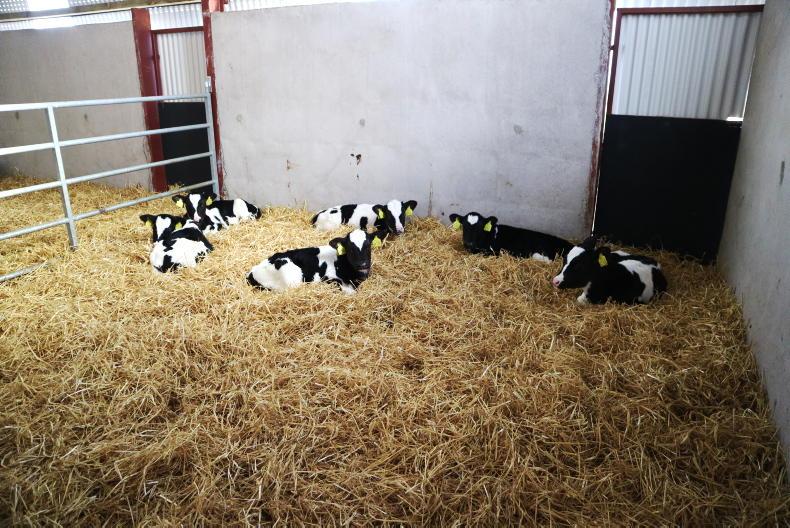
Time is at a premium on most Irish dairy farms over the course of the spring months and any few minutes that can be carved out in a spring day are like gold dust. If an automatic calf-feeder can help achieve that, it’s something worth looking at.
The big selling point of the automatic feeders is without doubt the flexibility they offer. The farmer would be no longer tied to feeding calves twice a day every day after morning and evening milking. With the feeder a farmer can tend to the calves at a point in the day that suits them.
An automatic feeder mimics the natural tendencies of calves by allowing them to drink smaller amounts at more frequent periods throughout the day and night versus the standard twice a day feed.
Calves are more settled as a result with no competition at feeding time and each calf is guaranteed to get their full quota of milk.
Another benefit of the feeder is the health alerts which notify the farmer of which calves have failed to drink and how many visits they make to the feeders. Sick calves typically drink less and will make more unsuccessful visits.
The technology of different brands of feeders differs slightly but overall, they offer a fairly similar service.
Urban and Forster-Technik were the most common brand in Ireland but JFC have started to increase in popularity over the last couple of years.
Forster-Technik machines are sold by companies like Lely, DeLaval and most milking machine dealers, while Holm & Laue feeders are sold under the Dairymaster brand in the south of Ireland and under their own brand in the north.
Costs
The cost of the feeders will vary depending on the number of stations. Typically, there will be either two or four stations and each station will feed 30-35 calves.
A two-station feeder is costing approximately €15,000 including VAT, while the four-station feeder is costing in the region of €21,000 including VAT.
A lot of farmers are buying the four-station feeders to allow them to rear a greater number of calves.
With tighter regulations around calf rearing and TB a big worry, more farmers are future proofing their facilities to accommodate all of the calves for a longer period.
TAMS is available on calf-feeders and it is based on the number of stations. The calculation for the grant is based on the formula 2,608.8(x) + 6,818.8 with x being the number of stations.
Therefore, a four-station feeder is grant aided to the value of €17,254. At the grant rate available to all farmers of 40%, that’s a reduction of €6,900 off the cost of the feeder.
This would bring the investment cost of a new four-station feeder to €14,100. The 60% grant available to young farmers and women would see a reduction of €10,352 off the cost price.
Yearly services are recommended on the feeders to keep them in good working order and this comes at a cost of around €375 for the two stations and €450 for the four stations.
Return on investment
The primary saving from a financial point of view is the labour. Teagasc have suggested that automatic calf feeders save an average of one minute per calf per day over twice a day manual calf feeding.
If we take a farm with 120 calves, reared for four weeks and 36 of this number kept on as replacement heifers (30%) who will be reared for a further 8 weeks, there’s a total time saving of 90 hours with a four-station feeder.
At a cost of €15/hour for labour that’s a saving of €1,350. There is also the opportunity cost for this time to be allocated to other jobs that could add value to the farm, jobs like grassland management or administration which hasn’t been accounted for.
Based on a cost of €14,100 after grant aid it will take roughly ten years to pay back the investment based on the labour-saving figure alone. In a scenario where the farm is simply unable to get additional help, this payback is obviously significantly quicker.
My Rating
An automatic calf feeder offers flexibility in a time of the year that requires it most. It can make calf rearing a more enjoyable experience with no time spent mixing milk, feeding calves and cleaning feeders.
Granted, the return on investment from a financial point of view is quite poor with a payback of over ten years however, if the farm is tight for staff and cannot justify paying an extra labour unit to cover the spring months, the feeder offers a good solution.
There’s no doubt there might be more pressing investments on most farms but I’ve yet to hear of a farmer who’s taken out a feeder and gone back to the old system after putting one in.
In my opinion, the feeder can offer an extra hour in the day when every hour is precious. For that reason, I’d give this investment a 4/5 rating.


SHARING OPTIONS