



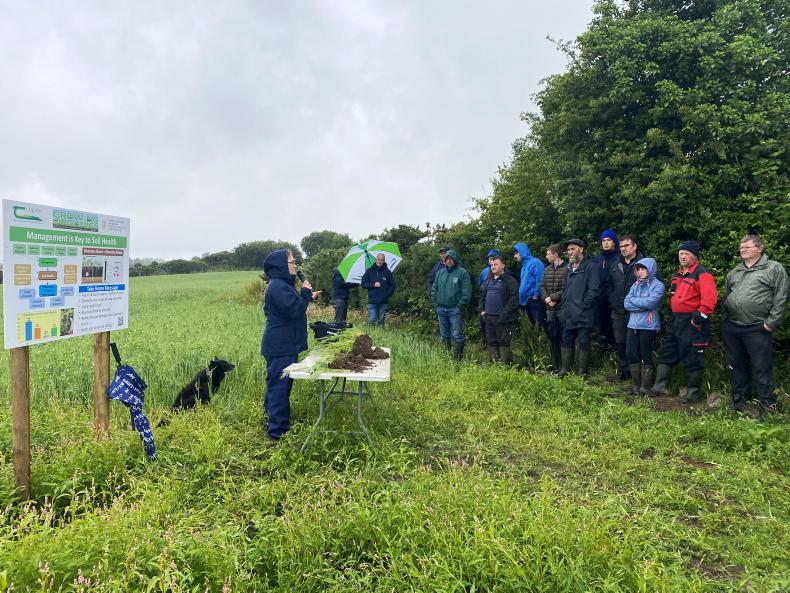
Congratulations to Donald Logue, Craig, Muff, on hosting a successful and informative Teagasc organic farm walk recently.
Organic farming definitely isn’t for everyone, including probably myself, but done well it can be very successful.
Donald started transitioning to organic in 2017 by converting a small part of his farm, which was traditionally a beef farm, into a veg patch and erected a polytunnel. He began growing organic vegetables and salad leaves there, after which he would sell the produce on to local houses and restaurants.
Donald quickly realised that the small area of veg was making him almost as much money as the cattle on the rest of his farm.
Livestock replaced
So, he decided to take the plunge and convert the rest of the farm, which is now completely in organic tillage with no livestock at all.
Donald has since erected more polytunnels and grows a wide variety of seasonal produce, as well as potatoes and other root crops in the field, selling them under the Bee Organic brand.
This year, he is also growing a combi crop, which contains barley, oats and peas, which I must say, was looking extremely healthy on the day of the walk.
He intends to combine, possibly roll the crop and then sell to local organic livestock farmers, to feed and bedstock in the winter.
Demand for organic
Teagasc estimates demand for organic tillage produce - which includes grain, legume/grain mix, concentrate, oats for human consumption, and demand from other mills and distilleries - to be in the region of 40,000t per annum.
It also estimates existing organic production to be closer to 20,000t.
Teagasc outlined potential organic tillage profitability by comparing a conventional spring-oat crop, an organic spring-oat crop being sold at a premium and an organic spring-oat crop being sold at conventional price in the event of market collapse.
Conventional v organic
The figures were based on 2022 grain prices, taking conventional oats at a price of €290/t and a yield of 7.2t/ha, and organic oats at a price of €430/t and a yield of 4.5t/ha. The conventional system showed a gross margin of €796/ha.
The organic system, with grain being sold at an organic premium, showed a gross margin of €1,483/ha; and the organic system with grain being sold at conventional price showed a gross margin of €853/ha.
The main obvious differences were tonnage of grain produced and lack of fertiliser and spray cost on the organic side.
All systems exclude fixed costs and the organic systems exclude the organic payment, which would be another €270 to €320/ha.
A potential seven-year organic rotation was outlined, which started with two years in red clover, one year winter wheat, one year spring oats, one year peas/beans, one year winter wheat, and one year in winter oats, and showed an average gross margin of €1,225/ha.
Now, paper doesn’t refuse ink and there are definitely a lot of variables to be taken into consideration, but it does make for some interesting reading.



SHARING OPTIONS