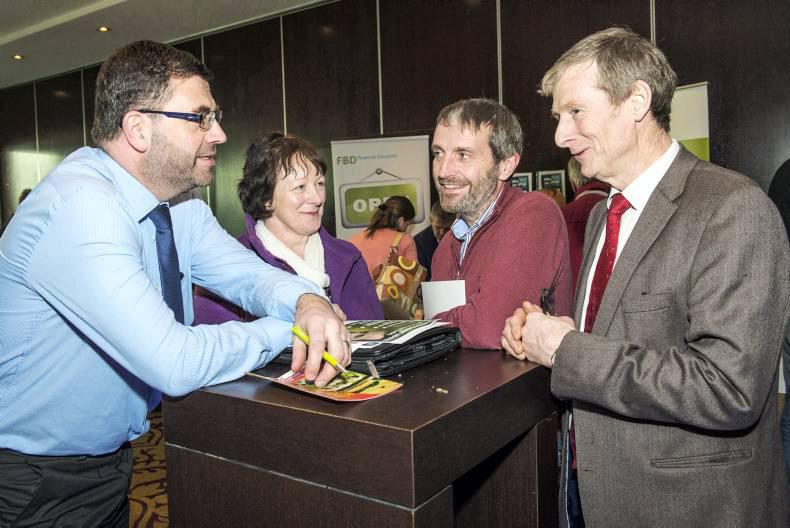
Pictured at the Teagasc 'Get Farm Financially Fit' seminar in Little Island, Cork are Mike Knightson, FBD, Bridget and David Malone, Glenroe, Co Limerick and Gerard MacMahon, Teagasc Regional Manager.
ADVERTISEMENT
Teagasc, in partnership with a host of other financial-related organisations, held a number of meetings around the country this week as part of its focus on farm financial fitness.
Local TD Tom Barry opened the Cork Farm Financially Fit meeting on Tuesday. He suggested that the office side of farming hasn’t developed as well as some of the other areas.
“I know a lot of small businesses that haven’t the turnover of many farms around here and they do quarterly accounts and have full-time staff involved with managing accounts. There are huge resources available in rural Ireland from 9.30am until 3.30pm while kids are in school for part-time work helping farm businesses.”
ADVERTISEMENT
Deputy Barry went on to say farmers must focus on getting soil fertility improved and the nonsense associated with paying high money per acre for rented land that is not performing. He also disagreed with the model of investment on some farms where all the work is done at the start of a business, preferring instead a planned multi-year investment approach.
Teagasc economist Trevor Donnellan explained the various categories of viability on Irish farms.
“Effectively, most cattle and sheep farms are not viable without EU subsidies and many of these farmers have to look at the option of off-farm income or changing the model of farming they currently operate,” said Donnellan.
It was a pity a relatively small crowd attended this event as there was plenty of good information available on the day, and to have all the various stakeholders under the one roof is very advantageous.
“We planned for our kids’ education by taking out an assurance policy on each of them. When it matured, we had options on whether to spend it on their education or other costs.” Katherine O’Leary, Irish Country Living.
“Long-term leasing should increase this year, but make sure you have the lease stamped by both the landowners and the Revenue Commissioners.” Brian Denn, IFAC.
“On a typical farm, costs are spread through the year, but the majority of payments or income come into the business between September and December – need to plan for this on all farms.” Liz Duffy, Teagasc.
“EU inflation will rise and the EU will manage this with increasing interest rates, but I don’t see any significant increase in interest rates in the short- to medium-term” – John Fitzgerald, Bank of Ireland.
“While the weak euro is helping all those business exporting, we will see the cost of goods that are imported rising, including food in many of our supermarkets.” Trevor Donnellan, Teagasc.
“One of the basic things all farm businesses can do is to create a house account and a farm account. Very soon you can see what living expenses are costing.” John Fitzgerald, Bank of Ireland.
Register for free to read this story and our free stories.
This content is available to digital subscribers and loyalty code users only. Sign in to your account, use the code or subscribe to get unlimited access.
The reader loyalty code gives you full access to the site from when you enter it until the following Wednesday at 9pm. Find your unique code on the back page of Irish Country Living every week.
CODE ACCEPTED
You have full access to the site until next Wednesday at 9pm.
CODE NOT VALID
Please try again or contact support.
Teagasc, in partnership with a host of other financial-related organisations, held a number of meetings around the country this week as part of its focus on farm financial fitness.
Local TD Tom Barry opened the Cork Farm Financially Fit meeting on Tuesday. He suggested that the office side of farming hasn’t developed as well as some of the other areas.
“I know a lot of small businesses that haven’t the turnover of many farms around here and they do quarterly accounts and have full-time staff involved with managing accounts. There are huge resources available in rural Ireland from 9.30am until 3.30pm while kids are in school for part-time work helping farm businesses.”
Deputy Barry went on to say farmers must focus on getting soil fertility improved and the nonsense associated with paying high money per acre for rented land that is not performing. He also disagreed with the model of investment on some farms where all the work is done at the start of a business, preferring instead a planned multi-year investment approach.
Teagasc economist Trevor Donnellan explained the various categories of viability on Irish farms.
“Effectively, most cattle and sheep farms are not viable without EU subsidies and many of these farmers have to look at the option of off-farm income or changing the model of farming they currently operate,” said Donnellan.
It was a pity a relatively small crowd attended this event as there was plenty of good information available on the day, and to have all the various stakeholders under the one roof is very advantageous.
“We planned for our kids’ education by taking out an assurance policy on each of them. When it matured, we had options on whether to spend it on their education or other costs.” Katherine O’Leary, Irish Country Living.
“Long-term leasing should increase this year, but make sure you have the lease stamped by both the landowners and the Revenue Commissioners.” Brian Denn, IFAC.
“On a typical farm, costs are spread through the year, but the majority of payments or income come into the business between September and December – need to plan for this on all farms.” Liz Duffy, Teagasc.
“EU inflation will rise and the EU will manage this with increasing interest rates, but I don’t see any significant increase in interest rates in the short- to medium-term” – John Fitzgerald, Bank of Ireland.
“While the weak euro is helping all those business exporting, we will see the cost of goods that are imported rising, including food in many of our supermarkets.” Trevor Donnellan, Teagasc.
“One of the basic things all farm businesses can do is to create a house account and a farm account. Very soon you can see what living expenses are costing.” John Fitzgerald, Bank of Ireland.
If you would like to speak to a member of our team, please call us on 01-4199525.
Link sent to your email address
We have sent an email to your address. Please click on the link in this email to reset your password. If you can't find it in your inbox, please check your spam folder. If you can't find the email, please call us on 01-4199525.
ENTER YOUR LOYALTY CODE:
The reader loyalty code gives you full access to the site from when you enter it until the following Wednesday at 9pm. Find your unique code on the back page of Irish Country Living every week.







SHARING OPTIONS