Heavy rainfall continues to leave ground saturated in many parts of the country.
While the slurry spreading period opens for the counties in zone 3 for nitrates and Northern Ireland on 31 January, ground conditions look set to delay the spreading of slurry in the coming weeks.
Therefore, there is still an opportunity to get grassland sampled to check soil fertility levels before you try and get slurry out to ease the pressure on storage tanks.
Taking soils samples later in spring is fine. But only sample fields that have not received any chemical fertiliser, slurry or farm yard manure for at least 10 weeks prior to the sampling date.
Sampling now will give you a better insight into which type of fertiliser to buy for the first and second dressing this spring.
Outlined are five tips for soil sampling.
1. Sample less productive fields
Soil sampling will indicate if poor grass growth is down to a fertility issue. But if the analysis shows soils are fine for lime, phosphate (P) and potash (K), then you may need to check for soil compaction, drainage or sward quality.
Fields that have been marked for reseeding should also be sampled.
2. Sample top six inches of soil
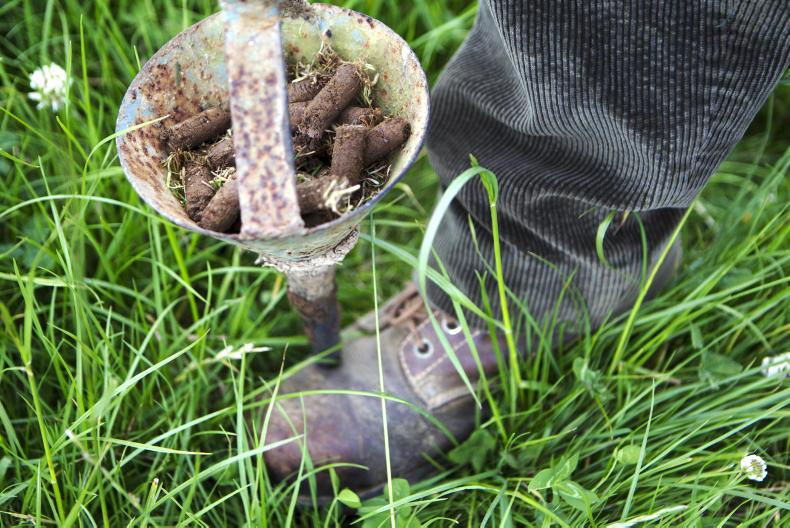
If you do not have access to a soil corer, you can still takes samples with a spade. You only need to take a sample from within the top four to six inches of soil. You will need no more than a handle of soil from each sample point.
3. Take a representative sample
There can be plenty of variation in soil type within a field. So the more cores you take the better, especially as field size increases.
Take at least 20 cores per sample area and empty in a bucket. Mix the samples before filling the sample bag. When sampling, walk the field in a zig-zag pattern to give more variation in soil type.
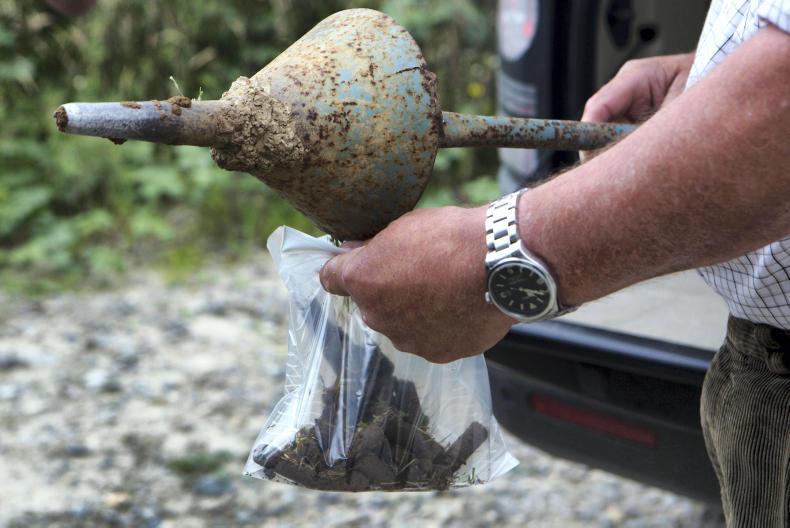
Take a minimum of 20 cores for each sample area.Take a minimum of 20 cores for each sample area.
4. Areas to avoid
Do not sample areas where ring feeders, or meal troughs, are usually placed as you will get a false reading from your soil samples.
Cattle will pass greater quantities of dung and urine in these areas. For the same reason, avoid sampling areas close to dung pats.
Avoid the area around water troughs, field headlands and boundaries where fertiliser applications are much lower.
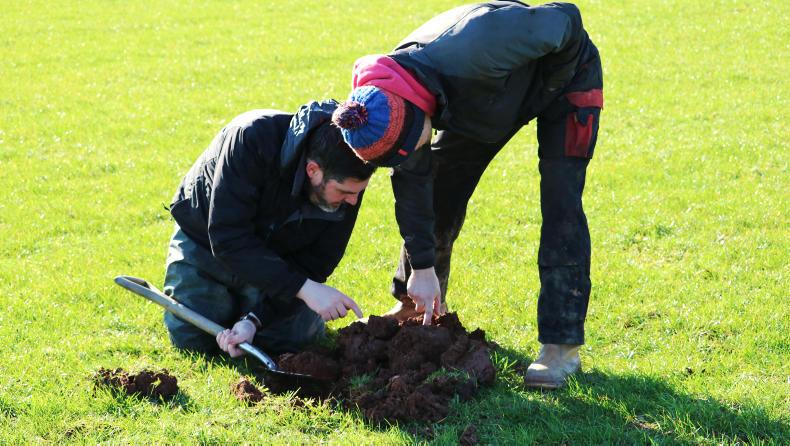
Samples should be taken from various points in the field.Samples should be taken from various points in the field.
5. Limit sample areas to 10 acres max
Ideally one sample should be taken from each field but this is not always practical.
Smaller grazing fields of one acre to two acres that receive the same fertiliser rates and grazing management can be grouped together as one sample.
Limit the sample area to a maximum of 10 acres. Trying to get a larger area into one sample increases the level of soil variation and reduces the reliability of the sample.
Likewise, when sampling a field greater than 10 acres, split into two or more samples.
Read more
Planning for profit: what you need to know
Weekly weather: drier conditions followed by more rain
Slurry rules spark concern among farmers
Heavy rainfall continues to leave ground saturated in many parts of the country.
While the slurry spreading period opens for the counties in zone 3 for nitrates and Northern Ireland on 31 January, ground conditions look set to delay the spreading of slurry in the coming weeks.
Therefore, there is still an opportunity to get grassland sampled to check soil fertility levels before you try and get slurry out to ease the pressure on storage tanks.
Taking soils samples later in spring is fine. But only sample fields that have not received any chemical fertiliser, slurry or farm yard manure for at least 10 weeks prior to the sampling date.
Sampling now will give you a better insight into which type of fertiliser to buy for the first and second dressing this spring.
Outlined are five tips for soil sampling.
1. Sample less productive fields
Soil sampling will indicate if poor grass growth is down to a fertility issue. But if the analysis shows soils are fine for lime, phosphate (P) and potash (K), then you may need to check for soil compaction, drainage or sward quality.
Fields that have been marked for reseeding should also be sampled.
2. Sample top six inches of soil
If you do not have access to a soil corer, you can still takes samples with a spade. You only need to take a sample from within the top four to six inches of soil. You will need no more than a handle of soil from each sample point.
3. Take a representative sample
There can be plenty of variation in soil type within a field. So the more cores you take the better, especially as field size increases.
Take at least 20 cores per sample area and empty in a bucket. Mix the samples before filling the sample bag. When sampling, walk the field in a zig-zag pattern to give more variation in soil type.
Take a minimum of 20 cores for each sample area.Take a minimum of 20 cores for each sample area.
4. Areas to avoid
Do not sample areas where ring feeders, or meal troughs, are usually placed as you will get a false reading from your soil samples.
Cattle will pass greater quantities of dung and urine in these areas. For the same reason, avoid sampling areas close to dung pats.
Avoid the area around water troughs, field headlands and boundaries where fertiliser applications are much lower.
Samples should be taken from various points in the field.Samples should be taken from various points in the field.
5. Limit sample areas to 10 acres max
Ideally one sample should be taken from each field but this is not always practical.
Smaller grazing fields of one acre to two acres that receive the same fertiliser rates and grazing management can be grouped together as one sample.
Limit the sample area to a maximum of 10 acres. Trying to get a larger area into one sample increases the level of soil variation and reduces the reliability of the sample.
Likewise, when sampling a field greater than 10 acres, split into two or more samples.
Read more
Planning for profit: what you need to know
Weekly weather: drier conditions followed by more rain
Slurry rules spark concern among farmers





SHARING OPTIONS