Hair thinning or loss can be a very sensitive issue for women, whether it happens gradually, or suddenly,” says Cork-based hair and scalp specialist Anita Kirby. “There can be a huge number of causes and sometimes the exact cause isn’t known.”
On a healthy person hair grows all the time.
“It goes through the four phases in the cycle of growth* with the different phases ranging, timewise, from 10 days to seven years. Each hair may be at a different stage in the cycle at any one time – with old hair being pushed out as new hair grows.”
We all lose about 100 hairs a day, says Anita.
“This happens naturally, and normally and we don’t really notice it. When something happens to interfere with the normal cycle, however, causing one phase, eg the telogen or resting phase, to last too long, hair loss can result. When you notice hair loss, it may have been triggered by some cause three to four months beforehand. You have to understand the hair’s cycle of growth to understand how there can be a time lapse between cause and effect (actual hair thinning).”
IMPORTANCE OF DIET
Diet is hugely important in having healthy hair, Anita states.
“Hair grows in the basal area of the skin and if the body isn’t healthy, the hair won’t be.
“People with eating disorders, eg anorexia nervosa can experience serious hair loss because the body is malnourished. For hair health, it’s important to eat a balanced diet, including iron-rich foods.
“Omega 3 fatty acids (in fish) and B vitamins (egg yolks) are very important, along with zinc and selenium (in nuts). Calcium and high-quality protein are also important. Lack of protein or low-quality protein can be the cause of brittle and dry, weak hair, for example.”
CAUSES
“Ageing and heredity are obvious ones, but hormonal change is also a huge cause. Women often experience hair loss a few months after having a baby, for example. That’s because hormone levels are so high during the pregnancy that the anagen growth stage in the hair cycle lasts longer. After the birth, hair loss can seem excessive, but it’s because hair that would normally have fallen out didn’t do so.”
Menopause is also a time when hair loss can be experienced due to the drop in oestrogen and the increase in dihydrotestosterone (DHT) in the woman’s system.
“Thyroid disorders, iron deficiency and skin conditions can also be causes.”
Stress can have a huge effect.
“That’s because of the hormone cortisol. I’ve seen cases where the hair loss occurs maybe three to six months after a stressful event, like sudden bereavement. Sustained stress over a long period of time can do it too. Chronic infection, major surgery or treatments for very serious illnesses are other causes. Rapid weight loss can also do it and hair loss may also be a side effect of some long-term medications.”
FEMALE PATTERN BALDNESS
Female pattern baldness is when all hair isn’t lost, but when there is diffused thinning on some or all areas of the scalp.
“It’s called androgenetic alopecia,” says Anita. “Hair loss happens due to the action of androgens – male hormones that women have in small amounts. It is now believed that hair follicles shrink or become less plentiful because of this DHT.”
TRICHOLOGISTS TREATMENT
So what can be done to treat hair loss if you don’t see regrowth happening?
“Every case is different,” says Anita.
“Each consultation, diagnosis and treatment is different and what works for one person may not work for another. This is why self-diagnosis is not a good idea.
“If a person does this, they can end up spending a lot of money on treatments that aren’t suitable for them. People can be very vulnerable when they are experiencing hair loss.”
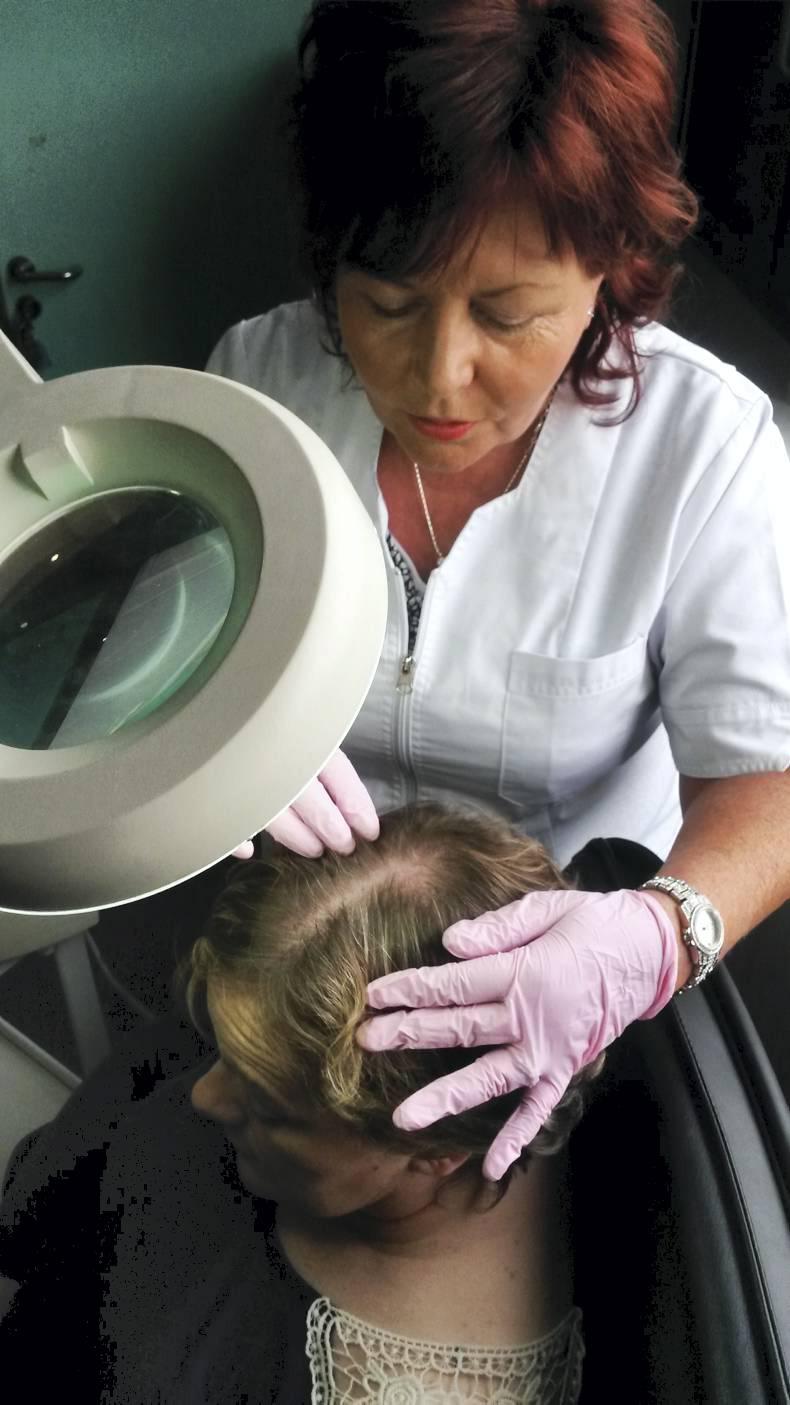
Qualified trichologists use laser treatment along with recommended shampoos and scalp treatments for use at home.
“Science has developed in so many ways, even in the past four years,” Anita says. “Overall, no one can guarantee that hair will come back with treatment, but for many people it does. It is important to get professional advice rather than self-diagnosing. There are currently many different varieties of treatments for the over 40 different hair and scalp disorders known to trichologists.”
OTHER SOLUTIONS – WIGS AND HAIR PIECES
A hair piece or a wig could be the answer, too, if nothing works or you’d prefer not to use treatments.
“There’s a huge range of wigs and hairpieces available now and more and more specialist shops and hairdressers are opening up, so there’s lots of choice.
“The whole thing with wigs is for them to be light and styled specifically for you, and to have a mesh rather than a material cap so that the scalp can breathe.”
* THE HAIR CYCLE
• Anagen or growing phase – takes three to seven years.• Catagen or transition phase – lasts 10 days, the hair follicle shrinks and detaches.• Telogen or resting phase – lasts for three to four months. While old hair is resting, new hair begins to grow underneath. Noticeable thinning can occur if hair enters the resting phase too early. • Exogen – phase where new hair continues to grow.Alopecia Ireland
Alopecia Ireland is the support group for those experiencing hair loss and its website www.alopeciaireland.ie has lots of useful information.
These are Alopecia Ireland’s tips for healthy hair:
• Follow a healthy diet plan to ensure optimal hair growth.• Exercise to improve delivery of nutrients to hair follicles.• Reduce the amount of damage you do to your hair, eg colouring, tight hairstyles, straighteners.• If you are sick, talk to your doctor about ways to prevent hair loss.• If you are pregnant, going through menopause or experiencing other hormonal changes, be gentle with your hair. Use a shampoo formulated for increasing body and volume and eat foods rich in soy to help protect hormonal health. • Tip – to cope with hair loss learn all the facts you can about it and research ways that you can treat it, hide it or learn to live with it. • Explore different hairstyles, colours and accessories. • Talk to other women who’ve been through this.• The most important coping mechanism is acceptance. You are not defined by your hair. HealthBytes
Red Scaly Patches on your Skin
Are you a farmer over 60 and have noticed that you have a small, red, scaly patch or patches on sun-exposed areas of your skin – scalp, face, neck, arms? Do the patches feel rough and sandpapery?
Take the time to look, says Dr Patrick Ormond of the Irish Skin Foundation (ISF).
The ISF will be at the National Ploughing Championships to remind farmers of the dangers of sun exposure.
Farmers, outdoor workers and fair-skinned people are vulnerable to actinic keratosis (or AK), which manifests in the symptoms mentioned above. If these patches become sandpapery, start to grow into a lump, become itchy or tender, or start to bleed, you should see a doctor as these changes could indicate the development of skin cancer (a squamous cell carcinoma).
Farmers are urged to remember to wear sun protection – sunscreen and clothing – and to examine their skin regularly. See your doctor about any skin changes, rashes, growths, lumps or bumps that do not heal within six weeks. For more, see www.irishskinfoundation.ie
ANGER MANAGEMENT
COURSE in KNOCK
Knock Counselling Service is running a two-day anger management programme on Saturday 3 and Sunday 4 October. The Temper Your Anger programme teaches participants how to control their anger and stress levels. For more, contact Knock Counselling Centre at 094-937-5032.
Hair thinning or loss can be a very sensitive issue for women, whether it happens gradually, or suddenly,” says Cork-based hair and scalp specialist Anita Kirby. “There can be a huge number of causes and sometimes the exact cause isn’t known.”
On a healthy person hair grows all the time.
“It goes through the four phases in the cycle of growth* with the different phases ranging, timewise, from 10 days to seven years. Each hair may be at a different stage in the cycle at any one time – with old hair being pushed out as new hair grows.”
We all lose about 100 hairs a day, says Anita.
“This happens naturally, and normally and we don’t really notice it. When something happens to interfere with the normal cycle, however, causing one phase, eg the telogen or resting phase, to last too long, hair loss can result. When you notice hair loss, it may have been triggered by some cause three to four months beforehand. You have to understand the hair’s cycle of growth to understand how there can be a time lapse between cause and effect (actual hair thinning).”
IMPORTANCE OF DIET
Diet is hugely important in having healthy hair, Anita states.
“Hair grows in the basal area of the skin and if the body isn’t healthy, the hair won’t be.
“People with eating disorders, eg anorexia nervosa can experience serious hair loss because the body is malnourished. For hair health, it’s important to eat a balanced diet, including iron-rich foods.
“Omega 3 fatty acids (in fish) and B vitamins (egg yolks) are very important, along with zinc and selenium (in nuts). Calcium and high-quality protein are also important. Lack of protein or low-quality protein can be the cause of brittle and dry, weak hair, for example.”
CAUSES
“Ageing and heredity are obvious ones, but hormonal change is also a huge cause. Women often experience hair loss a few months after having a baby, for example. That’s because hormone levels are so high during the pregnancy that the anagen growth stage in the hair cycle lasts longer. After the birth, hair loss can seem excessive, but it’s because hair that would normally have fallen out didn’t do so.”
Menopause is also a time when hair loss can be experienced due to the drop in oestrogen and the increase in dihydrotestosterone (DHT) in the woman’s system.
“Thyroid disorders, iron deficiency and skin conditions can also be causes.”
Stress can have a huge effect.
“That’s because of the hormone cortisol. I’ve seen cases where the hair loss occurs maybe three to six months after a stressful event, like sudden bereavement. Sustained stress over a long period of time can do it too. Chronic infection, major surgery or treatments for very serious illnesses are other causes. Rapid weight loss can also do it and hair loss may also be a side effect of some long-term medications.”
FEMALE PATTERN BALDNESS
Female pattern baldness is when all hair isn’t lost, but when there is diffused thinning on some or all areas of the scalp.
“It’s called androgenetic alopecia,” says Anita. “Hair loss happens due to the action of androgens – male hormones that women have in small amounts. It is now believed that hair follicles shrink or become less plentiful because of this DHT.”
TRICHOLOGISTS TREATMENT
So what can be done to treat hair loss if you don’t see regrowth happening?
“Every case is different,” says Anita.
“Each consultation, diagnosis and treatment is different and what works for one person may not work for another. This is why self-diagnosis is not a good idea.
“If a person does this, they can end up spending a lot of money on treatments that aren’t suitable for them. People can be very vulnerable when they are experiencing hair loss.”
Qualified trichologists use laser treatment along with recommended shampoos and scalp treatments for use at home.
“Science has developed in so many ways, even in the past four years,” Anita says. “Overall, no one can guarantee that hair will come back with treatment, but for many people it does. It is important to get professional advice rather than self-diagnosing. There are currently many different varieties of treatments for the over 40 different hair and scalp disorders known to trichologists.”
OTHER SOLUTIONS – WIGS AND HAIR PIECES
A hair piece or a wig could be the answer, too, if nothing works or you’d prefer not to use treatments.
“There’s a huge range of wigs and hairpieces available now and more and more specialist shops and hairdressers are opening up, so there’s lots of choice.
“The whole thing with wigs is for them to be light and styled specifically for you, and to have a mesh rather than a material cap so that the scalp can breathe.”
* THE HAIR CYCLE
• Anagen or growing phase – takes three to seven years.• Catagen or transition phase – lasts 10 days, the hair follicle shrinks and detaches.• Telogen or resting phase – lasts for three to four months. While old hair is resting, new hair begins to grow underneath. Noticeable thinning can occur if hair enters the resting phase too early. • Exogen – phase where new hair continues to grow.Alopecia Ireland
Alopecia Ireland is the support group for those experiencing hair loss and its website www.alopeciaireland.ie has lots of useful information.
These are Alopecia Ireland’s tips for healthy hair:
• Follow a healthy diet plan to ensure optimal hair growth.• Exercise to improve delivery of nutrients to hair follicles.• Reduce the amount of damage you do to your hair, eg colouring, tight hairstyles, straighteners.• If you are sick, talk to your doctor about ways to prevent hair loss.• If you are pregnant, going through menopause or experiencing other hormonal changes, be gentle with your hair. Use a shampoo formulated for increasing body and volume and eat foods rich in soy to help protect hormonal health. • Tip – to cope with hair loss learn all the facts you can about it and research ways that you can treat it, hide it or learn to live with it. • Explore different hairstyles, colours and accessories. • Talk to other women who’ve been through this.• The most important coping mechanism is acceptance. You are not defined by your hair. HealthBytes
Red Scaly Patches on your Skin
Are you a farmer over 60 and have noticed that you have a small, red, scaly patch or patches on sun-exposed areas of your skin – scalp, face, neck, arms? Do the patches feel rough and sandpapery?
Take the time to look, says Dr Patrick Ormond of the Irish Skin Foundation (ISF).
The ISF will be at the National Ploughing Championships to remind farmers of the dangers of sun exposure.
Farmers, outdoor workers and fair-skinned people are vulnerable to actinic keratosis (or AK), which manifests in the symptoms mentioned above. If these patches become sandpapery, start to grow into a lump, become itchy or tender, or start to bleed, you should see a doctor as these changes could indicate the development of skin cancer (a squamous cell carcinoma).
Farmers are urged to remember to wear sun protection – sunscreen and clothing – and to examine their skin regularly. See your doctor about any skin changes, rashes, growths, lumps or bumps that do not heal within six weeks. For more, see www.irishskinfoundation.ie
ANGER MANAGEMENT
COURSE in KNOCK
Knock Counselling Service is running a two-day anger management programme on Saturday 3 and Sunday 4 October. The Temper Your Anger programme teaches participants how to control their anger and stress levels. For more, contact Knock Counselling Centre at 094-937-5032.





SHARING OPTIONS