



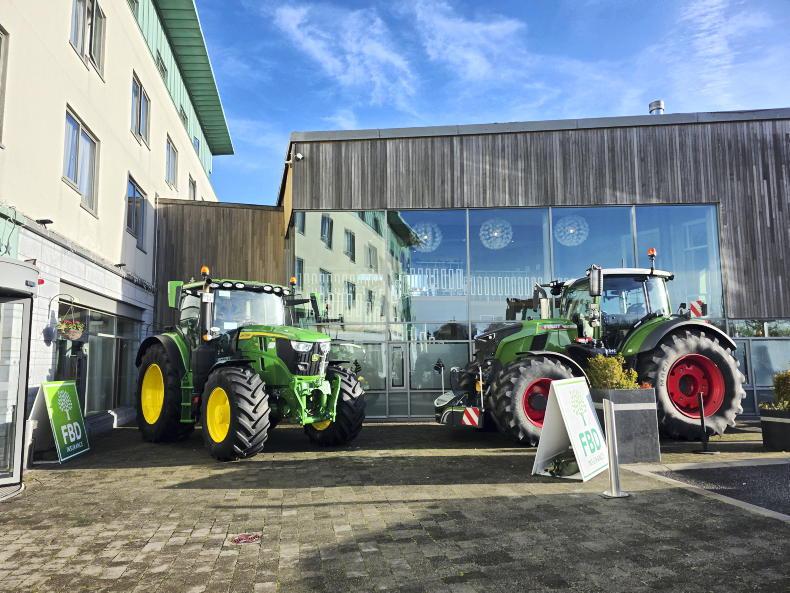
The Minister for State at the Department of Agriculture, Food, and the Marine with responsibility for Forestry, Farm Safety and Horticulture, Michael Healy-Rae opened the fourth annual National Agriculture Contractor Conference which took place in Portlaoise on Wednesday 3 December.
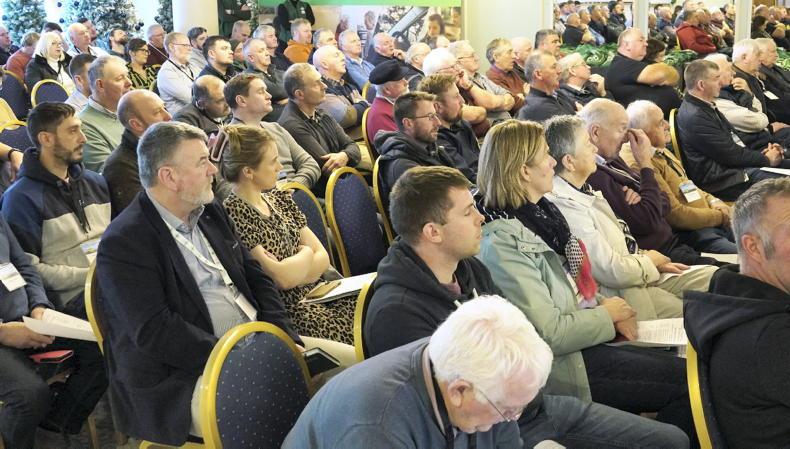
The minister spoke in depth to the 150 contractors in attendance from around the country about the importance of the contracting sector to the rural economy, and the value of the service contractors provide to farmers.
The minister also launched the new Association of Farm & Forestry Contractors in Ireland (FCI) young operator/driver/new entrant skills training course, where the focus is on ‘Skill not Speed’.
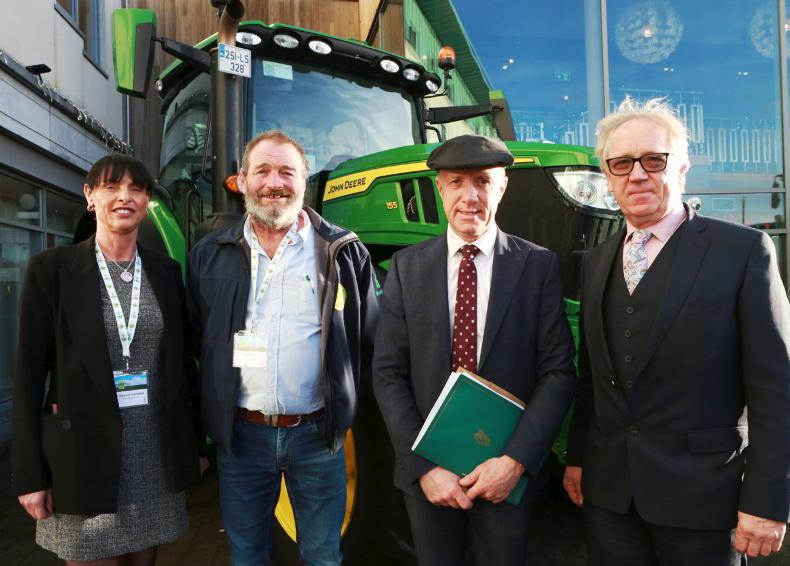
The development of this new course has been supported by the Department of Agriculture (DAFM), through the open call for farm safety, health and wellbeing projects. It aims to reduce the risk of injuries and fatalities in the agricultural and forestry contracting sector.
The course will deliver practical guidance and the safe management strategies for young operators to identify the potential hazards associated with the operation of agricultural machinery in a contracting business.
The message is that skill, not speed, is the focus for the future.
FCI managing director, Ann Gleeson Hanrahan said: “This new training course was designed by those working directly in the agricultural contractor sector. It will provide new entrants with a practical understanding of hazard identification, control measures, maintenance routines, associated with machines used in a modern agricultural contractor fleet, along with legal responsibilities associated with agricultural vehicle operation.”
Gerth Petersen Holm from the Danish Contractors Association (DM&E) spoke about the challenges, opportunities and the future of Danish contracting. The association is made up of agricultural contractors, forestry contractors and construction contractors.
So what problems are Danish contractors facing?
Gerth explained there is a shortage of skilled labour, rising machinery prices and high maintenance costs, unpredictable weather, stricter rules on equipment, fertiliser and spraying, more documentation required, no subsidies for machinery, business succession, uncertain technology requirements (today v the next five years) and finally, the demand from large farms who want high capacity. For example, they want their silage cut and ensiled in two days.
Giving some examples of how Danish contractors are mitigating these problems, Gerth noted that contractors have set higher cooperation requirements for customers, they are now doing more work based on hourly rates, some have gone down the route of offering a full-service in return for working with a minimum of two-year contracts for its larger customers.
He added that Danish contractors are also entering agreements with neighbouring contractors for support with big clients, who need a lot of work done in short-time periods.
Looking to the future of contracting in Denmark, new legislation means 250,000ha of agricultural area will be going to forest and nature, while higher N regulation will essentially result in fewer farmers and fewer cows.
This will result in a change in contracting works – there will be fewer cows, more of a focus on data and documentation, more biogas work, more nature and biodiversity work, more work around planting of forests, and establishment and care of wetlands. Although there will be fewer farms, there will be bigger farms, which means longer transport from fields to farm.
He said there will be a battle for labour, and that those who win the labour will win the battle. He can see a role for automation and self-driving, automated units. Contractors will grow; offering a total solution for the customer. However, there will be specialisation, which is already becoming common in Denmark amongst younger contractors.
Gerth said there has to be more focus on the economy, and that there is no other option than ‘professionalisation’.
One message Gerth wanted all contractors to take home from the event was: “Don’t send a tractor out of your yard unless it is making money. Contracting is a business, and farmers understand this.”
Philip O’Connor, ifac head of farm support, looked at what 2026 holds for the dairy and beef sectors. Looking back at the performance of the dairy sector in 2025, the amount of milk produced increased, while feed use increased by 6% to about 1,440kg per cow and fertiliser prices increased by 9%.
The average milk price was estimated at 53c/l, with an estimated production cost of 42c/l.
For 2026, the milk base price is forecasted to be around 35-37c/l until Q3. He noted that despite this, high cull cow and calf prices will buffer the forecast in reduction in margins, but that significantly lower income levels are envisaged for 2026.
Meanwhile, average prices for finished cattle were 40% higher and weanlings were 70% higher in 2025, in comparison to 2024. The average gross margin per hectare earned on suckling enterprises is estimated to be €1,307 per hectare, a 126% increase on the 2024 level.
The average gross margin per hectare earned on cattle finishing enterprises is estimated to be €966 per hectare, a 23% increase on the 2024 level.
For 2026, he outlined that the average cattle prices are forecast to be 5% higher relative to 2025.
However, average weanling prices are forecast to be 5% lower than in 2025. He sees the cost of cattle finishing rising by 1%, while suckling production costs will rise by 2%. He concluded that contractor costs on dairy farms range from 1c/l up to 8c/l, which ranges from €45/cow up to €530/cow. On average, contractor charges are from €250-€275/cow.
Philip said he prefers to see his client utilising contractors services, but that on some farms, he sees a high machinery cost and a high contractor cost, which is not desirable.
James McDonnell from Teagasc spoke on business and farm succession. He started by acknowledging that generational renewal is complex, and there is no magic bullet, but it’s about individual solutions for each farm family.
It needs to start by making a will. James said it’s important that the business/farm owner decides how their assets are distributed.
Remember, if something untimely happens to you as a business owner, prior to getting your succession plan completed, intestacy laws will decide as per the 1965 Succession Act.
There is lots to consider with rules and associated conditions that can impact the decisions made and the timing of eventual transfer.
James outlined that it is important for farm families to “talk early and talk often”.
Remember, it’s easier to plan tax reduction strategies when all parties are alive. Pay attention to taxes and plan to maximise reliefs to minimise tax, but don’t let taxes completely dictate what is right for you and your family when it comes to farm transfer.
Under the Succession Planning Advice Grant, a grant of up to €1,500 from DAFM is available to help with succession planning.
Mary McDonagh, head of HR and payroll services at ifac spoke about auto-enrolment, which is set to come into play in January 2026. Auto-enrolment is a mandatory retirement savings scheme designed to increase retirement savings across Ireland’s workforce.
The scheme addresses the pension gap by automatically enrolling employees who have no pension coverage. It removes the burden from employers to establish their own occupational pension schemes.
Auto-enrolment is a mandatory deduction, similar to PAYE, PRSI and USC.
Eligible employees are those aged from 23 to 60, earning over €20,000 annually, who do not already have a workplace pension.
Employees do not need to opt in. Instead, they will be automatically included in the scheme but have the option to opt out after six months. The scheme features a phased introduction of contributions from employees, employers, and the state, increasing every three years.
The employer and employee will pay the same rate, while the State will be in a reduced rate. This will be 1.5% for the first three years, 3% for years four to six, 4.5% for years seven to nine and 6% for year 10 and onwards.
The National Automatic Enrolment Retirement Savings Authority will oversee the entire scheme. The savings pot will follows employees across different jobs.
Pension plans
Cathal Daly, sales manager, life and pensions FBD, spoke about pensions, which he said are a long-term tax-efficient savings plan designed to provide an income at retirement.
He said that getting started with a pension can seem daunting, but it’s simpler than you think.
By bringing simple information to a financial adviser such as details of your company structure (sole operator, family-run or limited company), existing life or pension plans, retirement goals – when and how you’d like to retire and details of employees or family members involved, your adviser will create a plan that protects your family, supports your business, and builds your financial future.
Fergal O’Sullivan, lecturer at MTU Tralee spoke on autonomy, and what role he can see it playing in Ireland in the future. He picked out a handful of autonomous projects from leading machinery companies, to highlight the level of investment these firms are making in autonomy, highlighting that it undoubtedly will play a huge role in the future of agriculture.
For example, John Deere has invested $2.29 billion in its autonomous 8R, CNH has invested $2.1 billion in its autonomous Magnum, AGCO has invested $1.98 billion in its Fendt Xaver GT, while Kubota has invested $1.215 billion in its autonomous orchard sprayer.
At present, autonomy requires a large capital investment as new technologies often carry a higher cost than existing ones. With this, it currently has an uncertain return on investment.
The technology is relatively new, and data doesn’t exist to justify its benefits for Irish contractors. Irish conditions are currently a big barrier to autonomy, such as field size, field variations, field obstacles like stones, water troughs and ESB poles, while narrow roads and narrow gateways are also an issue.
Despite its many challenges, Fergal sees opportunities with the introduction of autonomous machines. He says contractors will have remote supervision of vehicles, allowing for greater fleet management.
He notes that many contractors will be able to enter new areas of work and offer new services such as robotic weeding or spot spraying. It will bring about increased efficiency with 24/7 operation without any workers and consistent precision. It will require a smaller human workforce, allowing more work to be completed with fewer people.
Autonomous equipment relies on data. This data is of high value and will help fleet managers and farmers to make better, data-driven decisions, it will also enable contractors to offer data-driven services, such as soil, crop and yield mapping, precision application advice and analytics.
Fergal feels that small robots will likely be the go-to in terms of autonomy in Ireland in the future. Small field robots can weed, seed, spray and scout with centimetre accuracy, reducing waste and inputs.
They help address labour shortages by handling repetitive or physically demanding tasks such as spot-spraying and crop monitoring.
Lightweight robots reduce soil compaction compared to large tractors, improving long-term soil health.
They offer 24/7 operation, working day and night with sensors and AI, increasing output without extra labour hours.
He can see contractors running fleets of small robots to offer services like precision weeding, targeted herbicide application, or crop-health mapping, and thus not relying on one machine.
Mike Keane, founder of Hibra Design, told the conference about his automotive engineering company, which specialises in the development of bespoke vehicle solutions.
The company was founded in 2022 by Mike following a 20-plus year career in automotive development, over which he worked on a variety of vehicle programmes for Ford, Nissan, Liebherr, Land Rover and Jaguar.
Hibra Design showcased Ireland’s first electric battery-converted tractor at this year’s Ploughing in September. The John Deere 5070M on display at the Ploughing had its 70hp, 4.5l four-cylinder engine removed and replaced with a 73kW motor and 55kWh battery system, as part of a project commissioned by Bord na Móna.
The project was funded by the Peatlands and People EU to repurpose one of Bord na Móna’s existing John Deere 5070M tractors for use in extreme peatland conditions for rewetting along with the planting of sphagnum moss.
In addition, the tractor is used as a mobile energy source for battery-powered drones. The project took the team 13 months from start to finish. This was split into a nine-month design phase and a four-month build and testing phase.
To prevent premature failure of the drivetrain, power output was controlled to the equivalent of 100hp, while torque was controlled to a maximum of 578Nm (continuous 294Nm).
Weighing 20kg less than the tractor’s original weight of 3,700kg, he explained how the motor’s torque curve has been mapped to mimic a similar driver experience to the previous diesel engine.
The 55kWh battery pack allows a continuous runtime of up to 2.5 hours while a larger 110kWh option is available, offering twice the run time at five hours.
Using DC fast charging, charge time of the standard battery takes 60 minutes, while the dedicated AC charger takes up to 8.8 hours.
David Kennedy from The Lifestyle Blueprint, is a relatable individual for farmers and contractors because he understands the unique work environment and schedule of a contractor.
David’s messaging around physical wellbeing is tailored for lasting results. With his Lifestyle Blueprint, he focuses on suggestions to better mental and emotional health and the importance of off-farm activities.


SHARING OPTIONS