



Submissions are currently being examined by the Department of the Arts, Heritage and the Gaeltacht (DAHG) on the review of existing burning and hedge cutting controls. These are based on the consultation document Review of Section 40 of the Wildlife Act – Burning/Cutting Controls.
The main purposes of Section 40 of the Wildlife Act, according to the DAHG, are “to protect bird life during the nesting season, to prevent forest fires, and to protect vegetation and wildlife habitats during the months of growth and reproduction”.
The Department sought the views of stakeholders on the Act as well as suggestions “on any potential changes”.
There are two elements to Section 40 of the Wildlife Act under review:
Both are broadly treated similarly under the Act in terms of the closed period between 1 March and 31 August (see panel).
The main question addressed in submissions made to the DAHG related to the closed period. The IFA, for example, maintained that to allow burning from September 1 to the end of February is too restrictive while the Irish Timber Growers Association (ITGA) claimed that an extension of the closed period could put more forests at risk of fire damage.
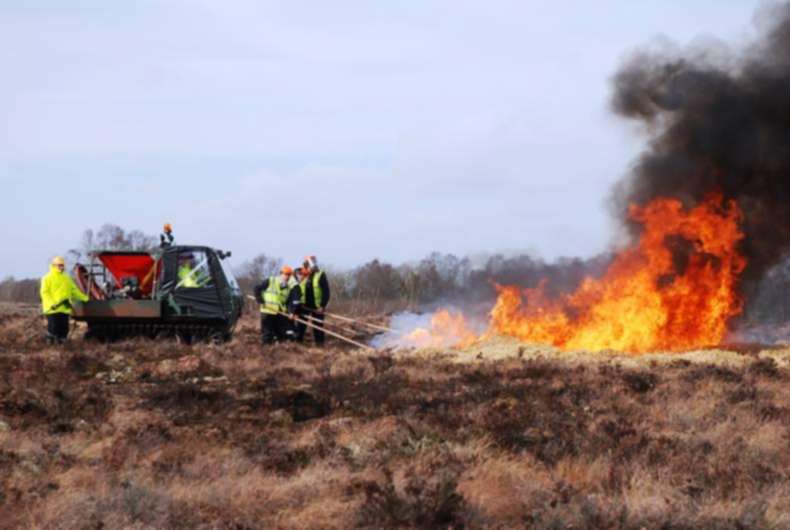
Burning
The IFA maintained the burning season should be extended because:
IFA proposed that the period during which burning is allowed should be extended to 15 April and beyond this date “in instances where the spring period is very wet”
The ITGA is opposed to the extension of the closed period mainly because of the risk of forest fires.
“In recent years there has been a significant increase in the incidence of forest fires and wildfires in Ireland,” argued Donal Whelan of ITGA. “Teagasc highlighted that in 2011, some 16,000 hectares, mostly valuable habitat, were destroyed by wildfires, costing €20m, in addition to 3,000 hectares of productive forestry destroyed in the 2010/2011 period alone,” he said.
The ITGA submission stated: “It is the [forestry] sector’s experience that uncontrolled burning is a very significant, if not the main source of forest fires. In Ireland, fire poses the greatest risk to young forests and this review of Section 40 of the Wildlife Act is an opportunity to reduce this risk by ensuring specific actions are taken prior to and during any controlled burning along the lines outlined in the Department of Agriculture, Food and the Marine’s Code of Practice for Prescribed Burning.”
To permit controlled burning outside the current closed period would certainly lead to a greater risk of fire spreading given the drier period from 1 March, according to the ITGA technical director, and “would therefore significantly increase the fire risk to our forests”.
He explained that the State-aided forest reconstitution grant is no longer available for forest fire damage, so the entire risk of fires is now exclusively with forest owners – mainly farmers. “This has implications for future insurance costs, fire prevention costs and potential fire losses to the forest-owning community,” he maintained.
“ITGA is concerned about the proposed burning of large areas of commonage in relation to the proposed new GLAS scheme and the significant fire risk that this practice will pose to our members’ forests,” he said.
“This refers to the large areas of commonage that are now overgrown and would have to be brought back to grazing condition, including by controlled burning.” This will be stipulated in Commonage Management Plans (CMPs) and will, according to the ITGA, “increase risk of forest fires in already high-risk areas and potentially increase forest insurance costs and insurance availability”.
The ITGA made the following proposals to DAHG:
Hedge cutting
The IFA argued that the earlier nesting season was reflected in the amendment introduced in the 2000 Wildlife Act. “However, the Act should also have ended the closed season on 31st July, in line with nesting patterns,” the submission maintained. IFA proposed that the hedge cutting closed season should be changed to 17 March – 31 July.
Val Swan, Monasterevin accepted in his submission that most hedgerow birds will have generally left their nests by the end of July but exceptions include the woodpigeon and yellowhammer both of which nest during August. He argued that the yellowhammer is a species of high conservation concern and “is generally confined to tillage areas building its nest in the vegetation near the bottom of the hedge”.
Closed period for destroying vegetation
Section 40 of the Wildlife Acts, 1976 to 2012 sets out the legal position with regard to the removal of vegetation. It states that it is an offence:



SHARING OPTIONS