



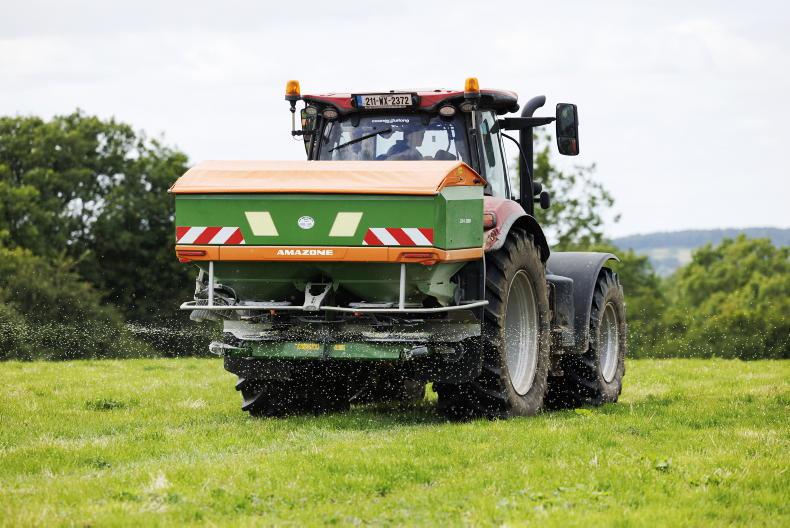
A major focus of the revised Nutrients Action Programme (NAP) is to reduce phosphorus (P) fertiliser use on NI farms, a leading agricultural scientist has said.
Speaking to UFU members last week, Dr Sinclair Mayne highlighted a key target within the new NAP is to cut surplus P on NI farms by 30% over the next four years.
He explained there is currently just over 8,500t of excess P going on to NI farms each year, so the 30% reduction target equates to around 2,600t.
“Somewhere between 1,800t to 2,000t of P can be removed by reducing P fertiliser,” Mayne said during the online event.
He said another 500t of P can be removed from NI farms through slurry separation and there is also “some scope” to cut P levels in concentrate feed.
“It does not mean a destocking policy in any shape or form, providing we achieve the targets in terms of fertiliser and manure processing,” Mayne said. UFU environment chair Ian Buchanan described cutting P fertiliser as an “easy win” because it is being used unnecessarily on many farms at present.
“If farmers can demonstrate a need for P fertiliser, then there is no question that they will be allowed to purchase it. That is what we have agreed,” he said.
The issue of fertiliser moving from NI to the Republic of Ireland was raised at last week’s meeting, due to concerns about it skewing figures on fertiliser use in NI.
“It is important that it’s not factoring into our P balance calculation. We need to think through the best way of ensuring that, if there is stuff moving south, we know what the quantities are,” said Sinclair Mayne.
New derogation is ‘crucial’ for NI
The revised nitrates derogation is “crucial for the future of NI farms”, according to Dr Sinclair Mayne.
Under the latest NAP review, the derogation has been overhauled and renamed as the Nutrient Stewardship Programme.
It will still allow intensive farms to run a stocking rate up to 250kg manure nitrogen (N) per hectare, rather than the standard N loading limit of 170kg.
“That is significant because we will now be the only country in Europe that is allowed to operate up to 250kg. In the South [of Ireland], the derogation was brought down to 220kg,” Mayne said.
The former AFBI chief executive said there was “important logic” in allowing NI farms to operate at 250kg, due to our ability to grow and utilise significant yields of forage. Mayne, who was part of the stakeholder group that reviewed the NAP proposals, said the derogation has been made “more accessible” to local farmers by having two tiers.
The first tier is for farmers who already meet the extra requirements for derogation, with the main one being having a P balance below 10kg/ha/year. The second tier is for farmers who are not yet fully compliant, so it gives them the option to cut their P balance by at least 10% over four years.
“If you can show a stable or declining soil P status across the whole farm area over four years, then that will also entitle you to enter the Nutrient Stewardship Programme,” Mayne said.
DAERA to keep new NAP under review
The rollout and uptake of NAP measures will be kept under review by DAERA and a new body made up of representatives from agri food and environmental groups.
During a briefing at Stormont last week, Julie Thompson from DAERA pointed out that farmers were being asked to get involved with new NAP measures “in a voluntary way”.
“If that’s not working, we may then need to move towards extra measures, more advice, and potentially making things mandatory that are currently voluntary,” she told MLAs.
Speaking at a UFU online event, environment chair Ian Buchanan said it was important that farmers got involved in the new Nutrient Stewardship Programme.
“We want to be prepared for the next NAP when it comes along after this one. I think it’s essential not to bury our heads in the sand,” Buchanan said.
Splash plate ban based on cattle only
The NAP requirement to use low-emission slurry spreading equipment (LESSE) on more farms will be based on cattle numbers only. The NAP review states farms with over 100 livestock units must use LESSE from 2028, moving to farms with 75 livestock units in 2029, and 50 livestock units in 2030.
“It only includes cattle livestock units because it’s the cattle slurry that is being targeted. Sheep have a certain amount of slurry when they are housed but it’s minimal,” said Ian Buchanan from the UFU.


SHARING OPTIONS