



The autumn and early winter is an important time to get on top of any sheep scab problems in flocks, a leading expert has said.
Speaking at an online event, Dr Stewart Burgess from the Moredun Research Institute explained that scab is spread by mites which live on the skin at the base of the wool.
“The mites need a warm, moist, dark, fully fleeced environment. It is a very seasonal disease, starting in the autumn and peaking in the spring,” he said.
Burgess explained that aside from fleeces being longer, housing and feeding during the winter period allows more opportunity for mites to spread between sheep.
Ultimately, farmers should try to avoid scab problems lingering over the winter months as it could mean having to treat ewes in the spring when they are heavy in lamb.
Gold standard
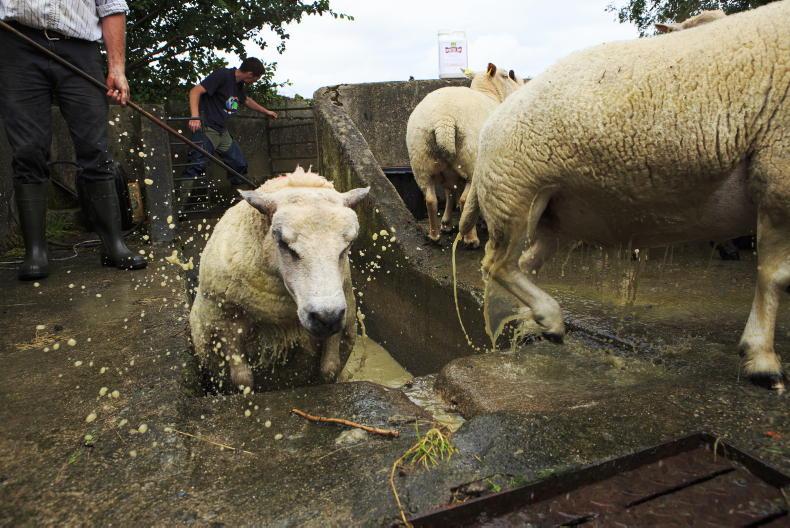
Burgess described plunge dipping sheep with the diazinon-based dip Gold Fleece as “the gold standard treatment” for scab because it provides protection for at least eight weeks.
Crucially, mites can only survive in the environment away from sheep for around 17 days, so dipping is a key way of breaking the cycle of re-infestation.
Also, there are currently no known issues with mites being resistant to diazinon and dipping is effective against other external parasites, such as lice.
“My recommendation would always be that if you can, plunge dip,” Burgess said.
However, he acknowledged plunge dipping is not always suitable for everyone.
Issues for individual farmers can include a lack of dipping facilities, problems getting a contract dipper or a reluctance to dip pregnant ewes.
Injectable wormers
If plunge dipping is not an option, then the other treatment for sheep scab is injectable wormers.
“There is quite a lot of confusing advice because there are different actives, different delivering routes and different doses,” Burgess said.
The Edinburgh-based scientist said a common option for scab treatment is a Moxidectin-based wormer, such as Cydectin 1%.
“It gives 28 days protection against re-infestation, but you do have to do two injections 10 days apart,” he said.
Another option is Cydectin 2% which gives 60 days protection and only requires one injection, although it is more difficult injection to administer at the base of the ear.
There are a range of Ivermectin-based wormers that are available but Burgess said he generally does not recommend using them to treat sheep scab.
“The problem is it only treats them, so it does not protect them against re-infestation. Plus, you have to give two injections, so if you miss one animal, then it will re-infest everything else,” Burgess said.
All injectables mentioned so far are administered by subcutaneous injection into the skin.
Dectomax is different as it is a single intramuscular injection, but like Ivermectin, it is for treatment only so there is no persistent protection against scab.
“Unless you have got spare pasture to move the sheep to after treatment where there is no risk of re-infestation, do not use it,” Burgess said.
He described under-dosing with wormers as “a big problem” which is mainly due to under-estimating the live weight of the animals being treated.
It is a key factor behind mites developing resistance to injectable wormers and Burgess said there is “clear evidence” of this in NI.
“The active in Dectomax targets the same part of the parasite as the active in Cydectin and the active in the Ivermectins, so resistance to one is resistance to all,” he said.
Take time to plunge dip sheep properly
Key advice on plunge dipping includes keeping sheep in the dipper for at least a minute to ensure that the chemical reaches the base of the wool.
Stewart Burgess presented research which shows that if sheep are dipped for just 40 seconds, then 38% less chemical is absorbed and a 20 second dip means 50% less.
“It means there is no way you will get eight weeks protection against re-infestation. Take the time and do it right,” he said.
It is also recommended to submerge the head of each sheep at least twice to ensure that mites around the eyes and ears are covered by the dip.
Crucially, Burgess pointed out that Gold Fleece is only licenced for plunge dippers and should not be used in showers or jetters.
“These units do not work to treat sheep scab. They do not get the active down to the skin which is exactly where the mites are.
“It will appear that it has worked because it will lessen the symptoms, but it won’t have killed all of the mites and they will eventually re-establish in a few months or even the following season,” he said.







SHARING OPTIONS