Over the last six years, daily liveweight gains on the beef finishing unit owned by Foyle Food Group director, Wayne Acheson, have increased from 1.3kg to 1.9kg per head per day.
“A small part of that is nutrition, a lot of it is down to management and expertise,” Gareth Anderson from FarmGate Nutrition told the large crowd of farmers gathered at an annual event on the farm last Friday.
He said a focus on dry matter intake was one of the main factors driving this improvement, with the aim for each individual animal to consume 2.2% of its bodyweight each day.
Therefore, a 600kg animal would eat over 13kg of dry matter per day.
Water intake has a large part to play and fattening cattle will drink between 25 and 75 litres a day, said Anderson.
The unit has recently installed a nanobubble generator oxygen injection system. It pumps minute oxygen bubbles through the water lines to increase cleanliness by minimising algae growth.
Anderson acknowledged it was too soon to identify definitive results, but suggested it should help drive performance.
Either way, he said drinkers must always be clean to achieve good intakes.
Forage
Silage is regularly analysed on the Foyle unit, with results showing first cut is excellent at 31% dry matter, ME12.1, D-value of 76, protein at 13.6% and pH of 3.4.
However, Anderson did note that pH is low and it is something he now regularly sees across NI. Ultimately a low pH increases the risk of acidosis.
To help address this, 1kg/head of wholecrop wheat silage and 0.5kg/head of chopped straw has been included in the diet to add fibre.
Drought
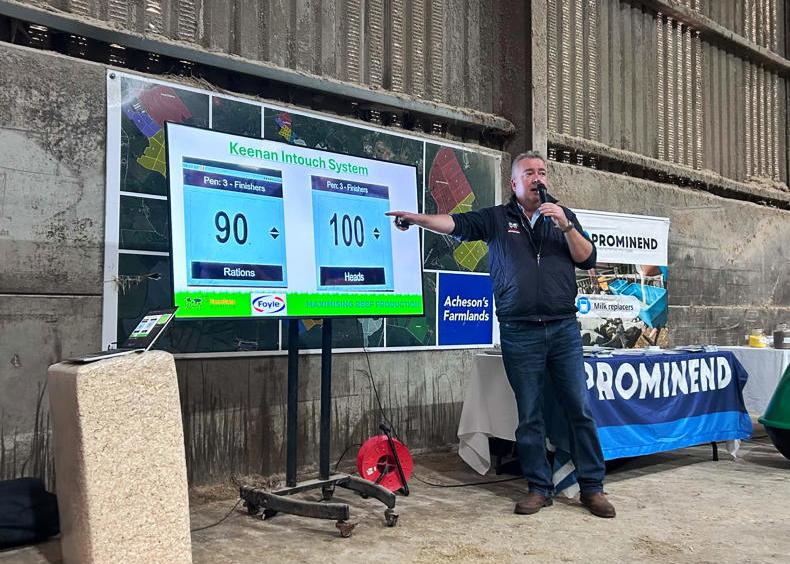
A Keenan feed system is used on the Foyle unit and it identifies how much feed is delivered daily and monitors ration performance.
During the summer, heat stress had an impact, with feed intakes in July down 28% when compared with April.
“When our intakes go down, our daily liveweights go down as well,” said Anderson.
Despite the costs associated with installing and running fans, he suggested that beef finishers should give it serious consideration.
“If your intakes collapse the way they did this summer then it is going to put everyone under pressure,” he said.
Feed costs
Anderson works off a basic beef blend containing maize meal, rolled barley, maize distillers, sugar beet nuts, soya, molasses and minerals.
Between 15 June and 15 September, the cost of this raw material basket has already increased from £246/t to £273/t.
“Those of us who haven’t sat down and bought feed for the winter are looking at significant rises in feeding costs,” he said.
With rising costs, he added it is more important than ever to be measuring what you’re feeding to ensure feed is being efficiently used.
Over summer 2026, the Foyle farm ran a trial which involved offering free access minerals and feed additives to cattle at grass. The trial involved splitting a batch of 70 cattle weighing 300kg to 500kg into two groups for 100 days. One group had free access to minerals and the other had access to minerals plus the feed supplement, Techna Elensis 10. Liveweight gains in the batch offered Elensis were higher (1.15kg v 1kg/head/day). Throughout the trial, the extra additive cost £4.50/head, however, the extra weight gain equated to £46/head.
At the event on the Foyle finishing unit last Friday, Gary Spence from Fane Valley outlined the potential benefits from growing wholecrop wheat.
“When you look at the price per acre, it sounds expensive but it can be a very good value crop to grow when you look at the benefits it can bring,” he said.
A crop of winter wheat was grown on the Foyle farm this year, with growing costs at £705.58 per acre (£54.28 per tonne).
Typically, wholecrop wheat could yield 15 to 18t per acre, but the crop on the farm was behind that at 13t. However, analysis shows the crop to be exceptional quality at 45% dry matter and 33.5% starch.
Spence estimated that 10kg of wholecrop silage at 33% starch is equivalent to 4kg of concentrate.
“It is a good opportunity to reduce concentrates and reduce inputs coming up your lane by growing some of it on your own farm,” he said.
Typically, dry matter intake will also increase 5 to 10% when a second forage such as wholecrop or maize is introduced and that will result in more meat or milk, said Spence.
The other benefit from growing wholecrop is that it creates an opportunity to rejuvenate swards.
It is typically harvested in July, which gives plenty of time to get new grass established before the autumn.
Anita van der Molen, from Dutch company Nuprovit, highlighted the importance of measuring colostrum antibodies when rearing calves.
“Calves need 210g of antibodies within the first feed to give protection from all kinds of pathogens,” she said.
By sampling colostrum with a refractometer, farmers can identify the quality of the milk however, it is crucial that these tools are regularly calibrated to ensure a correct reading is given, she added.
Straw
When it comes to a source of forage, van der Molen suggested that feeding shortly chopped straw is optimum as it is easier to digest in the rumen than unchopped material.
Van der Molen also strongly encouraged the use of skimmed powder when feeding calves on a twice daily system, as it contains casein which remains in the abomasum for six to eight hours and keeps calves fuller for longer.
Whey-based powder is best suited to an ad lib system as calves digest it within two hours, she said.