



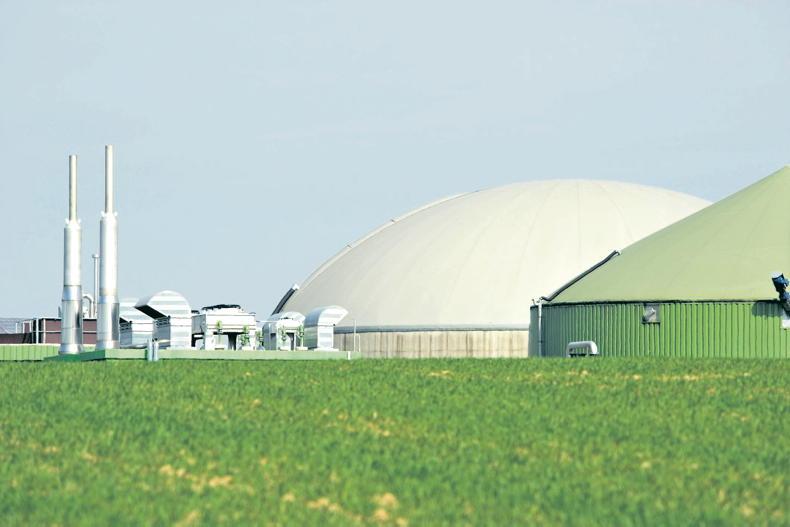
US president Donald Trump has made no secret of his hostility towards wind and solar power, with federal support for the technologies cut since his return to the White House. But one renewable energy technology appears to be charting a different course under his administration, farm biogas.
The number of US farms capturing biogas has more than doubled in five years, with agricultural projects increasingly focused on producing biomethane rather than electricity.
There are now 631 farms operating biogas systems across the US, according to the American Biogas Council (ABC), with the volume of biogas captured on farms increasing by 166% over the last five years.
Some 41 new farm systems came online in 2025 alone, representing investment of $835m (€720m). Total investment in US farm biogas systems now stands at an estimated $6.4bn (€5.5bn), according to the industry body.
The expansion is continuing despite uncertainty over US renewable energy policy following Trump’s return to the White House.
Speaking to the Irish Farmers Journal at the World Biogas Expo, Vaughan Company senior engineer Erik Larson said the industry was changing but remained positive about its prospects: “There are a lot of drivers driving this market, and we see it as something that’s not moving backward. It’s moving forward.”
Biomethane shift
Similar to Europe, the US industry is turning towards renewable natural gas (RNG), the term commonly used in the US for biomethane.
New ABC figures show that 46% of captured US biogas is now upgraded to RNG, compared with around 25% in 2020.
Electricity generation still remains the largest overall use, accounting for 53% across the entire industry. However, the picture is very different at farm level. Almost 80% of biogas captured by US farm digesters is now upgraded to RNG, with significant potential for further expansion.
The ABC estimates that more than 17,000 additional biogas systems could be developed across the US, including projects on farms, at wastewater treatment plants, landfills and standalone food-waste facilities. If fully developed, it estimates this resource could generate enough renewable electricity for 23.7m homes or sufficient RNG to meet the energy needs of 27.4m homes.
Dairy farms
Livestock manure is an important feedstock for the agricultural sector, with large dairy and pig units particularly suited to AD. The US Environmental Protection Agency (EPA) estimates that biogas recovery systems are technically feasible at more than 8,000 large dairy and hog operations.
Larson said farmer attitudes towards AD in the US had generally been supportive, contrasting with some of the opposition that has emerged around proposed developments in Ireland and Britain.
“I’ve generally seen a lot of support,” he said. “You’re always going to have your naysayers, but I think generally the farmers that are doing it have really been a voice to the other farmers, that this is really a great value.”
Manure tax advantage
Like in Europe, animal manure for biogas production in the US is set to become more important, under proposed changes to the US Clean Fuel Production Credit, known as Section 45Z.
The federal tax credit supports lower-emission transport fuels, with its value linked to the carbon intensity of the fuel.
Legislation signed by Trump in July 2025 extended the credit until the end of 2029, but also changed how particularly low-carbon fuels are treated.
For fuel produced after the end of 2025, emissions rates generally cannot fall below zero. However, an exception allows fuels derived from animal manure to receive a negative emissions rate.
This could be particularly important for dairy and pig biogas projects, as capturing methane from manure that would otherwise be emitted can give the resulting RNG a particularly low carbon intensity.
While the regulations remain proposed, the example illustrates the potentially favourable treatment of manure-derived RNG under the revised US clean-fuel regime. Government support helped provide a “backstop” for farmers being asked to take on the risk associated with a relatively new technology. However, Larson said the industry should not become entirely reliant on the State. “You don’t really want to be in a situation where you’re completely dependent on government for everything.”
Changing investment
While the tax credit remains, Larson said changes to carbon accounting and government incentives were already altering project economics.
“We see a reduction in the value of biogas from a tax credit standpoint,” he said. “That’s definitely changing how the market is approaching biogas projects, how they’re being accounted for and really where the investment is coming from.”
Large energy companies have also become involved in the sector.
“We’re definitely seeing a lot more engagement from energy companies that are looking to round out their green energy portfolios,” Larson said. “So you’re seeing some acquisitions and some movement there.”
Trump question
Trump’s return to the White House has brought a major change in direction for US energy policy. His administration has moved to curtail federal support for wind and solar and halt new offshore wind leasing, raising questions over how other renewable energy industries will fare.However, Larson said it was difficult to categorise the administration as either for or against biogas: “I think it’s very nuanced. It’s a challenging thing to pin down at any given time what the actual policy will be. There’s a lot of debate that’s happening and a lot of discussion.”
Larson said he remained optimistic about where policy would eventually settle. He also highlighted the lobbying work being carried out by the American Biogas Council in Washington and the influence of US agriculture on policymakers.
“Don’t ever count out farmers for being vocal and telling the government what’s what,” he said.
Listen to the Podcast below:



SHARING OPTIONS