


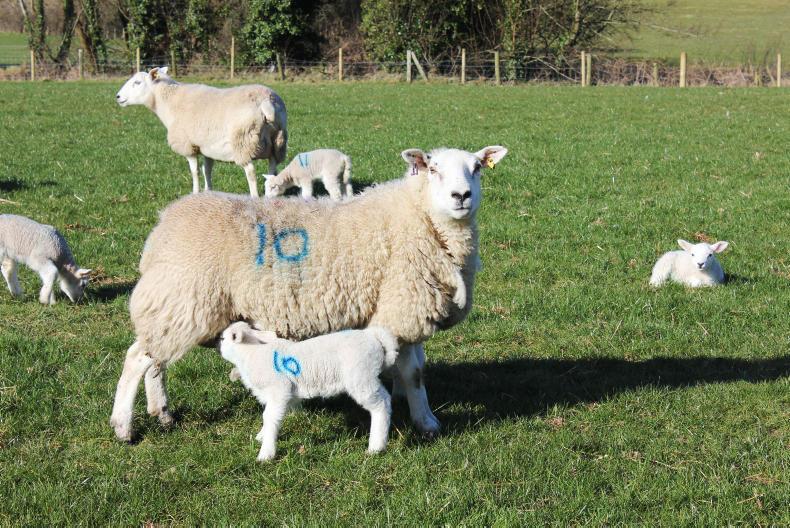
If I wait until the end of May, or even June, before writing about the lambing season, there may be a tendency for some of the tragedies to fade into the background, while minor successes float to the foreground.
This can distort the overall picture, so I thought I’d mention some of the current highs and lows while they are fresh in the mind.
Firstly, one of the positives from this year is also a negative. Ten per cent of the main flock were carrying more lambs than the scan suggested, and while some may see this as an advantage, I hate it when a ewe is being fed for carrying a double, then gives birth to three lambs.
If they are a decent size, and she has tonnes of milk, then she’ll be in poor body condition. If she is fat, then the lambs are likely to be the size of small cats. And then there are those that have small lambs, the ewe is thin, and the milk isn’t plentiful either. If a breeding ewe is to stand any chance of successfully rearing triplets, it is vital that she has been fed accordingly pre-lambing.
And on the subject of trebles, the cold weather proved a step too far for most of the ewes that were outside with threes apiece. One sheltered field, with unlimited grass, had nine sets of triplets and after the prolonged spell of bad weather, that quickly reduced to just three outfits.
Some lambs were removed and converted into pets, others were fostered onto spare sheep, and of course, one or two ‘disappeared’. All in all, I remain convinced that no sheep should be asked to rear three lambs. At the end of March only a dozen sheep were running with three lambs each, but kept inside where access is quick and easy if they need a bit of extra care and attention.
Scourge
We all recognise the scourge of lambing sheep that haven’t dilated properly, and one of my neighbours asked me if I had tried oxytocin and calcium as a two-pronged approach. I said I wasn’t having any bother on that front, which was the immediate trigger for two sheep in one day to give trouble.
Both ewes were nowhere near open (a mouse couldn’t have crawled through their cervixes), so I gave them 1ml of oxytocin, and about 60mls of calcium. Each sheep was left for three hours, and they not only relaxed and opened, but presented lambs which were easy to deliver.
I have no idea if this was just luck, but it’s a technique that I’ll pursue in the future. It seems that the calcium helps with additional muscle tone, especially in the case of a multiple birth, and may provide extra stimulus to assist a tired mother.
Gene
One other observation may not sit too easily with some pedigree breeders but is worthy of being posed as an open question. Is there a gene within the Texel breed that makes them particularly difficult when fostering lambs?
Let’s be clear: Texel blood is predominant in this flock. I think they are the near-perfect terminal sire for crossing onto mule ewes, and the resulting female lambs are an ideal animal in many ways. They provide cheap replacements, are good mothers, great milkers, last as long as any other breed, and make good money as fat ewes.
But, I have almost given up on trying to put lambs to them, and if you want to lose your temper, then just spend some time with a half Texel in an adopter unit.
If a mule ewe has a dead lamb, then two or three days in the adopter usually sees them falling head over heels in love with whatever lamb is placed with them.
By contrast, a Texel ewe will enter the adopter, immediately go on hunger strike, and give all the appearances of being gravely ill. Then, when you let her out into a small bedded pen, she will take one look at the wee lamb and knock it straight into the middle of next week.
You can call this trait “stubborn”, “pig-headed”, “strong-willed”, or whatever else you fancy, but the most accurate word is “thrawn”.
If you have the patience and willpower, then sheer persistence will eventually triumph over thrawness, but you must be prepared to stand in the pen with the sheep and lamb and wait for it to get a bellyful of milk. This should be done four times per day, for a period of two or three weeks. Don’t you just love lambing sheep?




SHARING OPTIONS