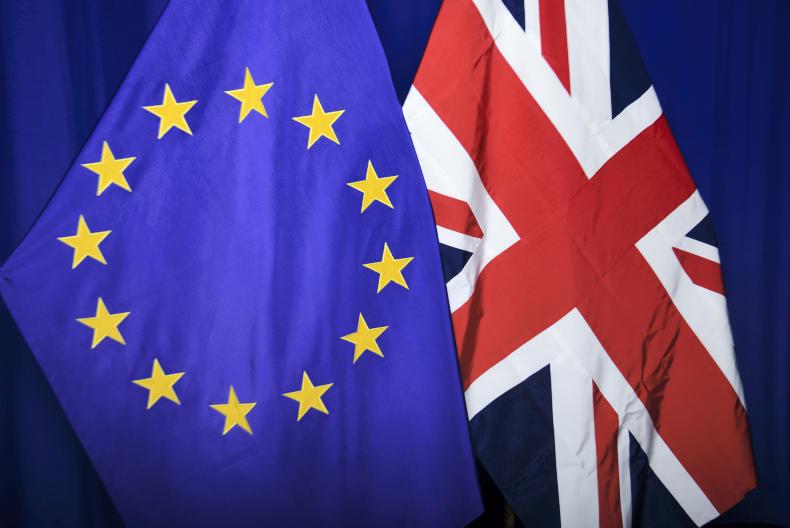
The rhetoric from Downing Street continues and is now based around no Brexit negotiations while the withdrawal agreement is in place. The Tánaiste has said this is putting the UK on a collision course with the EU.
All of this has the effect of increasing the risk of a no-deal Brexit and all that means for farmers across the island of Ireland and in Britain as well.
Agriculture particularly exposed
Irish farmers are exposed like no other sector of Irish industry. According to the CSO, Britain took 16% of Irish exports in 2017, making them our second largest export market, which is a fraction of what it was prior to EU membership. However, the spread of export markets has changed less for agricultural produce, with over half of Irish beef, poultry and pigmeat going to the UK and a bit less of our sheepmeat and dairy produce.
UK will be open
Ironically, Irish access to the UK market won’t be diminished greatly because of the UK position on keeping an open border through Northern Ireland. The problem is that the value of the market will be greatly diminished by the fact that the UK is opening its doors to agri-food imports, especially beef, if there is no deal.
Any base price on which they get a premium will be set by Brazil, not Ireland
Farmers in the north will be particularly squeezed as a no-deal will deny them access to southern markets, especially for live lamb exports and milk. Across the UK, farm prices will be undermined by the UK open border policy through zero tariffs on imports because any base price on which they get a premium will be set by Brazil, not Ireland.
Purpose of backstop
The idea of a backstop before it became politically controversial was that it would enable Northern Ireland to operate as if it was part of the single market even if the rest of the UK was outside it.
The two big issues with the border are fiscal or tariff controls and standards. Inspections are particularly required for standards and if there is no deal or an agreement that doesn’t keep at least Northern Ireland if not the entire UK in the single market, then inspections become inevitable.
The border in Ireland isn’t an Ireland-UK issue, it is an EU-third country issue if there is no deal. Inspections are a fact of life on the EU-Swiss borders and the Norway-Sweden border, even though Norway is part of the single market.
The bottom line is that as the rhetoric builds, the risk of no deal increases. A no-deal Brexit has huge consequences for the entire economy but particularly for farmers both in Ireland and the UK.
Read more
Boris Johnson's border wish: could it happen?
The rhetoric from Downing Street continues and is now based around no Brexit negotiations while the withdrawal agreement is in place. The Tánaiste has said this is putting the UK on a collision course with the EU.
All of this has the effect of increasing the risk of a no-deal Brexit and all that means for farmers across the island of Ireland and in Britain as well.
Agriculture particularly exposed
Irish farmers are exposed like no other sector of Irish industry. According to the CSO, Britain took 16% of Irish exports in 2017, making them our second largest export market, which is a fraction of what it was prior to EU membership. However, the spread of export markets has changed less for agricultural produce, with over half of Irish beef, poultry and pigmeat going to the UK and a bit less of our sheepmeat and dairy produce.
UK will be open
Ironically, Irish access to the UK market won’t be diminished greatly because of the UK position on keeping an open border through Northern Ireland. The problem is that the value of the market will be greatly diminished by the fact that the UK is opening its doors to agri-food imports, especially beef, if there is no deal.
Any base price on which they get a premium will be set by Brazil, not Ireland
Farmers in the north will be particularly squeezed as a no-deal will deny them access to southern markets, especially for live lamb exports and milk. Across the UK, farm prices will be undermined by the UK open border policy through zero tariffs on imports because any base price on which they get a premium will be set by Brazil, not Ireland.
Purpose of backstop
The idea of a backstop before it became politically controversial was that it would enable Northern Ireland to operate as if it was part of the single market even if the rest of the UK was outside it.
The two big issues with the border are fiscal or tariff controls and standards. Inspections are particularly required for standards and if there is no deal or an agreement that doesn’t keep at least Northern Ireland if not the entire UK in the single market, then inspections become inevitable.
The border in Ireland isn’t an Ireland-UK issue, it is an EU-third country issue if there is no deal. Inspections are a fact of life on the EU-Swiss borders and the Norway-Sweden border, even though Norway is part of the single market.
The bottom line is that as the rhetoric builds, the risk of no deal increases. A no-deal Brexit has huge consequences for the entire economy but particularly for farmers both in Ireland and the UK.
Read more
Boris Johnson's border wish: could it happen?





SHARING OPTIONS