



2023 and 2024 were successive disastrous years for tillage farmers, but the weather was mostly to blame.
The record grain prices from the 2022 harvest had disappeared by August 2023. That said, the prices farmers were receiving were better than average and inputs had come back in price from their record and unsustainable 2022 highs.
If yields had been good and quality had been good, money would have been made. But yields were bad, quality was poor and the harvest was difficult. Indeed, the whole year was difficult.
2024 was little better - a second awful spring following a challenging autumn planting season.
The harvest was better, but the price was worse and farmers again lost money.
When the weather is poor, you have to make more runs of the field. Work is at times halted and restarted, crops are uneven, the spraying programme is more difficult to manage.
When you compound that with a complicated harvest, it turns into an expensive year.
In both years, then-Minister for Agriculture Charlie McConalogue recognised the issues. Many farmers commented on the fact that a Donegal man seemed more sympathetic to tillage farmers than many of his predecessors.
Emergency relief
And money was found for what I suppose you would call emergency relief. The unharvested crops scheme saw all the money go to those most in need in 2023, while all tillage farmers received €100/ha for the 2024 campaign.
That money was promised at the 2024 Fianna Fáil Ard Fheis in April 2024, in the midst of the poor spring, as many farmers contemplated leaving fields fallow.
It wasn’t delivered until the 2025 budget and was finally paid out earlier this year, by which time we had seen a general election and Martin Heydon’s elevation as Minister for Agriculture.
And here we are in 2025 following a third difficult year for tillage farmers.
In many ways, this is even more challenging for the sector, because we can't blame the weather. We had an excellent spring, good growing conditions, good crops, good quality, we had decent yields. And still, farmers are not going to make money, and that's because the price is wrong.
The price is wrong at a time when the price of other agricultural commodities, especially milk and meat, are buoyant
Even more worryingly, the price is wrong at a time when the price of other agricultural commodities, especially milk and meat, are buoyant.
That broken relationship between meat, milk and the grain that feeds dairy cows, beef, sheep, pigs and poultry is a huge problem and it's probably going to be a problem in the future, because global prices are depressed and unlikely to recover in the short term.
There's nothing that suggests prices are going to gallop toward meeting the high cost of grain production anytime soon.
The gathering
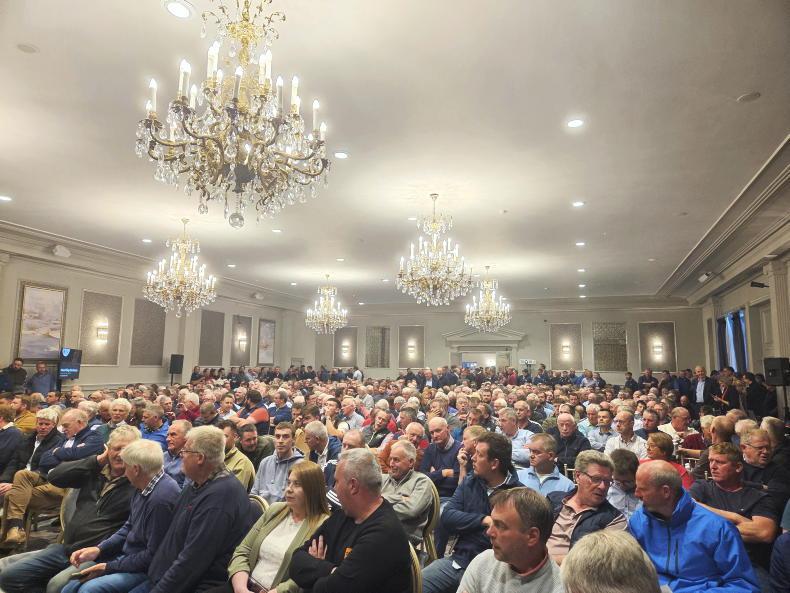
On Friday night, in Killashee House Hotel, 700 grain farmers from around the country gathered to hear what Minister Heydon had to tell them and to appeal to him for further financial support.
I was unable to attend, Siobhan Walsh reported from it here.
I do know there has a lot of grumbling among grain farmers about imports, a lot of talk about the need for mandatory inclusion of native grain to underpin grain prices.
There is a lot of talk about the hoops tillage farmers are made to jump through the loss of chemistry, the red tape around things such as the three-crop rule and the requirement to till some stubble post-harvest, while a counter-requirement prohibits stubble cultivation of up to a quarter of the land being farmed.
Ultimately, it all came down to money - the lack of money in the tillage sector and the need for a financial injection from Government.
I understand Martin Heydon’s message was that he will fight for as much of a budget allocation as he can get for his department and will distribute it to those areas most in need.
He mentioned TB - the other big story of the week - and the ever-growing demand for money to cope with the cost of spiralling numbers of reactor cattle.
That does not augur well for the Irish Farmers' Association’s (IFA) demand for €250/ha, a call which was backed up by Food Vision tillage group chair Matt Dempsey. That would cost €60m a year, the IFA said.
Pledges
I think that’s a slight understatement of what is required, but, then, €60m a year is exactly is what Martin Heydon pledged less than a year ago in the general election campaign.
And he clarified in the debate the Irish Farmers Journal hosted that that was an additional €60m to existing schemes. You can watch his comments from about 54 minutes in here.
If you watch on, you’ll see that Martin Kenny for Sinn Féin and Eddie Punch for Independent Ireland both outbid Martin Heydon, so there can’t be much grumbling from those sections of the opposition benches if the money is delivered.
And the €60m pledge was repeated by then-minister Charlie McConalogue and by the current Taoiseach and Tánaiste Micheál Martin and Simon Harris. So there is no doubt as to what the pre-election commitment was.
The economy has continued to perform strongly this year, but there are massive economic clouds on the horizon - trade disputes (which have hurt the grain sector in terms of whiskey and porridge exports), the growing need for increased EU security spending as the US remains indifferent to Russia’s ongoing and escalating aggression and the fear that the whole global economy is in danger of reversal.
Commitments
So farmers must wait to see what can be delivered in terms of the financial commitments for 2026.
In fairness to Martin Heydon, he did deliver extra money to both the Protein Payment and the Straw Incorporation Measure (SIM) this year to ensure everyone who applied gets paid in full.
I'm not sure how much of the extra €5m pledged to the SIM will be needed. A lot of farmers applied to enter the SIM, but we don't know how many withdrew when it became obvious there would be no Baling Assistance Payment (BAP) such as there was in 2024.
The perception has been that many people entered the SIM this year as an each-way bet, in case the BAP was renewed, despite the fact that the Minister had said at every turn it would not happen this year.
I think that the turnout alone is testament to just how critical things are in the sector.
Tillage farmers are not known for turning up in large numbers at meetings and it's a sector where the slight reduction in acreage underestimates the reduction in number of full-time tillage farmers.
This is because falling margins have meant farmers have felt the need to “go big or go home” to grow or exit. Thus, we have less bodies in the room.
One positive feature of tillage farming is that it's still attracting a certain amount of young people. There was some youth in the room, including my own son, and that's perhaps because it's an attractive way of life.
The routine and constant involvement of livestock farming appeals to many that who just love spending time with animals.
For others, spending time in high-tech machinery, with the satisfaction of turning bare earth into a thriving crop, minding and harvesting it and then delivering it to the local merchant is something that appeals, especially to younger people.
So, there is some energy in the sector, but there's no money and that's a huge problem.
Solutions
The only way tillage farmers will make more money is if they increase their yields or their price.
The steadfast refusal of the EU to allow gene-edited crops to be grown is stifling technological progress.
Their allowing genetically modified (GM) and gene-edited crops grown elsewhere to be imported means we are forced to compete with world prices while one hand is tied behind our backs.
Irish tillage farmers are currently arguing those GM imports should be banned or limited.
There is no scientific argument in favour of doing so; in fact, there is growing evidence that the fight against global warming can be assisted by the resilience offered by such technology, developing plants where the latent genetic potential to cope with drought or heat stress, flooding, less fertiliser and less pesticide protection.
I predict that the argument to keep CRISPR and other gene-edited crops out will pivot to allowing us to grow them within the EU too.
There is a stronger argument against importing South American maize and soya in terms of the carbon footprint of its production. The Mercosur beef Irish farmers are so opposed to is mainly fed on these crops, so we should have pause in using them to feed Irish cattle, sheep, pigs and poultry if there was to be consistency and logic in that stance. I’ll hold my breath on that one.



SHARING OPTIONS