There is a mushrooming political scandal over alleged Common Agricultural Policy (CAP) funding fraud in Greece.
The scale of the corruption is staggering, with as much as €45m per year involved, going all the way back to 2017.
The European Commission has imposed a fine of about €400m on the Greek government.
And this is not just a case of wily farmers scamming the system and conning the Greek department of agriculture.
The nature of the cases being revealed implies that some people deep within the system were not just aware of what was happening, they were involved in either the fraud or the cover-up of fraudulent payments.
At the heart of the allegations lies a government agency called OPEKEPE. It is, to give it its full title, the Organisation for Payments and Control of Community Aid Guidance and Guarantees.
As the name suggests, they are instrumental in ensuring the probity of payments.
A woman named Paraskevi Tycheropoulou, who was head of OPEKEPE’s internal audit department, uncovered evidence of fraud, but was hamstrung by her superiors, having her access - even to her own office - restricted.
Her lawyer Antonis Vagionis told news organisation Politico that her work had “led to the uncovering of an extensive ring, which, through false declarations of ownership, illegally received EU aid through the national reserve”.
Dubious land leases and applications for payments on state lands have been alleged. Tycheropoulou has been assisting the EU authorities in their investigation.
The Greek prime minister has promised a full investigation, but with five former government ministers and over a dozen MPs implicated in the scandal, others say he is seeking to preside over a whitewash.
Effect on payments won’t be positive
But does any of this matter to Irish farming? It might, you know.
In the battle for EU finding that lies ahead for 2028-2035, agriculture starts out with one hand tied behind its back.
The von der Leyen/Serafin proposals see the money committed to the CAP fund cut by over 20%.
Most analysts find it hard to see where much extra money stands available from within the broader cohesion fund to be added to the €296bn pledged.
The last thing we need is a fraud scandal enveloping CAP. The fact that it’s over three thousand kilometres - and two time zones - away is of little matter. The CAP itself is damaged by this unfolding mess.
And the prospects of farmers in Gortahawk, Glenamaddy, Glounthane or Gorey retaining their current level of payment is undermined by the Greek CAP scandal.
The Greek CAP farrago gives fuel to the CAP critics who portray it as bloated and ineffective. It makes it harder to push for the restoration of the “missing” €90bn to funding Europe’s farmers. The timing could hardly have been worse.
Ireland’s occupied territories bill occupying US politicians minds
In last weekend’s Long Read, I used a phrase that comes to mind again and may encapsulate the precarious state of diplomacy and politics right now.
It’s that if you don’t stand for something, you lie down for everything. This week, it springs to mind in relation to the occupied territories bill that has been in gestation for years in the Dáil.
The bill, as I understand it, simply states that Ireland won’t allow goods produced from land seized by Israeli settlers to be traded in this country. The proposal is a step back from a previous bill, which would also have banned services based in the occupied territories.
And now US politicians are openly threatening that there will be negative consequences for Ireland if we proceed in passing this legislation.
Sixteen Republican members of congress have proposed that Ireland be added to a list of countries boycotting Israel if the bill is passed by our Dáil.
Ireland is the country where the boycott earned its name and it seems a stretch to characterise this very specific and limited action as a boycott of Israel as a country. But Irish companies exporting to the US will be concerned by this sequence of events, particularly US multinationals active in Ireland.
Genuine problem
It is a genuine problem for our little country and our little economy. Some say making such a stance is a futile gesture, that Ireland doesn’t have much of a trading relationship with the occupied territories in any event. Risking Ireland’s diplomatic and trading relationship with the United States would be unnecessary and unjustifiable.
The counter argument is that Ireland should make its voice heard, that right is right. Slovenia, an even smaller country, took a similar step last week.
And while the presence of Hamas as the elected representatives of the people of Gaza is the stated justification for the continuous Israeli bombardment, the West Bank is run by Fatah, the party founded by Yasser Arafat, among others, in the 1950s.
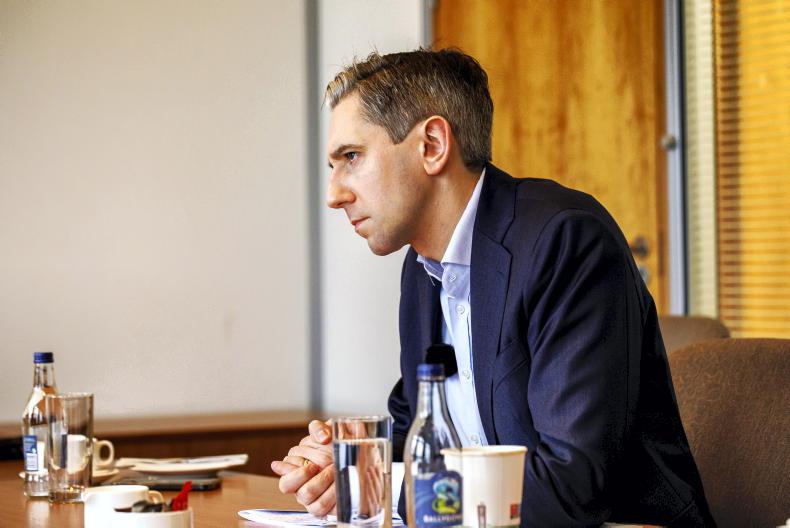
Tánaiste Simon Harris is the person who will have to make the hard call on this issue, as it falls under his remit as Minister for Foreign Affairs and Trade. Of course, Micheál Martin will have his input too.
Harris is representing Government at Sunday's flagship Tullamore Show, deputising for the Taoiseach.
He's unlikely to make any announcement on foreign policy on the day, but may seek to dampen farmer expectation in relation to how much money the government will commit to the sector in its first budget.
It wasn’t just Ireland that was in the sights of US politicians. Mike Huckabee, the preacher-turned-state-governor who is now the US ambassador to Israel, took Keir Starmer to task over the British prime minister’s call for a ceasefire in Palestine.
Huckabee used the analogy of the Dresden bombings in World War II for Israel’s continued aggression against the defenceless and starving Palestinian people.
Reneging
Meanwhile, Donald Trump is already reneging on whatever commitment he gave in relation to tariffs on pharmaceutical products only two weeks ago. Agri exports will be vulnerable if that fragile agreement unravels.
And Irish farmers' hopes of seeing the funding pledged to it in last year’s general election by both main Government parties (and the main opposition party) in the upcoming budget will be compromised by the prudence required when our leading revenue driver, pharmaceuticals, is so vulnerable.
Will Europe stand up to him on trade? Will Europe stand with Ukraine if Trump and Putin agree some form of ceasefire deal that cedes Ukrainian territory to Russia without the involvement, much less the consent, of the Ukrainian government?
In this context, and at this moment, the occupies territories bill is politically challenging. But doing the right thing is often the harder choice.
Farming does not exist in a bubble and both the domestic budget for agriculture for 2026 and the CAP budget for 2028-2034 are under considerable pressure due to external forces.
The integrity of the CAP cannot be compromised - it undermines us all. And Ireland’s integrity as an independent nation that stands for international justice should not be lightly undermined either.