



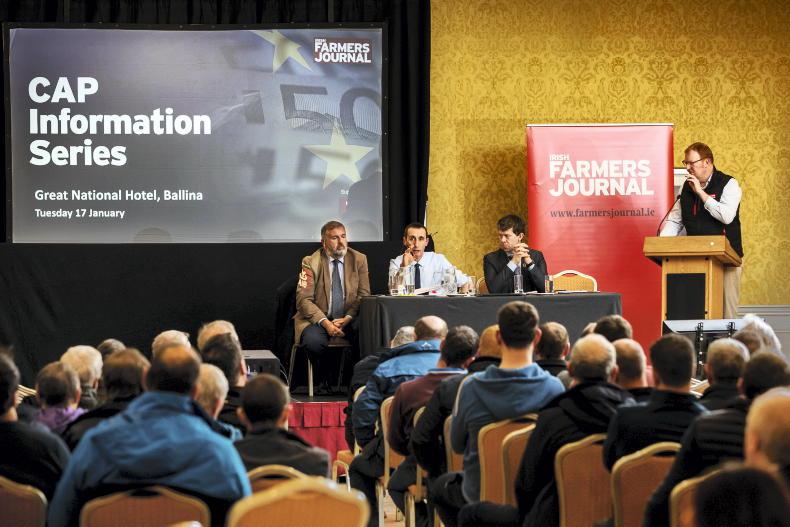
The Irish Farmers Journal roadshow of CAP information meetings held in recent months, in conjunction with the Department of Agriculture and AIB, presented the latest information available on the new CAP strategic plan to in excess of 2,000 farmers.
The Department of Agriculture team included Fran Morrin, head of CAP entitlements and financial controls division; David Buckley, head of eco schemes, beef schemes and fodder support scheme; and John Muldowney, head of the agricultural environment and structures division (covering ACRES and TAMS technical support and inspections).
The focus of discussions varied significantly between venues.
For example, in Carlow, there was a lot of concern and anger from tillage farmers and beef finishers who have higher-value entitlements and who stand to see a significant reduction in their level of direct payments.
Focus
In the west and northwest, there was a greater focus as can be expected on suckler, sheep and agri-environment schemes, while in the south of the country changes in the manner in which entitlements are paid, including the effect of changes on the leasing of entitlements, came to the fore.
In the midlands and border regions, there was a wide range of questions, with a balance across all sectors reflected in the attendance.
The questions and answers below give a flavour of some of the common topics which were raised across all venues.
How long can you lease out entitlements without clawback?
You can rent them out as long as you like, but bear in mind we don’t know what is there [in the next CAP reform] from 2028 onward. For longer-term leases over five years, you need to make sure that there is flexibility in the lease to cope with whatever structures change in direct payments from 2028 and beyond.
Is it better to sell or lease my entitlements?
The Department of Agriculture has no role in determining the value of entitlements. We will facilitate the trade of entitlements but the value of the transaction is determined by the market.
Know that the value of those entitlements will change. You can use the CAP calculator to get a good idea of what the payments will be from 2023 to 2027 and, as we said before, we do not know what is coming in 2028.
Will there be an eco-scheme payment on scrubland that was taken out before?
For example, if you had a hectare of land and there was scrub on it, we drew a red line around it and took it off. Now, the European Commission recognises there is an environmental value to this scrub.
If it goes between 50% and 70%, the scrub is deducted as it is in the current model
Now, if you have a hectare of land and assuming you have farming activity on it, if there is up to 50% of that parcel scrub, the eligible area is still a hectare.
If it goes between 50% and 70%, the scrub is deducted as it is in the current model. Once it goes above 70%, the entire parcel is ineligible. Once it goes above 70%, there is no eco payment, but the area is included in the space for nature.
Will stone walls that are topped with concrete or built with concrete qualify for maintenance under ACRES?
No, stone walls must be naturally built to be eligible and contain no concrete.
I am currently planning succession on my farm and hope to split the farm between my son and daughter in three years’ time. Can I join ACRES and leave early or can an ACRES plan be split?
ACRES is a five-year contract and you are obliged to fulfil the duration of the contract. Any lands in receipt of a payment must be under your control for the duration of the scheme.
If you know this is not possible, then these lands should not be used to generate payments under the scheme.
Can beech trees be planted under eco schemes or ACRES?
Trees planted must be native and there are lists showing permitted trees in the respective terms and conditions. Beech trees are not classified as native to Ireland so are not included under relevant schemes.
Why will areas of scrubland continue to be identified on maps if they are not eligible for payment under eco schemes, CRISS, etc?
While you rightly say that beneficial features such as scrub are now eligible for payment under a number of schemes, they do not count towards the farm’s stocking density and this is one reason why these areas will continue to be monitored.
Another reason why we will continue to identify the area of scrub present is to quantify the percentage of beneficial features within a parcel.
Given the pressure that farmers are coming under with stocking rates and nitrates, was stacking ever considered for entitlements?
No, there’s no stacking and there won’t be for the next CAP. It hasn’t been there for the current CAP either. Stacking meant you had few, but higher-value, entitlements and they will only be converging down anyway, so there is no benefit in it.
Does existing forestry qualify as space for nature?
Eligible forestry that is planted since 2009 and that draws down a BPS payment will receive a per-hectare eco-scheme payment. Ineligible forestry, which is forestry planted before 2008, won’t receive a per-hectare eco-scheme payment.
Will the BISS payment be paid out in October as usual?
The payment schedule will be more or less as it is now, but exactly what gets paid when across the different schemes, that’s not 100% defined yet.
In the new suckler scheme, you have to be in Bord Bia – why?
In the BDGP scheme, there was a carbon navigator and the calibre of information received back wasn’t great. In negotiations around the requirements we were going to have, such as the weighing and genotyping, part of what the Commission wanted in it is a requirement for the farmer at the time of application to be in the Bord Bia Sustainable Beef and Lamb Assurance Scheme (SBLAS). Farmers have to be in it to get in and then they have to stay in it for the duration of the scheme.
Is there still time to make changes or can it [the Bord Bia Quality Assurance requirement] be dropped?
The Suckler Carbon Efficiency Programme (SCEP) is an element of the overall CAP plan which has been approved by the European Commission and therefore cannot be altered. We cannot drop the requirement for applicant’s to join the Sustainable Beef and Lamb Assurance Scheme and still have a SCEP programme.
Will there be capacity in the [auditing] system for everyone who wants to join quality assurance to get in to the suckler scheme on time?
We don’t see this as a problem but we will monitor it closely. We may well have to show some flexibility at the application stage but within a matter of months people are going to have to be in it [SBLAS].
All these schemes are for producing less food - will there be more schemes paying people for producing food in future?
CAP is a juggernaut – it takes a long time to turn it around.
There is a big influence on food security at the moment. COVID-19 actually played into that and protected the CAP budget when discussions were taking place in 2020 and staved off a significant cut at that time.
The framing of the next CAP will start in about two years’ time
Food security, particularly in the context of the war [in Ukraine], has turned people’s heads.
Other than things like the Fodder Incentive Scheme, it’s not going to change CAP now, but possibly will in future CAP discussions.
The framing of the next CAP will start in about two years’ time. They will poll taxpayers all across Europe as to what they want to see included. Last time around, the environment was the big-ticket item and hence now you see eco schemes and ACRES.
Is there any amnesty on capital gains tax on the sale of entitlements?
Capital gains tax does not come under the remit of the Department of Agriculture and as far as we know there are no plans to alter taxation rules. It is worth checking with your accountant to see what tax implications there may be.


SHARING OPTIONS