


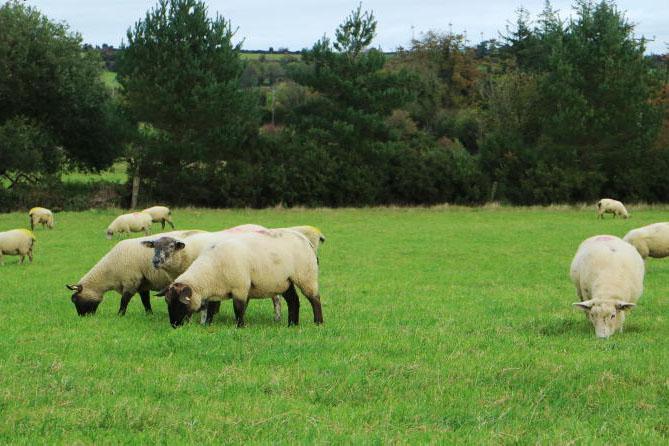
The variation between farms in terms of grass supplies is major. In the western half of the country and northern regions it has been close to a textbook year, with grass supplies in a good position on many farms. The greatest challenge for some will be utilising heavier covers and, if high rainfall continues, finishing lambs on grass with a low dry matter.
In contrast, there are pockets of the southeast where rainfall has come too late and there is a challenge in building grass supplies due to demand increasing ahead of breeding. The concern on some of these farms is that there is no bulk of heavy covers available to sustain ewes and that without close management grass reserves will run out too fast.
Taking stock
Focus at present is to take stock of existing supplies and to try and put a plan in place to extend the grazing season. The target at this stage of the year is to have at least 30 days grazing ahead of stock at the end of September. What this means is that if growth ceased in the morning there would be enough grass present to sustain stock numbers present for 30 days.
Where supplies look to be falling below this target then it is likely that there is a high percentage of low covers present which makes it difficult to build supplies. This information will be readily to hand for those measuring and budgeting grass, but where this is not the case an estimate can be obtained by walking paddocks and measuring the average height of grass.
Most farmers have a rough guide as to the area of lands in certain fields. Table 1 details the number of grazing days for a range of grass covers based on 100 ewes grazing a 1ha plot and offered 170kg DM/day.
This allocation of 170kg DM/day works on each ewe receiving a daily grass dry matter allocation of 1.7kg DM/ewe daily and consuming 1.3kg to 1.5kg DM depending on utilisation levels. Typical utilisation in October, November and December is in the region of 75% to 80% and is lower on more marginal lands or during inclement weather.
Corrective actions
The only real solution available at present where grass supplies are deficient is to reduce demand and give covers a chance to build. The target for mid-season lambing flocks is to have 80% of lambs drafted (including replacements retained) by early October. Adopting a different finishing plan for remaining lambs or dipping in to a strong store lamb market is one option to reduce demand from competing lambs, while moving cull ewes if not already sold is an obvious advantage – take care to ensure scheme reference numbers are not affected. Options for reducing demand where ewes are joining rams in the coming weeks are hard come by.
Segregating out ewes still requiring preferential treatment and introducing a level of concentrate supplementation will help ewes regain condition faster, but it will not have a major influence on slowing down demand, as such ewes often tend to have a higher intake requirement.
Feed buckers can also be used to sustain performance and condition, but are an expensive option. Temporary grazing agreements, where available, will help, but are not a solution for most. While targeting any remaining slurry or farmyard manure to swards capable of delivering a good response may help.
Maximising utilisation
The only other practices is ensuring grass utilisation is maximised. This is a big consideration for farmers with surplus grass or grazing heavier covers. This can be achieved by splitting the grazing area in to smaller sections.
In this manner ewes can be forced to graze down lower quality material for a short period without having any substantial effect on performance compared to ewes grazing all the best-quality grass first.



SHARING OPTIONS